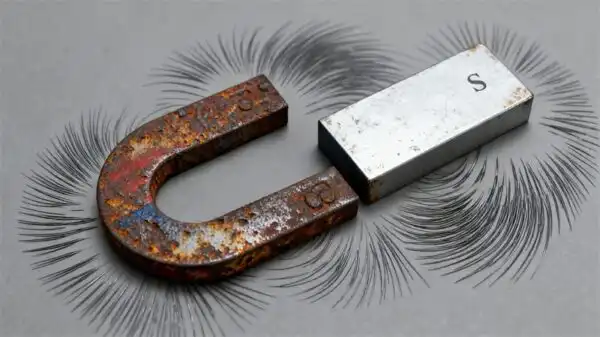
Quick Answer: Can You Drill Neodymium Magnets?
Usually, no. Finished neodymium magnets should not be drilled by regular users. They are hard but brittle, and drilling can crack the magnet, damage the coating, create fine dust and fragments, and generate heat that may reduce magnetic strength.
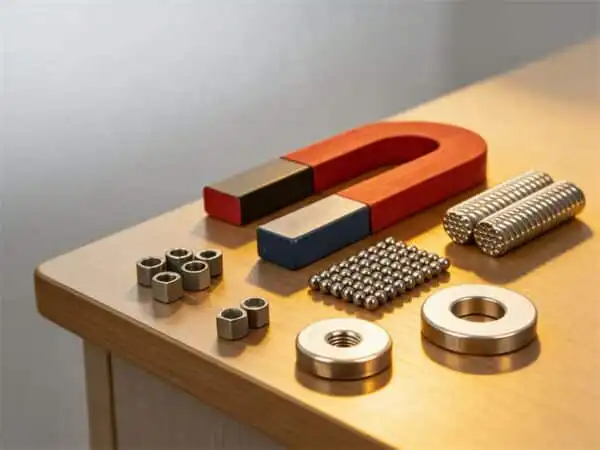
If you need a hole, it is usually better to order a ring magnet, tube magnet, countersunk magnet, pot magnet, adhesive-backed magnet, or custom neodymium magnet with the hole designed before final production.
This guide is written for buyers, engineers, and product teams who need magnets with holes for mounting, sensing, positioning, or custom magnetic assemblies. It focuses on finished neodymium magnets and practical design choices before production.
Best Alternatives at a Glance
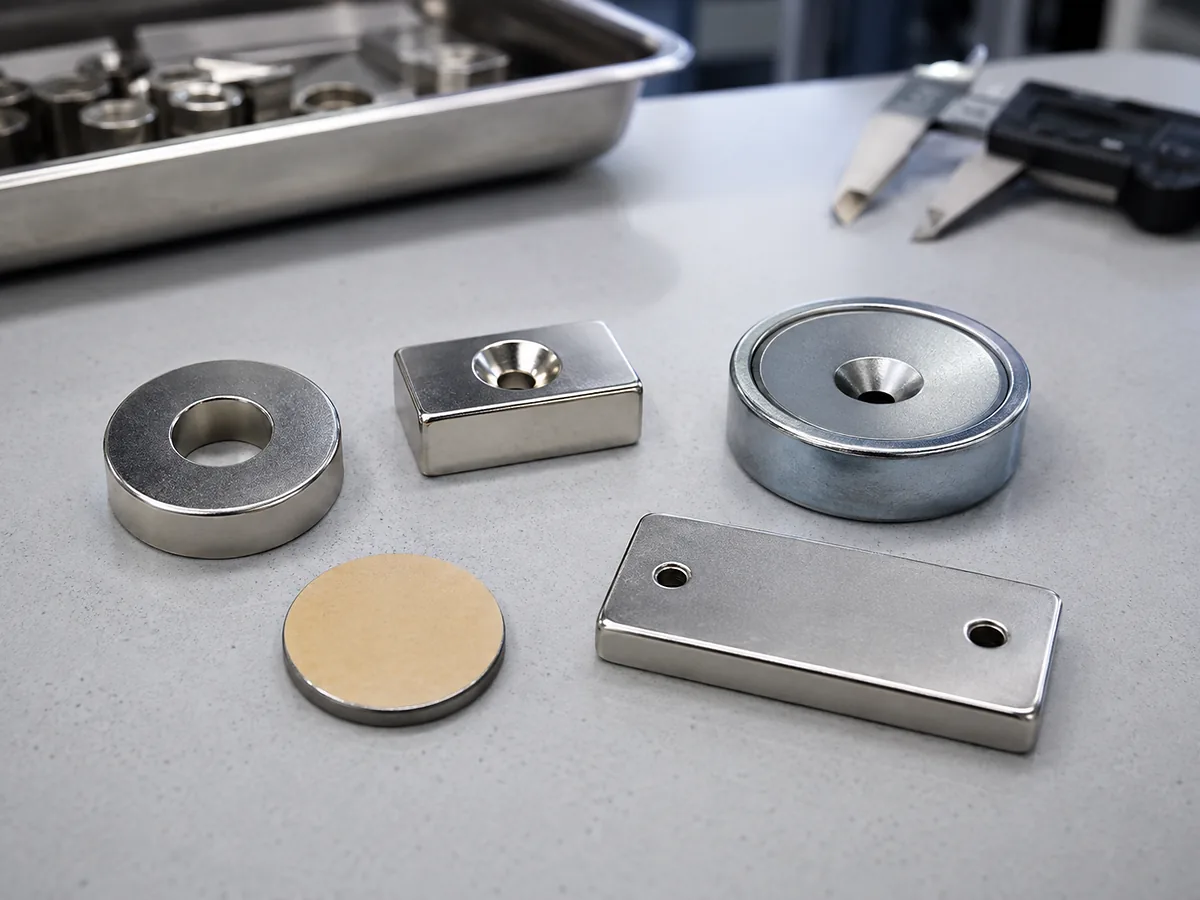
If you only need a way to mount or fix the magnet, drilling is usually not the best solution. In many cases, choosing the right magnet type from the beginning is safer and more reliable.
| If you need… | Better option | Why it works better |
|---|---|---|
| A center hole for a shaft, pin, or rod | Ring magnet or tube magnet | The hole is part of the magnet design, so size, coating, and magnetization can be controlled. |
| A flush screw head | Countersunk neodymium magnet | The countersunk hole allows a flat-head screw to sit flush without post-drilling the magnet. |
| Stronger mounting with mechanical protection | Countersunk pot magnet | The steel cup helps protect the magnet and can improve holding force on the working face. |
| Mounting without screws | Adhesive-backed magnet | Useful when the mounting surface should not be drilled, but adhesive and temperature should be checked. |
| Side holes, multiple holes, or non-standard geometry | Custom neodymium magnet | Hole position, tolerance, coating, and magnetization direction can be reviewed before production. |
These options are not the same product. The right choice depends on whether the hole is for a shaft, a screw, a protected mounting base, adhesive installation, or a custom assembly.
The key point is simple: do not treat the hole as an afterthought. For a reliable magnetic assembly, the hole should be part of the magnet specification.
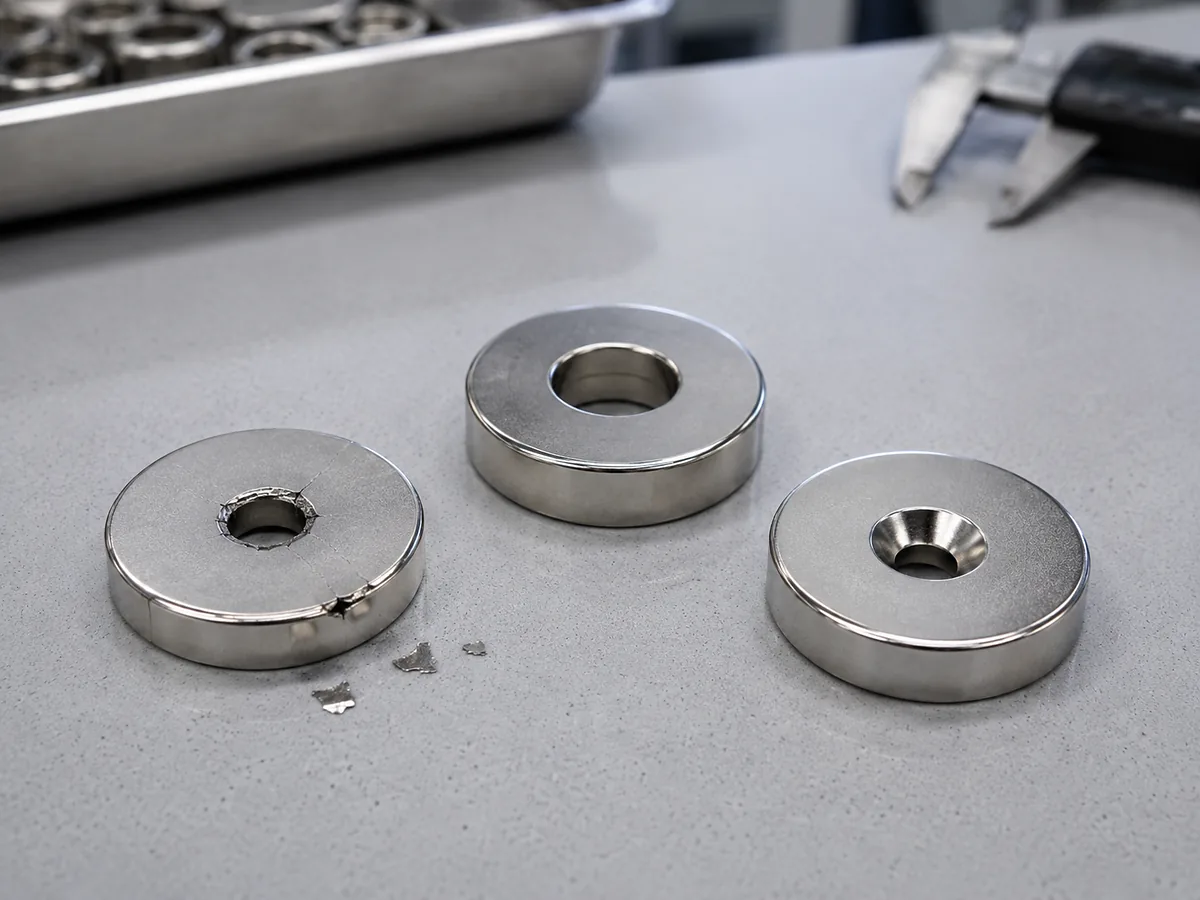
Why Is Drilling a Finished Neodymium Magnet Risky?
A finished neodymium magnet is not like a piece of mild steel or aluminum. It is made from a sintered magnetic material. That gives it very high magnetic strength, but it also makes it hard, brittle, and sensitive to poor machining conditions.
Neodymium Magnets Are Hard but Brittle
Neodymium magnets can feel solid and metallic, but mechanically they behave more like a brittle ceramic than a soft metal. When a drill bit applies pressure, the magnet may chip, crack, or break apart.
Even if the magnet does not fully break, small edge chips around the hole can still matter. They can affect appearance, coating protection, assembly fit, and batch consistency.
For one small hobby test, a damaged magnet may only be annoying. For an industrial assembly, the same problem can create rejected parts, unstable mounting, and repeated supplier communication.
Drilling Can Damage the Protective Coating
Most finished neodymium magnets are coated. Common coating options include nickel-copper-nickel, zinc, epoxy, Parylene, and other protective finishes. You can learn more about coating choices in our guide to neodymium magnet coating.
The coating is not only for appearance. It helps protect the NdFeB core from moisture and corrosion.
When you drill through a finished magnet, the hole wall is no longer fully protected by the original coating. The exposed area can become a starting point for corrosion, especially in humid, outdoor, salt spray, cleaning, lab, or regulated device environments where contamination and corrosion control matter.
This is one reason a pre-designed hole is better. The supplier can review the hole, coating, edge condition, and final dimensions together instead of treating them as separate problems.
For buyers, this matters because coating failure may not appear immediately. A drilled hole can look acceptable during assembly but later become a rust point, especially after humidity exposure, cleaning, or temperature cycling.
Heat Can Reduce Magnetic Strength
Drilling creates friction. Friction creates heat.
A short, uncontrolled drilling process may heat the local area of the magnet. If the magnet gets too hot, it may lose part of its magnetic strength. This can be irreversible depending on the grade, temperature resistance, and how much heat is generated.
It is not accurate to say that every drilled magnet will instantly become non-magnetic. The real issue is more practical: drilling removes magnetic material, changes the local field, and may create heat damage that is hard to control.
For sensors, encoders, motors, holding assemblies, or precision positioning parts, even a small magnetic change can matter.
Dust and Fragments Can Be Dangerous
Drilling can produce fine magnetic dust and small fragments. This is not something to treat casually.
Fine neodymium dust and broken fragments can create safety and contamination risks during drilling. Strong magnets can also attract tools, chips, and nearby metal parts, making the operation harder to control.
That is why this article does not provide a step-by-step drilling guide. For finished neodymium magnets, the better advice is usually to avoid post-drilling and design the hole before production.
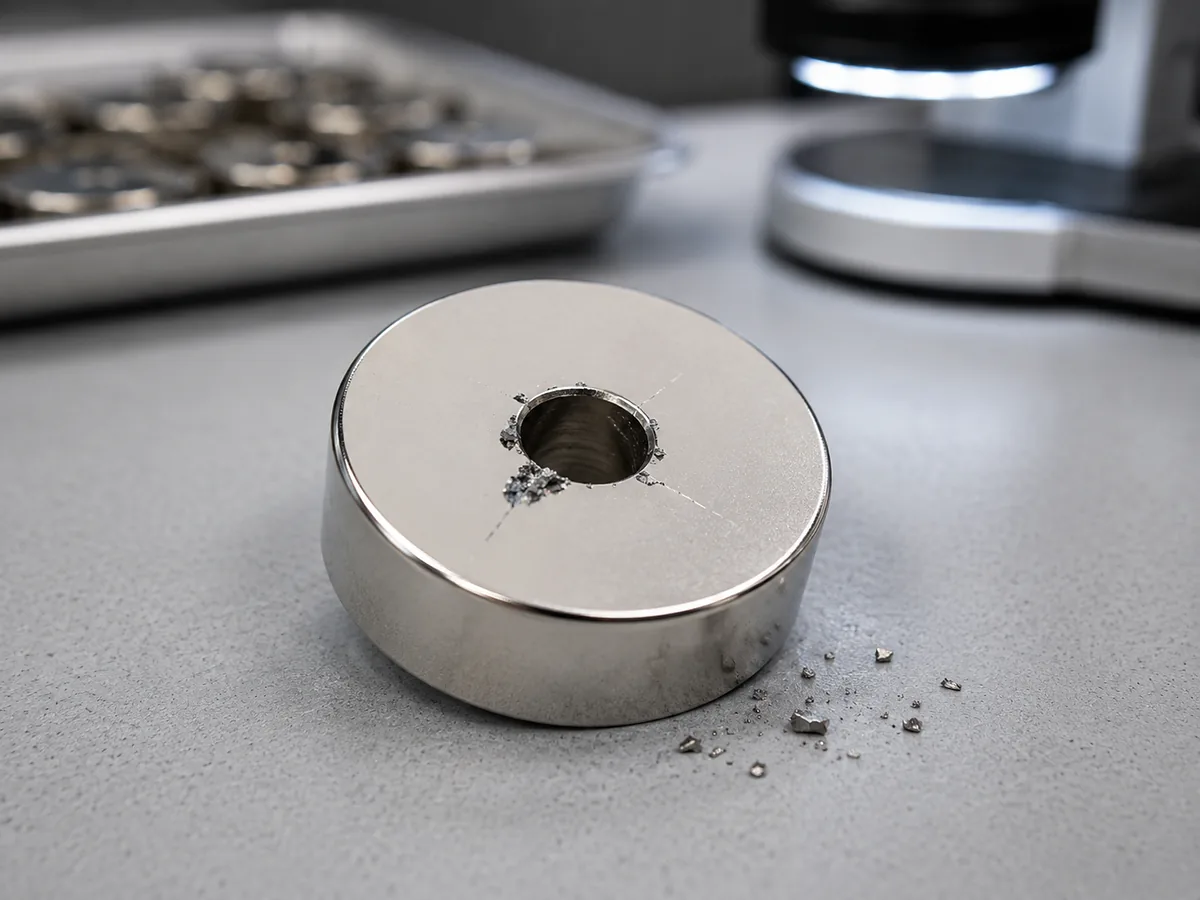
Will Drilling a Hole Make the Magnet Lose Its Magnetism?
Drilling a hole does not always make the whole magnet completely lose magnetism. A magnet with a hole can still be magnetic.
But the magnetic performance may change for three reasons.
First, the hole removes magnetic material. Less magnet volume usually means less magnetic output than the same magnet without a hole.
Second, the hole changes the local magnetic field distribution. This may not matter for a simple holding magnet, but it can matter in sensors, motors, encoders, and positioning systems.
Third, heat from drilling can cause partial irreversible magnetic loss if the magnet gets too hot for its grade.
So the better question is not only “Will it still be magnetic?” The better question is: “Will it still meet the magnetic and mechanical requirements of my application?”
For industrial use, guessing is risky. If the hole affects field strength, working distance, or sensor response, magnetic field simulation can help evaluate the design before sampling.
Is It Ever Possible to Machine or Drill Neodymium Magnets Professionally?
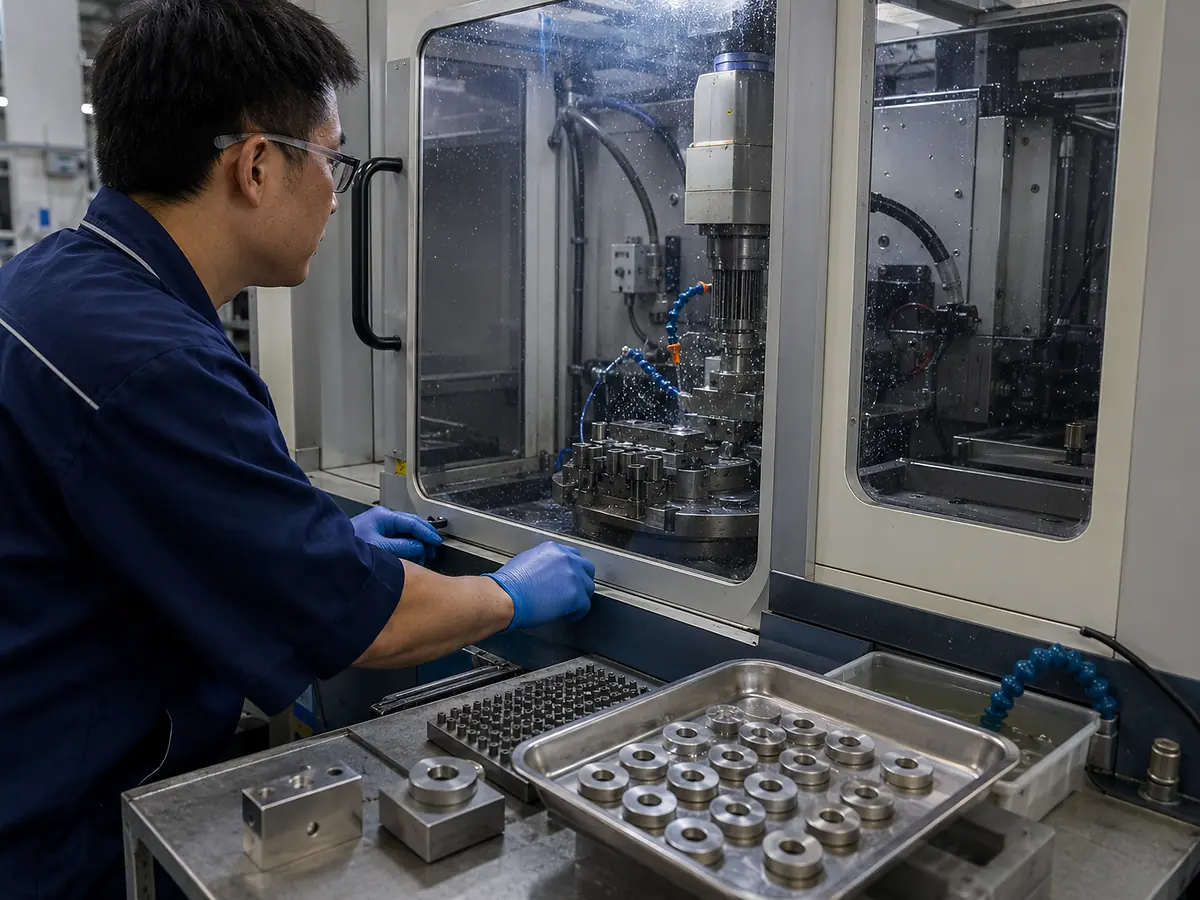
Yes, neodymium magnets can be machined under controlled manufacturing conditions. But this is different from drilling a finished magnet by hand.
The main issue is not whether a hole can ever be made in NdFeB material. The issue is whether it is safe and reliable to drill a finished, coated, magnetized part after production. In most industrial projects, the hole should be reviewed during the design and manufacturing stage.
Professional magnet machining may require specialized abrasive tools, coolant, dust control, careful fixturing, and experienced operators. In many cases, machining is handled before final magnetization and before the final coating process.
For production orders, post-drilling finished magnets is usually not the reliable route. It can create problems with cracking, coating damage, corrosion, dimensional variation, and magnetic consistency.
A better approach is to define the hole in the drawing and let the supplier review whether the hole size, wall thickness, tolerance, coating, and magnetization direction are suitable.
If You Need a Hole, What Type of Magnet Should You Choose?
If your goal is mounting, fastening, alignment, or assembly, you may not need to drill anything. You need the right magnet design.
Ring Magnets or Tube Magnets
Choose neodymium ring magnets or tube magnets when a shaft, pin, rod, or locating feature needs to pass through the magnet.
For this type of magnet, the key dimensions are usually:
- Outer diameter.
- Inner diameter.
- Thickness or height.
- Tolerance.
- Coating.
- Magnetization direction.
Ring magnets are common in sensors, fixtures, small mechanical assemblies, and positioning systems. For precision use, concentricity and coating thickness can also matter.
Countersunk Neodymium Magnets
Choose a countersunk neodymium magnet when you need to fix the magnet with a flat-head screw and keep the screw head flush with the magnet surface.
This is often useful for panels, doors, cabinets, displays, fixtures, and mounting points.
But the countersunk hole must match the screw. You should confirm the screw size, countersink diameter, countersink angle, magnet thickness, and which face needs the countersink.
Do not assume every countersunk magnet works with every screw.
Countersunk Pot Magnets
A pot magnet uses a steel cup or shell around the magnet. This can protect the magnet and concentrate holding force on the working face.
A countersunk pot magnet is often better than a bare countersunk magnet when the application needs stronger holding, better mechanical protection, or repeated installation.
These are common in signs, display systems, fixtures, tool holding, panels, and removable mounting points.
Adhesive-Backed Magnets
If you do not want to drill the mounting surface, adhesive-backed magnets may be easier.
But adhesive is not a universal solution. Temperature changes, vibration, surface texture, humidity, cleaning chemicals, and shear force can all affect bonding.
For light-duty indoor use, adhesive may work well. For industrial assemblies, it should be tested under the real working conditions.
Custom Neodymium Magnets With Holes
Choose a custom neodymium magnet when the hole is not standard.
This may include:
- Side holes.
- Multiple holes.
- Off-center holes.
- Special countersink geometry.
- Small holes.
- Tight tolerance holes.
- Non-standard shapes.
- Special coating needs.
- Specific magnetization direction.
For custom projects, it is best to send a drawing or assembly sketch. The supplier can then review whether the hole size, wall thickness, coating, and magnetization direction are realistic before sampling.
Ring Magnet vs Countersunk Magnet: Which One Fits Your Project?
Many users search for a “magnet with hole” without knowing which type they actually need. Ring magnets and countersunk magnets both have holes, but they solve different problems.
Choose a Ring Magnet When the Hole Is for Passing Through
A ring magnet has a hole through the center. It is usually used when something needs to pass through the magnet, such as a shaft, pin, screw post, rod, or locating feature.
Choose this option when the hole is part of the assembly geometry.
Common examples include:
- Positioning parts.
- Sensor assemblies.
- Small rotating parts.
- Mechanical fixtures.
- Shaft or pin mounting.
Choose a Countersunk Magnet When the Hole Is for Screw Mounting
A countersunk magnet has a recessed hole that allows a flat-head screw to sit flush.
Choose this option when the magnet needs to be fixed to a surface with a screw.
Common examples include:
- Cabinet catches.
- Door catches.
- Display panels.
- Signage.
- Equipment covers.
- Furniture hardware.
- Industrial fixtures.
Choose a Custom Magnet When the Standard Options Do Not Fit
If your hole position, hole size, magnet shape, or working condition is unusual, a stock ring or countersunk magnet may not solve the problem.
A custom magnet may be better when you need:
- A side hole.
- Two or more holes.
- A hole close to the edge.
- A special screw seat.
- A thin wall.
- A tight tolerance.
- A special magnetization pattern.
- A coating selected for humidity, salt spray, or wear.
In these cases, the drawing should be checked before production. A small design change can sometimes reduce cracking risk, improve coating reliability, and make assembly easier.
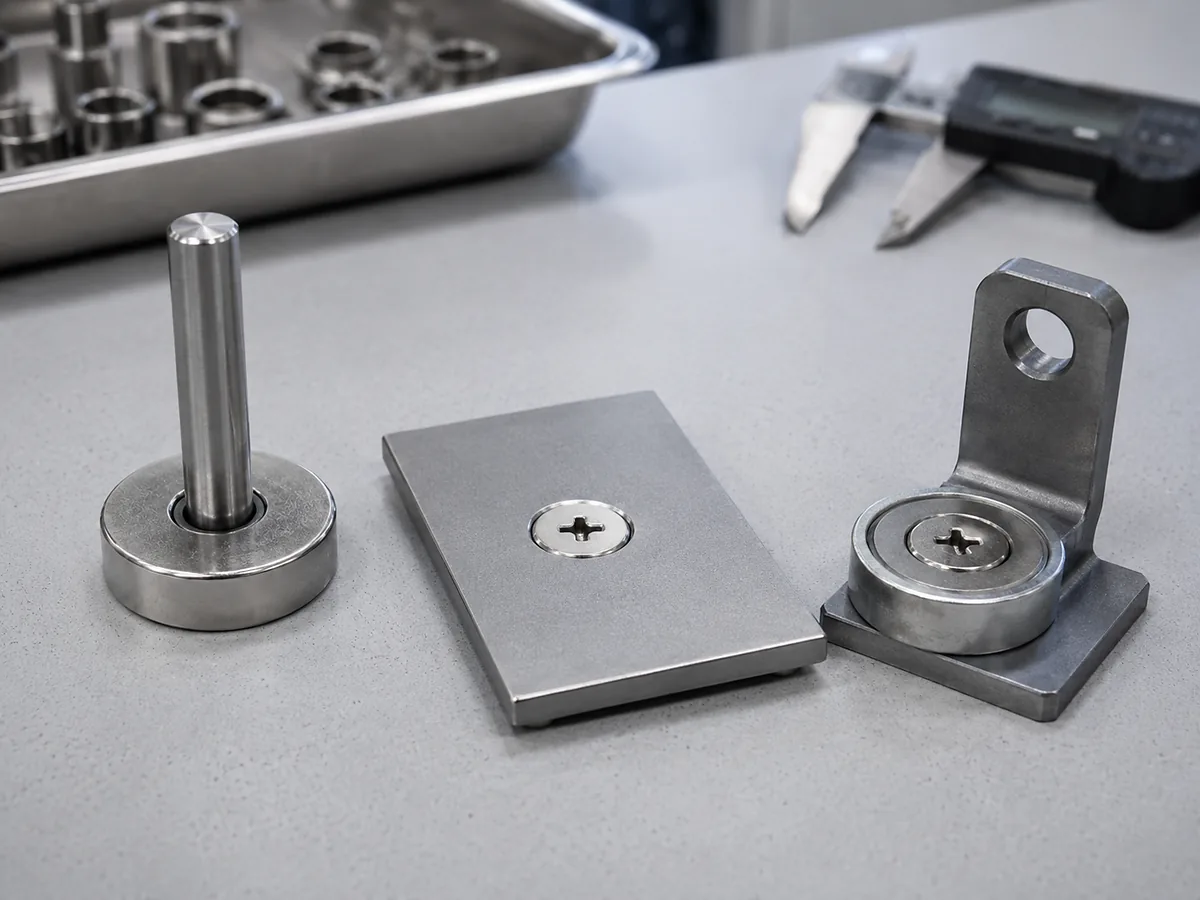
What Specifications Should You Provide for a Magnet With a Hole?
If you need a magnet with a hole, do not only say, “I need a magnet with a hole.” That is not enough for accurate quoting or manufacturing review.
A useful RFQ should include:
- Magnet shape.
- Outer diameter, length, width, and thickness.
- Hole diameter.
- Countersink diameter if needed.
- Countersink angle if needed.
- Screw size if the magnet is screw-mounted.
- Grade, such as N35, N42, N52, or another required grade.
- Coating, such as NiCuNi, zinc, epoxy, Parylene, or another finish.
- Magnetization direction.
- Tolerance.
- Operating temperature.
- Working environment.
- Quantity.
- Drawing or assembly sketch.
If the magnet is used in a sensor, motor, encoder, fixture, lab device, or regulated device project, also provide the working distance, target surface, and any magnetic performance requirement.
For very small holes or tight-fit assemblies, micro magnets need early review because coating thickness and hole tolerance can affect the final fit.
The more clearly you define the application, the easier it is to recommend the right magnet type.
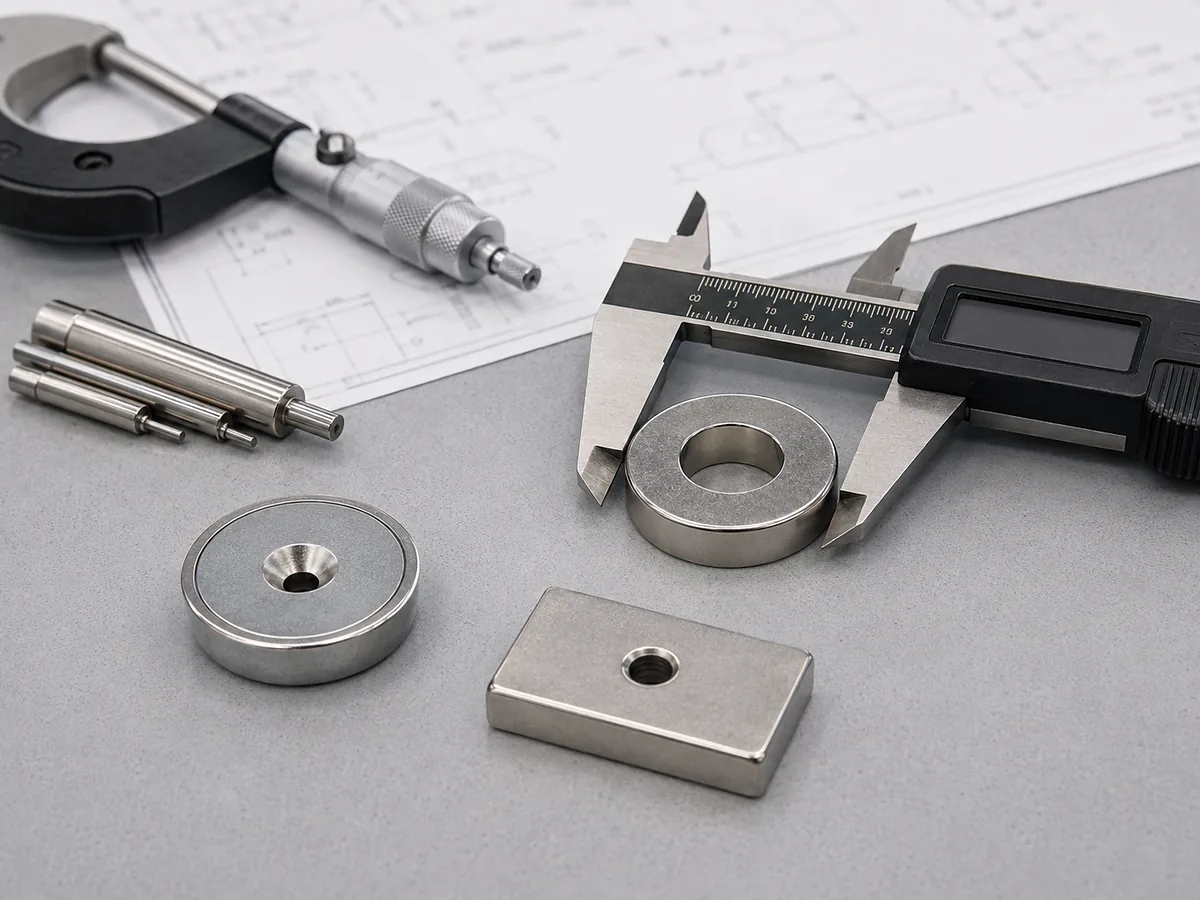
How Does Hole Design Affect Coating, Tolerance, and Assembly?
A hole is not just a missing area in the magnet. It affects coating, geometry, magnetic performance, and assembly reliability.
Coating Thickness
Coating adds thickness to the magnet surface. For large magnets, this may not be a major issue. For small holes, micro magnets, or tight-fit assemblies, coating thickness can affect the final inner diameter.
If your part needs a shaft fit, pin fit, or tight clearance, specify whether the drawing dimensions are before coating or after coating.
Edge Chipping
Hole edges can chip if the design is too thin, too sharp, or too close to the magnet edge.
Edge chipping may cause:
- Poor appearance.
- Coating damage.
- Assembly interference.
- Reduced yield.
- Higher rejection rate.
A small chamfer, better hole position, or adjusted wall thickness may improve manufacturability.
Magnetization Direction
The hole and magnetization direction should be reviewed together.
For example, a countersunk hole on the wrong face may create an installation problem. A ring magnet used in a sensor may need a specific magnetization direction to trigger the sensor correctly.
If two countersunk magnets are used as a pair, the pole direction also matters. Otherwise, the magnets may repel when they should attract.
Working Environment
The environment can change the best design choice.
High temperature, humidity, salt spray, vibration, impact, cleaning chemicals, and outdoor exposure can all affect magnet selection.
A simple adhesive-backed magnet may be fine for a light indoor panel. It may not be suitable for an industrial machine with vibration and temperature cycling.
Common Application Examples for Magnets With Holes
Magnets with holes are used when magnetic force needs to be combined with mechanical positioning or fastening.
Common applications include:
- Sensor mounting.
- Magnetic fixtures.
- Cabinet and door catches.
- Display and signage mounting.
- Industrial positioning tools.
- Equipment panels.
- Furniture and hardware.
- Lab device assemblies or medical-device-related projects where requirements are defined by the buyer.
- Motor, encoder, or rotor-related parts.
- Removable covers and access panels.
In these applications, the hole is often part of the functional design. It affects how the magnet is mounted, how it faces the target surface, and how stable the final assembly will be.
That is why it is better to design the hole early instead of drilling it after the magnet is finished.
Simple Decision Flow
If you only need a screw mount, choose a countersunk magnet.
If you need a shaft or pin through the magnet, choose a ring or tube magnet.
If you need stronger protected holding, choose a pot magnet.
If you cannot drill the mounting surface, test adhesive-backed magnets.
If the hole position or size is non-standard, send a drawing for a custom magnet review.
Should You Modify an Existing Magnet or Order a Custom One?
Sometimes users already have a magnet and want to modify it. That may look faster, but it is not always cheaper or safer in the long run.
Use this simple decision guide:
| Situation | Better decision |
|---|---|
| One-time hobby test | Buy a stock ring or countersunk magnet if possible. |
| Prototype with uncertain fit | Test stock sizes first, then customize if needed. |
| Industrial assembly | Order pre-designed hole magnets. |
| Tight tolerance or small hole | Send a drawing for manufacturability review. |
| Harsh environment | Confirm coating and hole-wall protection early. |
| Sensor, motor, or encoder use | Confirm magnetic field, hole position, and magnetization direction. |
For production, do not build the process around drilling finished magnets one by one. It is better to control the hole during manufacturing.
Common Mistakes When Choosing a Magnet With a Hole
Choosing a magnet with a hole sounds simple, but many design problems start from small missing details.
Mistake 1: Only Checking Pull Force, Not Shear Force
Many users only check pull force. But in real use, the magnet may face sliding force, vibration, impact, or repeated movement.
A magnet that holds well in direct pull may still slide under shear force. For these conditions, a screw-mounted magnet, pot magnet, bracket, or mechanical stop may be better.
Mistake 2: Ignoring Coating Thickness
Coating thickness changes the final size. This matters more when the hole is small or the fit is tight.
If the magnet must fit a pin, shaft, or screw, confirm the final coated dimension. Do not only check the uncoated magnet size.
Mistake 3: Forgetting Magnetization Direction
A hole does not tell the whole story. The magnetization direction affects which face works, how two magnets pair, and how the field reaches the target.
Always mark the magnetization direction on the drawing when it matters.
Mistake 4: Choosing a Countersunk Magnet Without Confirming Screw Size
A countersunk magnet must match the screw head.
If the countersink is too small, the screw head may not sit flush. If the screw is tightened too hard, the magnet may crack. If the countersink is on the wrong face, the part may not install correctly.
Confirm screw size, countersink diameter, countersink angle, and countersink direction before ordering.
Mistake 5: Using Adhesive in Vibration or Temperature-Cycle Environments Without Testing
Adhesive can be useful, but it is not always reliable in demanding environments.
Temperature cycling, vibration, humidity, and surface contamination can weaken the bond. If the magnet is used in equipment, sensors, or outdoor assemblies, test the adhesive under real conditions.
Mistake 6: Drilling After Plating and Exposing the NdFeB Core
Post-drilling a plated magnet can expose the NdFeB core inside the hole.
This can reduce corrosion protection and create a weak point in the coating system. In humid or corrosive environments, this is a serious concern.
If corrosion resistance matters, the hole and coating should be planned together.
FAQ
Can you drill a hole in a neodymium magnet?
Usually, you should not drill a finished neodymium magnet. It can crack, chip, damage the coating, create fine dust and fragments, and lose magnetic strength from heat.
If a hole is needed, it is usually better to order a magnet with the hole designed before final production.
Will drilling a neodymium magnet make it weaker?
It can. A drilled hole removes magnetic material and changes the local magnetic field.
Heat from drilling may also cause irreversible magnetic loss if the magnet gets too hot.
Can you cut or machine neodymium magnets?
Neodymium magnets can be machined under controlled professional conditions, but they are not easy to machine.
Finished magnets should not be casually cut or drilled by users. Professional processing often requires special tools, coolant, dust control, and careful handling.
What is the best alternative to drilling a magnet?
The best alternative depends on your purpose.
For a center hole, choose a ring magnet or tube magnet. For screw mounting, choose a countersunk magnet or countersunk pot magnet. For non-standard holes, choose a custom magnet made to your drawing.
What is a magnet with a hole called?
It depends on the hole type.
A magnet with a center hole is often called a ring magnet or tube magnet. A magnet with a recessed screw hole is often called a countersunk magnet. A steel-cased magnet with a mounting hole may be called a pot magnet.
What is the difference between a ring magnet and a countersunk magnet?
A ring magnet has a through-hole, usually for a shaft, pin, or positioning feature.
A countersunk magnet has a recessed screw hole, usually for flush screw mounting.
Can Osenc make custom neodymium magnets with holes?
Osenc can review custom neodymium magnet drawings, including hole size, hole position, countersink design, coating, tolerance, and magnetization direction.
Feasibility depends on the magnet size, geometry, grade, coating, and application requirements.
What information should I send for a custom magnet with a hole?
Send the magnet shape, dimensions, hole diameter, countersink size and angle if needed, screw size, coating, grade, magnetization direction, tolerance, quantity, operating temperature, and application drawing or assembly sketch.
Need a Neodymium Magnet With a Hole?
If your design needs a hole, do not rely on post-drilling finished magnets as a quick fix. It is usually safer to design the hole into the magnet from the beginning.
To reduce trial-and-error, send your drawing with the hole size, screw size, coating requirement, magnetization direction, quantity, and application details before sampling. Osenc can review whether a ring magnet, countersunk magnet, pot magnet, adhesive-backed magnet, or custom neodymium magnet is more suitable for your assembly.