Custom sintered neodymium tube magnets ground to your finished OD, ID, and length—MOQ 1 piece, ~25-day build time. Bare or coated magnet components only, not stainless filter rods.
Share OD × ID × L, grade, pole direction, coating, and quantity. Send CAD drawings via reply email or WhatsApp.
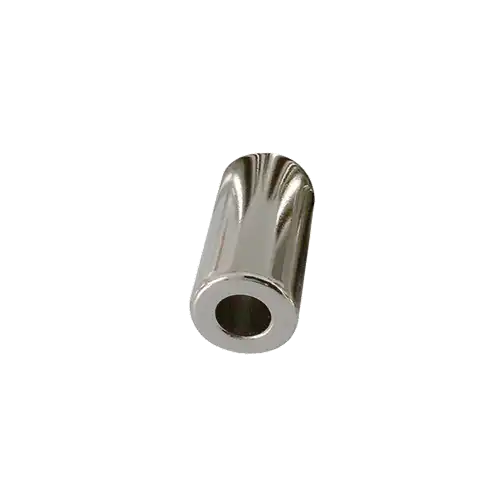
Choose tube-shaped NdFeB magnets when length exceeds wall thickness and bore alignment controls assembly fit.
| Your Goal | Key Choice | Standard Fit | When to Upgrade / Switch | Pre-Order Check |
|---|---|---|---|---|
| Fit a long sleeve on a shaft or sensor rod. | Tube magnet or flat ring? | Tube magnet when length is 2×+ wall thickness and ID ≥ L/4. | Switch to ring magnets for short washers; filter rods need steel housings. | Confirm finished OD, ID, length, and shaft clearance. |
| Prevent cracking during deep-bore grinding and plating. | Single sintered tube or multi-part? | Monolithic tube when wall ≥ 1.5 mm (≥ 10% OD) and L/W ≤ 32:1. | Stack short rings or use bonded NdFeB when walls drop below 1.5 mm. | Add 0.2–0.5 mm chamfers and mark concentricity datums. |
| Prototype 50 rotary tubes without radial die fees. | Axial, diametrical, or radial poles? | Axial or diametrical tubes machine from stock blocks with standard coils. | Use radial dies or arc segments only for uniform 360° motor flux. | Mark pole vector, pole count, and annual volume. |
| Stop 105°C flux loss and inner-bore rust. | Standard Ni-Cu-Ni or upgraded spec? | N35–N52 with Ni-Cu-Ni works below 80°C in dry indoor builds. | Upgrade to H/SH/UH (120–180°C) and Parylene or epoxy for heat or moisture. | State peak temp, moisture, and post-plate bore size. |
Need food or powder iron-removal bars? Those are sealed stainless-steel filter assemblies, not bare sintered neodymium magnet tubes.
OSENC grinds custom tube magnets from OD 1.5–60 mm, ID 0.4–50 mm, and lengths to 120 mm.
| Specification | Standard Supply | Precision / Custom Option | Engineering Rule & Test Basis |
|---|---|---|---|
| Geometry, Bore Grinding & Wall Limits | |||
| Dimensions (OD × ID × L) | OD 1.5–60 mm; ID 0.4–50 mm; L 0.3–120 mm | Larger OD or < 1.5 mm micro bores per drawing | Max magnetization length 120 mm; keep ID ≥ L / 4 |
| Wall & Aspect Ratio | Wall W = (OD − ID) / 2 ≥ 1.5 mm (≥ 10–15% OD) | Thin walls to ~0.5 mm reviewed for yield | Ceiling L / W ≤ 32:1 prevents grinding cracks |
| Tolerances & TIR | ±0.10 mm; concentricity TIR 0.05–0.10 mm | ±0.05 mm fine; ±0.02–0.03 mm OD/ID grind | Wet diamond ground unmagnetized; measured post-coating |
| Magnetic Grades, Thermal Limits & Pole Orientation | |||
| Standard Grades | N35–N52 (N42 ~1.30 T; N52 ~1.43 T, ≤ 80°C) | N54–N56 (N56 ≤ 70°C, 51–54 MGOe, 1.46–1.50 T) | Rated at L/D ≥ 0.7; Br drift −0.09% to −0.12%/°C |
| High-Temp Grades | M (≤ 100°C), H (≤ 120°C), SH (≤ 150°C) | UH (≤ 180°C), EH (≤ 200°C), AH (≤ 220–230°C) | 105°C motors need H or SH to prevent flux loss |
| Magnetization | Axial (end faces) or Diametrical (across OD) | True Radial, Multipole Radial, or arc array | Pole angle ±1°–5° axial; ±1°–2° multipole |
| Deep-Bore Coatings & Shaft Interface | |||
| Coating & Sizing | Ni-Cu-Ni (15–21 µm), Zinc (8–15 µm) | Epoxy (15–40 µm), Parylene (10–15 µm), Everlube (8–25 µm) | OD_pre = OD − 2t; ID_pre = ID + 2t; 0.2–0.5 mm chamfer |
| Shaft Fit & Retention | Clearance fit: 0.025–0.075 mm per side | 0.05–0.15 mm bond line + non-magnetic sleeve | Never press-fit on steel shafts (tensile ~75–80 MPa) |
Need sub-millimeter tubes under 1.5 mm OD? Check our micro magnets page. Mark critical mating datums on your drawing so grinding cost stays focused.
Electroplating adds thickness to every wall, shrinking the finished bore by double the coating thickness. Without pre-plate allowance, coated neodymium magnet tubes often bind on precision steel shafts.

Tolerance tightness and true radial tooling drive most custom tube cost on small runs.
Take a 12 × 8 × 25 mm motor tube (2.0 mm wall, L/ID = 3.1) for 50 prototypes. Choosing diametrical poles over true radial skips dedicated pressing dies during validation.
For thin walls or low-volume 360° fields, validate with arc segment magnets first.
Share OD × ID × L, grade, and pole direction to check tooling-free options.

Never press-fit sintered NdFeB tubes onto steel shafts—hoop tension splits brittle walls immediately. Sintered NdFeB reaches 550–650 HV hardness but only 75–80 MPa tensile strength, so wear eye protection.

Bond neodymium tube magnets using a controlled clearance fit and non-magnetic alignment guide.
Check clearance fit, peak thermal exposure, and bore plating first when field failures occur.
MOQ is 1 piece, with ~20–30 day typical custom production and full IQC/OQC checks. OSENC manufactures custom tube magnets in Changping, Dongguan, with drawing review coordinated by Ben and our engineering team.
| Stage / Term | OSENC Standard Supply | What Buyers Confirm |
|---|---|---|
| MOQ & Lead Time | 1 piece MOQ; ~20–30 days (~25 days typical) custom build; store dry in sealed packs. | Sample vs. bulk quantity and ship date |
| Dimensional & Magnetic QC | Material cert with B-H curve, post-plate CMM/caliper OD/ID/TIR, fixed-gap Gauss or Helmholtz flux. | Critical datums, probe fixture, and AQL |
| Cleanroom & Compliance | Optional 100% pull/flux sorting and Class 100–10,000 packing; ISO 9001 and RoHS/REACH per order. | Compliance declarations and cleanroom class |
| Air & Sea Shipping | IATA PI 953 (UN 2807): < 0.002 G at 2.1 m general air, ≤ 0.00525 G at 4.6 m DG; unmagnetized option. | Freight mode and plant magnetizing setup |
Never judge grade from a freehand Gauss probe—a 0.5 mm probe shift alters readings over 10%. See our quality management page or email CAD drawings after submitting the contact form.


Direct answers on bore tolerances, radial tooling, temperature limits, and air freight compliance.
Tube magnets are long hollow sintered NdFeB components where length far exceeds wall thickness.
Design sintered tube walls at ≥ 1.5 mm (≥ 10% OD) with bore ID ≥ L / 4.
Choose diametrical magnetization for 50-piece prototypes unless your rotor strictly requires 360° radial flux.
Upgrade to H (≤ 120°C) or SH (≤ 150°C) grades for any 105°C tube assembly.
Yes—ship shielded under IATA PI 953 (UN 2807) or send bulk tubes unmagnetized.
Share OD, ID, length, grade, pole direction, and quantity for a drawing-based quote. Our web form has no file-upload field—submit specs online, then send STEP/PDF drawings via reply email or WhatsApp.