Magnets hold parts closed, create motion, produce sound, store data, sense position, separate metals and support medical, laboratory and industrial equipment. This guide explains what the magnet is doing in each example, not just where it appears.
At a Glance: 10 Uses of Magnets
- Refrigerator door seals – magnetic strips help keep the door tightly closed.
- Speakers and headphones – magnets help convert electrical signals into sound.
- Dynamic microphones – magnets help turn sound vibration into an electrical signal.
- Electric motors – magnets help fans, washing machines and blenders create rotation.
- Hard disk drives – magnetic patterns store data in traditional HDDs.
- MRI scanners – strong magnetic fields support medical imaging.
- Automotive sensors and EV motors – magnets support wheel-speed sensing and motor torque.
- Laboratory stirrers – rotating magnetic fields mix liquids without a shaft.
- Recycling and metal sorting – magnets separate iron and steel from mixed materials.
- School experiments and whiteboards – magnets hold items and demonstrate poles, fields and attraction.
Quick Answer: What Are Magnets Used For?
Magnets are commonly used for holding, closing, moving, sensing, separating, recording and converting energy. In daily life, you see them in refrigerator seals, speakers, headphones, microphones, electric motors, hard disk drives, compasses, magnetic sensors, door latches, phone accessories and classroom experiments.
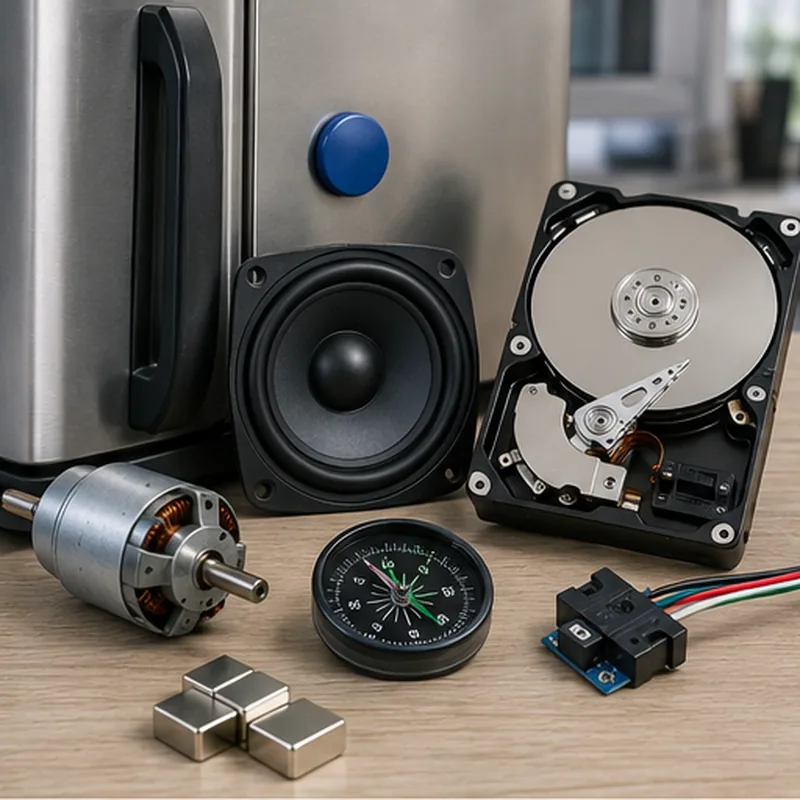
10 Common Uses of Magnets in Daily Life
| Use | Example | Magnet type | What the magnet does |
|---|---|---|---|
| 1 | Refrigerator door seal | Flexible permanent magnet strip | Pulls the gasket against the steel cabinet to help keep the door closed. |
| 2 | Speakers and headphones | Permanent magnet with voice coil | Creates a magnetic field so the coil can move a diaphragm and produce sound. |
| 3 | Dynamic microphones | Magnet and moving coil | Turns diaphragm vibration into an electrical signal. |
| 4 | Fans, blenders and washing machines | Permanent magnets and/or electromagnets | Converts electrical energy into rotating motion inside the motor. |
| 5 | Computer hard disk drives | Magnetic recording media and actuator magnets | Stores data as magnetic patterns and helps position the read/write head. |
| 6 | MRI scanners | Strong electromagnet, often superconducting | Creates a strong magnetic field used to make medical images. |
| 7 | Cars and electric vehicles | Permanent magnets, electromagnets and magnetic sensors | Supports motors, alternators, wheel-speed sensing and position detection. |
| 8 | Laboratory stirrers and experiments | Magnetic stir bar and rotating field | Mixes liquids without a mechanical shaft entering the container. |
| 9 | Recycling and metal sorting | Permanent magnets or electromagnets | Separates iron and steel from mixed material streams. |
| 10 | School whiteboards and compasses | Permanent magnets | Holds items in place or demonstrates poles, fields and direction. |
How Each Magnet Use Works
Refrigerator Door Seals
A refrigerator gasket usually contains a flexible magnetic strip. The strip attracts the steel frame of the refrigerator, helping the door close evenly and reducing cold-air leakage.
Speakers and Headphones
A speaker uses a permanent magnet and a voice coil. When the audio signal flows through the coil, the coil moves in the magnetic field and pushes the diaphragm, creating sound waves.
Microphones
A dynamic microphone works in the reverse direction of a speaker. Sound moves a diaphragm and coil near a magnet, generating a small electrical signal that can be amplified or recorded.
Electric Motors
Motors use magnetic fields to create torque. Fans, washing machines, vacuum cleaners, robotics and electric vehicles all depend on controlled magnetic interaction to create useful motion.
Hard Drives and Data Storage
Traditional HDDs store information using magnetic patterns on rotating disks. Many modern computers use SSDs for storage, but magnets can still appear in speakers, cooling fans, covers and sensors.
MRI and Medical Imaging
MRI systems use strong magnetic fields and radiofrequency energy to create images of body structures. Because the magnetic field is strong, medical screening and implant safety rules are essential.
Objects That Are Magnetic: What Sticks to a Magnet?
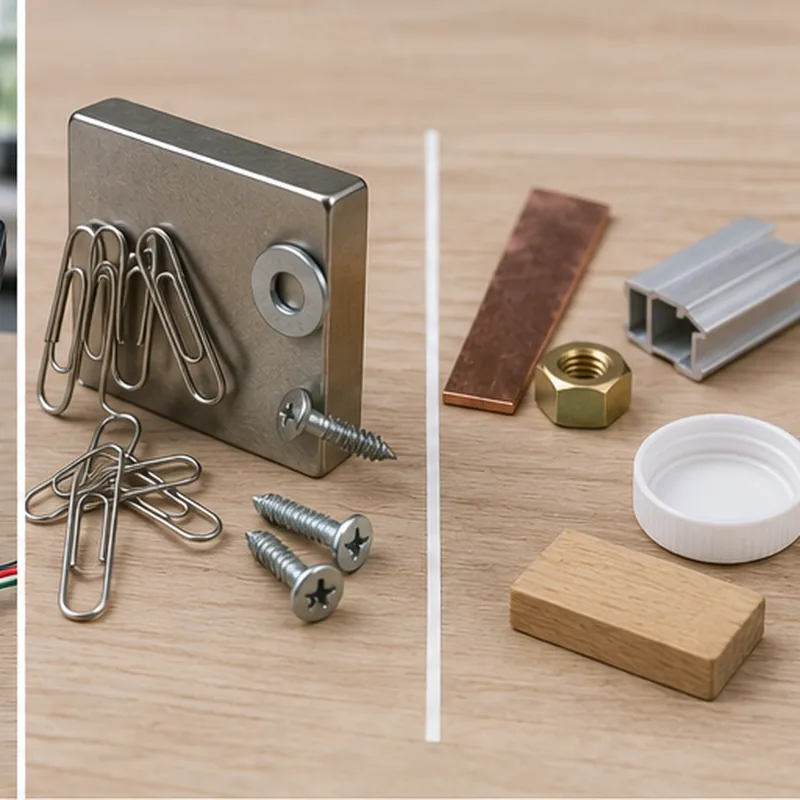
Many readers ask about magnet uses and magnetic objects at the same time. The practical answer is that a handheld magnet strongly attracts iron, many steels, nickel and cobalt. It usually does not strongly attract aluminum, copper, brass, gold, wood, glass or plastic.
| Object or material | Typical response to a magnet | Important note |
|---|---|---|
| Iron and carbon steel | Strong attraction | Common targets for holding, lifting and separation. |
| Nickel and cobalt | Magnetic | Important in some alloys and magnetic materials. |
| Stainless steel | Depends on grade and processing | Ferritic and martensitic stainless steels are normally magnetic; many annealed 304/316 parts are much less responsive. See Osenc’s guide: Is Stainless Steel Magnetic? |
| Aluminum, copper and brass | Usually no strong attraction | They can still interact weakly with changing magnetic fields, but they do not behave like iron or steel in a simple magnet test. |
| Wood, glass, paper and plastic | No practical attraction | Magnets may still hold these materials if a steel washer, insert or magnetic backing is added. |
Permanent Magnets vs Electromagnets in Daily Life
Some applications need an always-on magnetic field. Others need a magnetic field that can be switched on, switched off or adjusted. That is the basic difference between permanent magnets and electromagnets in real products.
| Type | Best for | Daily or industrial examples | Design concern |
|---|---|---|---|
| Permanent magnet | Compact holding, sensing and continuous magnetic field | Fridge seals, speakers, headphones, magnetic latches, sensors, EV motors | Grade, size, temperature, coating, magnetization direction and assembly gap. |
| Electromagnet | Switchable or adjustable magnetic force | Relays, lifting magnets, MRI systems, solenoids, some motors and lab devices | Power, heat, coil design, duty cycle, control method and safety. |
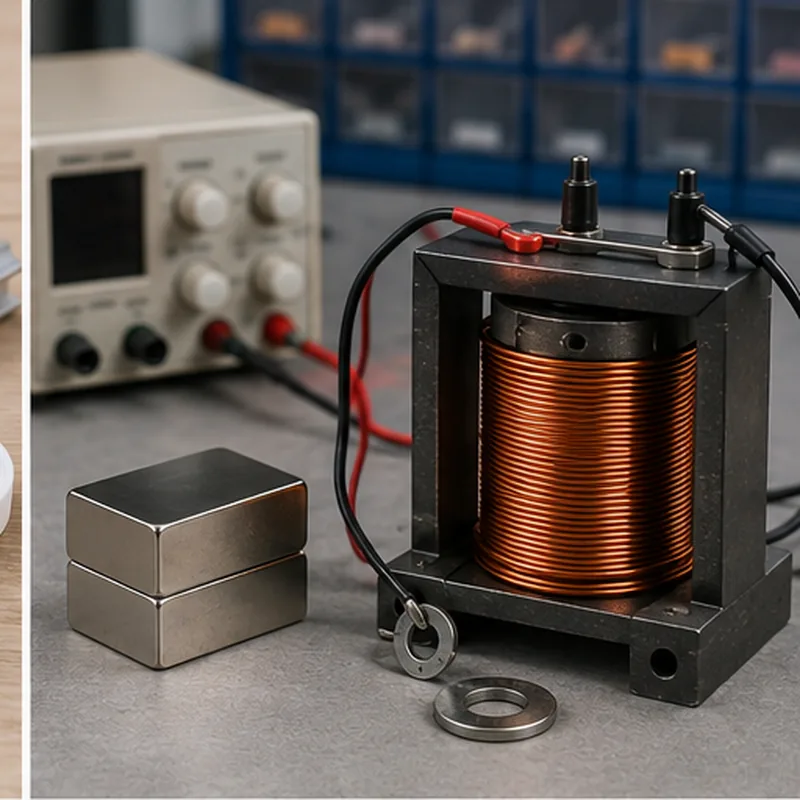
For compact permanent magnet applications, neodymium magnets are often chosen because they provide strong magnetic performance in a small volume. Osenc supports custom neodymium magnets, including shape, grade, coating, tolerance, magnetization and assembly-related review.
Uses of Magnets in Technology, Laboratories and Industry
Technology That Uses Magnets
Modern technology uses magnets in motors, speakers, microphones, magnetic sensors, HDDs, charging alignment, haptic vibration motors, magnetic covers and position detection. In higher-performance systems, magnets may need custom dimensions, controlled tolerances and a specific magnetization direction.
Magnet Uses in Laboratories
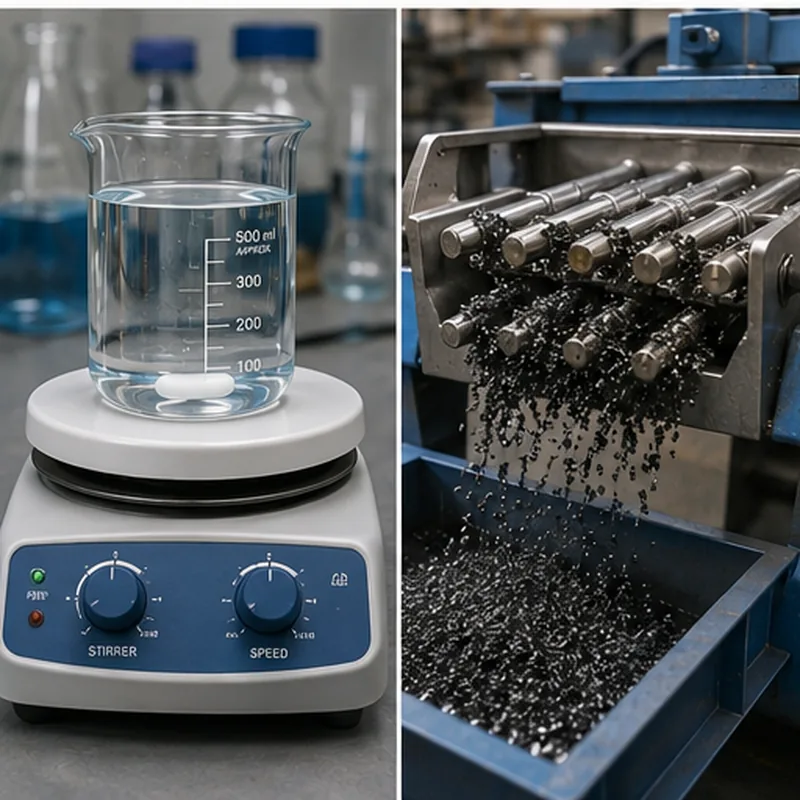
Laboratories use magnets in magnetic stirrers, separation demonstrations, compasses, field mapping, material testing and some scientific instruments. A magnetic stirrer is a simple example: a rotating magnetic field drives a coated stir bar inside the liquid.
Recycling and Metal Separation
Magnetic separators remove iron and steel from mixed materials. Osenc supplies magnetic separation products such as magnetic drum separators for material streams where ferrous contamination or recovery is important.
Motors, Sensors and Magnetic Assemblies
Permanent magnet motors, encoders and sensors often need more than a standard magnet. For motor projects, Osenc can help review grade, coating, magnetization direction and assembly requirements. See also Permanent Magnet Motor vs Induction Motor.
20 Everyday Examples of Magnets
For readers who need a broader list, here are 20 common places where magnets or magnetic effects appear. Some use permanent magnets, some use electromagnets, and some use magnetic sensors or magnetic materials as part of a larger system.
| Example | Where the magnet is used | Simple function |
|---|---|---|
| Refrigerator door | Flexible magnetic gasket | Keeps the door sealed against the cabinet. |
| Speakers | Magnet and voice coil | Moves a diaphragm to create sound. |
| Headphones and earbuds | Miniature speaker driver | Converts electrical signals into sound. |
| Dynamic microphones | Coil moving in a magnetic field | Converts vibration into an electrical signal. |
| Electric fans | Motor assembly | Creates rotation for airflow. |
| Washing machines | Motor and sensing systems | Controls rotation, speed and position. |
| Vacuum cleaners | Motor | Turns electrical energy into suction-producing motion. |
| Car wheel-speed sensors | Magnetic sensing system | Helps monitor wheel speed for ABS control. |
| Electric vehicle motors | Rotor magnets and stator fields | Generates torque for propulsion. |
| Hard disk drives | Magnetic recording media | Stores data as magnetic patterns. |
| Compasses | Magnetized needle | Aligns with Earth’s magnetic field. |
| Door and cabinet latches | Small permanent magnets | Holds doors closed without complex hardware. |
| Phone mounts and covers | Holding or alignment magnets | Positions accessories or holds parts together. |
| Security sensors | Magnet and reed/Hall sensor | Detects whether a door or window is open. |
| Magnetic stirrers | Rotating field and stir bar | Mixes liquids in laboratories. |
| Magnetic separators | Permanent magnet or electromagnet | Removes iron and steel from material streams. |
| MRI scanners | Strong magnetic field | Supports medical imaging of internal body structures. |
| Relays and solenoids | Electromagnetic coil | Moves a switch, plunger or actuator. |
| Retail anti-theft systems | Magnetic or electromagnetic security components | Supports tag detection or deactivation. |
| School experiments | Bar magnets, compasses and iron filings | Demonstrates attraction, repulsion, poles and fields. |
This list is useful for general learning, but it also shows why magnet selection changes from one product to another. A speaker magnet, a refrigerator gasket, a laboratory stir bar and an EV motor magnet do not have the same shape, grade, coating, tolerance or magnetic field requirement.
When a Daily Magnet Use Becomes a Custom Magnet Project
A classroom magnet, fridge magnet or simple holder may only need a standard product. A real device, machine or OEM assembly is different. The magnet must fit the part, survive the environment and deliver the required force at the actual working distance.
Before requesting a quotation, prepare the real application conditions rather than asking only for the strongest magnet. The strongest grade is not always the best choice if temperature, corrosion, air gap, assembly stress or cost is the limiting factor.

Useful RFQ Information
- Magnet shape, dimensions, tolerance and drawing if available.
- Material preference, such as NdFeB, ferrite, SmCo or Alnico.
- Required pull force, surface field, torque, sensing distance or holding condition.
- Magnetization direction, pole layout or mating steel structure.
- Working temperature, humidity, chemicals, outdoor exposure or cleaning process.
- Coating requirement such as nickel, zinc, epoxy, Parylene or PTFE.
- Prototype quantity, annual volume, packaging and shipping requirements.
Safety Notes for Strong Magnets
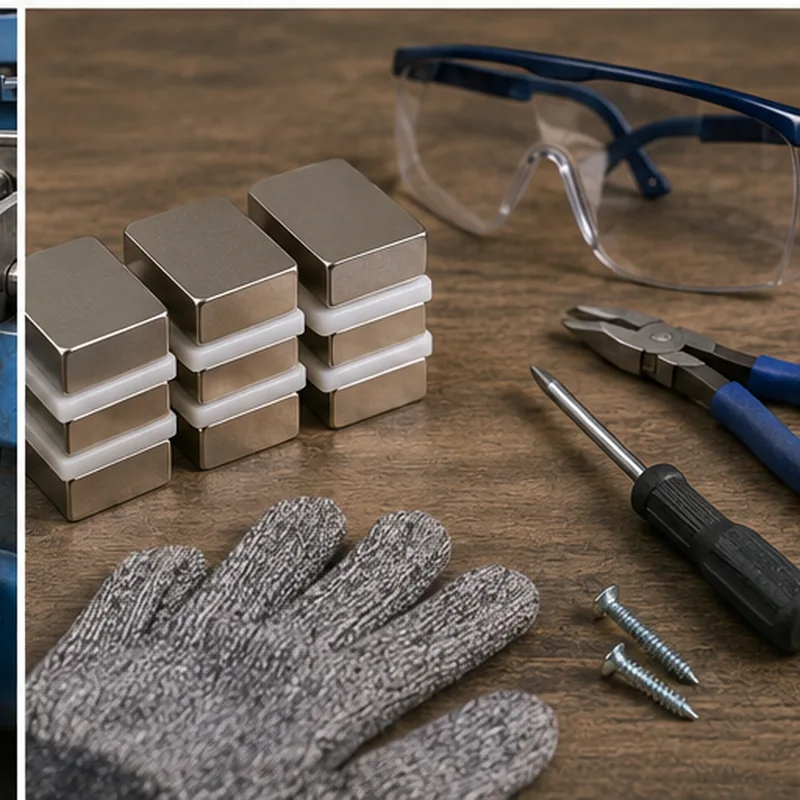
Small household magnets are usually easy to handle, but strong neodymium magnets require more care. They can pinch skin, chip if they snap together, damage magnetic storage media, attract tools unexpectedly and interfere with some medical implants or sensitive devices.
- Keep strong magnets away from children and pets.
- Do not let strong magnets slam together; they may chip or crack.
- Keep strong magnets away from pacemakers and other medical implants unless a qualified professional has confirmed safety.
- Use caution around traditional HDDs, magnetic cards, compasses and sensitive instruments.
- Do not cut, drill or grind finished neodymium magnets casually. For more detail, see Osenc’s safety guide: Are Neodymium Magnets Safe?
Conclusion
Magnets are used in daily life because they can create force without direct contact, work with electric current, store magnetic patterns, sense movement and separate magnetic materials. That is why the same basic principle appears in refrigerator seals, speakers, microphones, motors, hard drives, MRI scanners, lab stirrers, recycling equipment and industrial separators.
For a simple demonstration, a standard magnet may be enough. For a real product or machine, the magnet should be selected around the application: size, grade, coating, magnetization, temperature, air gap, mating steel and test requirement all matter.
FAQ
What are 10 uses of magnets in daily life?
Ten common uses are refrigerator door seals, speakers, headphones, microphones, electric motors, hard disk drives, MRI scanners, car sensors, laboratory stirrers, recycling separators and school experiments.
What objects are magnetic?
Iron, many steels, nickel and cobalt are strongly attracted to magnets. Some stainless steels are magnetic, while others are much less responsive. Aluminum, copper, brass, gold, wood, glass and plastic usually do not show strong attraction to a simple magnet.
Where are magnets used in technology?
Magnets are used in speakers, microphones, motors, hard drives, sensors, magnetic covers, wireless charging alignment, haptic motors, medical imaging, laboratory equipment and industrial automation.
What is the difference between a permanent magnet and an electromagnet?
A permanent magnet provides an always-on magnetic field without electricity. An electromagnet creates a magnetic field when current flows through a coil, so it can be switched, adjusted or controlled.
Do computers still use magnets?
Yes. Traditional HDDs use magnetic recording. Even computers with SSD storage may still contain magnets in speakers, fans, sensors, covers or accessories. Strong external magnets are a bigger concern for magnetic storage media than for SSDs.
When should I choose a custom magnet instead of a standard magnet?
Choose a custom magnet when the application requires a special size, tight tolerance, specific coating, controlled magnetization direction, defined pull force, temperature resistance or integration into a product assembly.