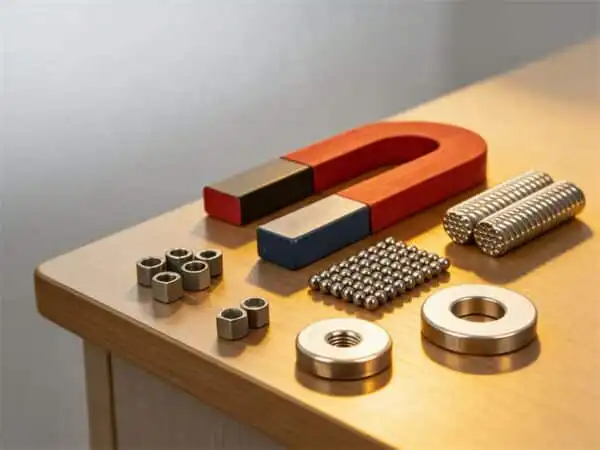
Quick Answer: What Is Magnetic Permeability?
Magnetic permeability describes how a material responds to an applied magnetic field. In a linear, isotropic material, the basic relationship is B = μH, where B is magnetic flux density, H is magnetic field strength, and μ is absolute permeability.
The engineering boundary matters: permeability is not one fixed number for every material under every condition. In ferromagnetic materials such as iron and many steels, the effective response changes with field level, magnetic history, frequency, temperature, stress, alloy, processing, and component geometry.
Magnetic Permeability at a Glance
| Quantity | Meaning | Typical Expression | Engineering Boundary |
|---|---|---|---|
| Absolute permeability | Magnetic response expressed in SI units | μ = B/H for a linear material | For nonlinear materials, B/H describes a particular operating point rather than a universal constant. |
| Relative permeability | Material permeability compared with vacuum | μr = μ/μ0 | Dimensionless; may vary with test and operating conditions. |
| Vacuum permeability | Reference permeability of free space | μ0 ≈ 1.25663706127 × 10⁻⁶ H/m | Since the 2019 SI redefinition, μ0 is no longer an exact defined value. |
| Magnetic susceptibility | How strongly magnetization changes in response to H | μr = 1 + χm for a linear isotropic medium | The simple relation is not a universal replacement for a nonlinear B-H curve. |
For most purchasing and design work, the question should not be only “What is the permeability of this material?” A better question is: which permeability, measured at what field, frequency, temperature, and material condition?
What Do μ, μr, and μ0 Mean?
The symbol μ represents absolute magnetic permeability. In the simplest linear case:
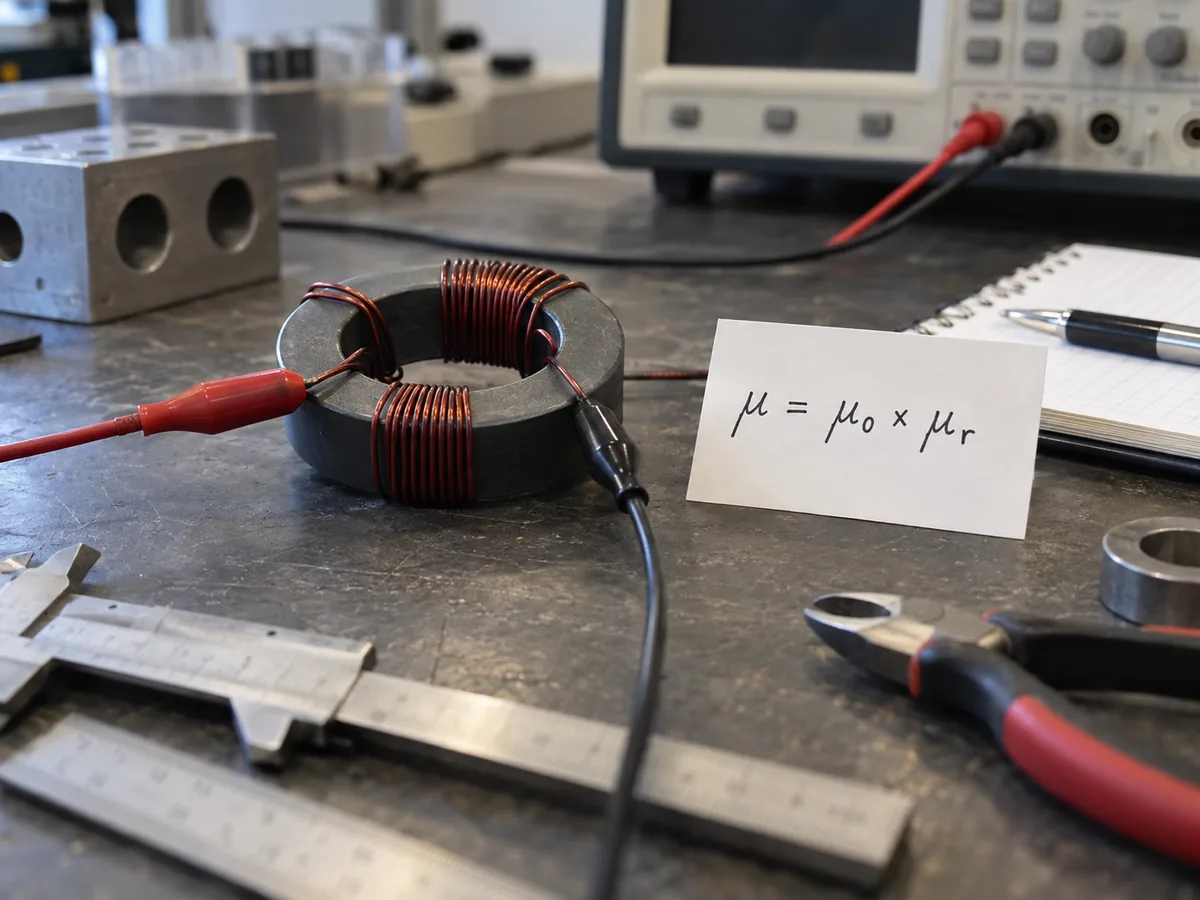
Relative permeability μr compares a material with vacuum:
μr = μ / μ0Vacuum therefore has μr = 1. Air is also extremely close to 1 for ordinary engineering calculations. Diamagnetic materials such as copper have relative permeability slightly below 1, while paramagnetic materials such as aluminum are slightly above 1. Ferromagnetic materials can be much higher, but their permeability is strongly condition-dependent.
What is the current value of μ0?
The 2022 CODATA recommended value for vacuum magnetic permeability is 1.25663706127(20) × 10−6 N/A², which is equivalent to H/m. Before the SI was redefined in 2019, μ0 was fixed exactly at 4π × 10−7 H/m. That expression remains an excellent engineering approximation, but it is no longer exact by definition.
Reference: NIST 2022 CODATA recommended values.
How is relative permeability related to magnetic susceptibility?
For a linear, isotropic medium, relative permeability and magnetic susceptibility are related by:
μr = 1 + χmIf χm is slightly negative, the material is diamagnetic. If it is slightly positive, the material is paramagnetic. Ferromagnetic behavior is more complicated because domain motion, hysteresis, and saturation make the response nonlinear.
Why Magnetic Permeability Is Not One Fixed Material Number
This is the point that simple permeability tables usually hide. A quoted μ or μr value can be useful only when the material and test conditions are sufficiently defined.
1. Magnetic field strength changes the operating point
Ferromagnetic materials do not follow one straight B-H line from zero field to saturation. As H increases, domain behavior changes, the slope of the B-H curve changes, and the material eventually approaches saturation. The permeability calculated at a low field can therefore be very different from the permeability relevant near a high-flux operating point.
2. Magnetic history matters
Because ferromagnetic materials exhibit hysteresis, the current B-H state can depend on how the material was magnetized previously. That is why initial permeability, maximum permeability, incremental permeability, and other definitions are not interchangeable.
3. Frequency and DC bias matter
In AC systems, permeability can change with frequency and losses become important. A superimposed DC bias can also move the operating point and change incremental response. NIST measurements on ferromagnetic stainless steels explicitly report relative permeability as a function of both frequency and magnetic field strength.
Reference: NIST relative permeability measurement research.
4. Temperature, stress, and processing can change magnetic behavior
Alloy chemistry, heat treatment, cold work, forming, welding, residual stress, and temperature can change microstructure and magnetic response. This is especially important when somebody asks for “the permeability of steel” or “the permeability of stainless steel” without specifying the exact grade and condition.
5. Component geometry creates an effective permeability
Material permeability is not the same thing as the effective magnetic behavior of a finished core, yoke, shield, or assembly. Air gaps, joints, fringing, demagnetizing effects, and geometry can dominate the finished magnetic circuit even when the base material itself has high permeability.
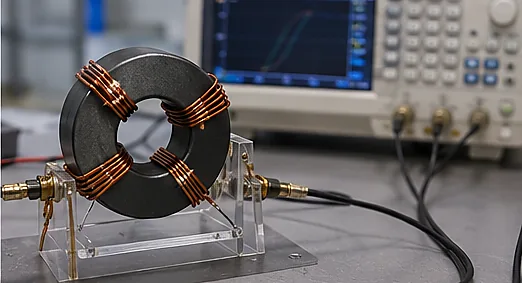
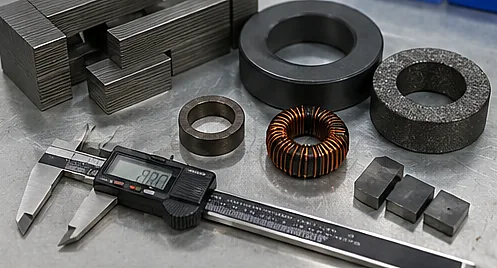
Magnetic Permeability of Common Materials
The table below is designed for engineering use rather than memorizing one number per material. Near-unity values are often useful for weakly magnetic materials. Generic values for ferromagnetic metals are far less reliable because their magnetic response changes with operating conditions.
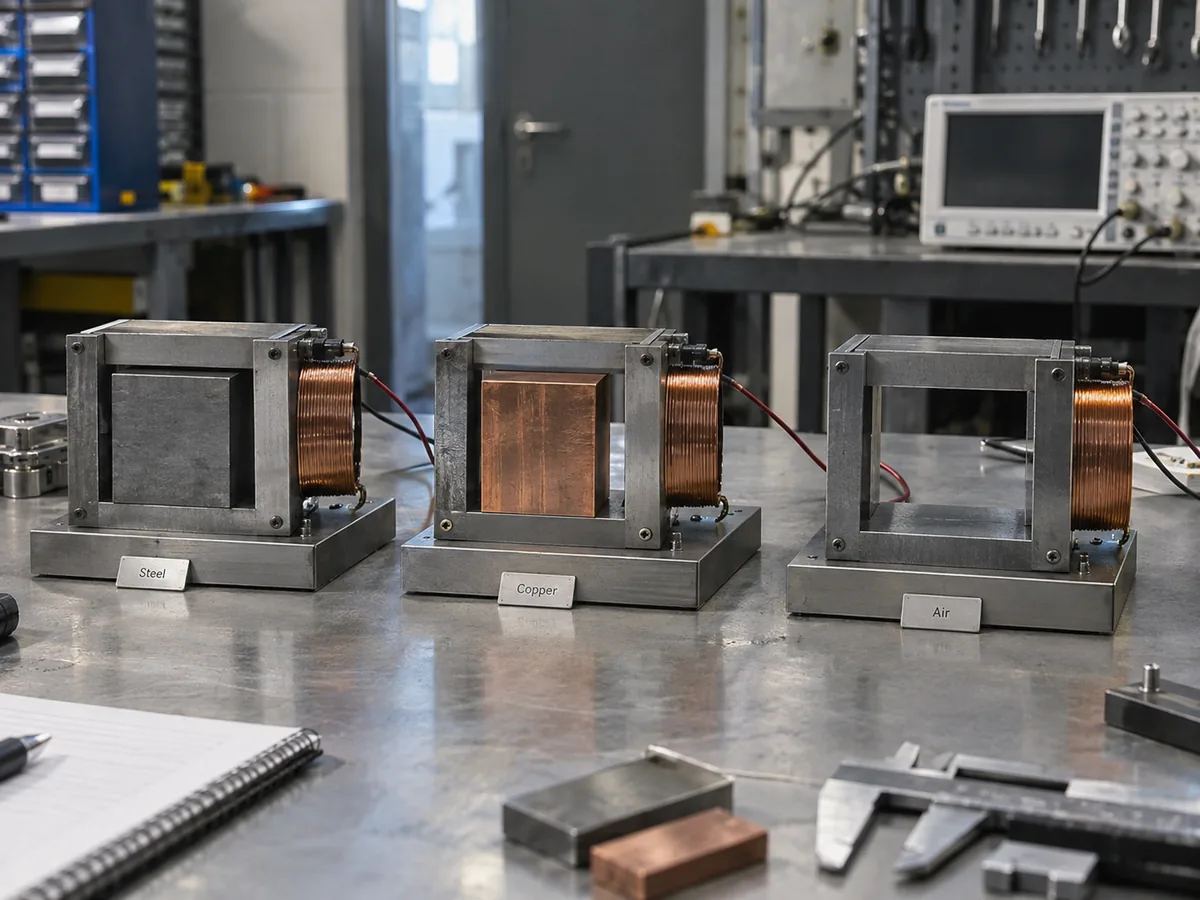
| Material | Relative Permeability Behavior | Can One Value Be Used Directly? | Engineering Action |
|---|---|---|---|
| Vacuum / free space | μr = 1 | Yes, as the reference condition. | Use μ0 as the SI reference permeability. |
| Air | Extremely close to 1 | Usually, for ordinary magnetic-circuit calculations. | Treat air approximately as free space, but include the actual air gap because it may dominate total reluctance. |
| Copper | Slightly below 1; diamagnetic | Often, for first-pass calculations. | For precision work, specify purity and temperature. High-purity annealed oxygen-free copper is roughly μr ≈ 0.99999 near room temperature. |
| Aluminum | Slightly above 1; paramagnetic | Often, for first-pass calculations. | Use material-specific data when a small deviation from unity can affect the result. |
| Wood and common polymers | Generally very close to 1 | Usually. | For ordinary permanent-magnet circuit work, they are commonly approximated as magnetically similar to free space. |
| Pure iron / soft magnetic iron alloys | Can be high but strongly nonlinear | No. | Use an alloy-specific B-H curve or permeability data tied to the actual processing and operating range. |
| Low-carbon / electrical steel | Potentially high, with large grade-dependent variation | No. | Check grade, heat treatment, sheet condition, field level, saturation, and frequency when applicable. |
| Stainless steel | Ranges from near-unity to significantly magnetic depending on alloy and processing | No generic value. | Identify the exact grade and condition. Cold work, forming, welding, and phase changes can alter magnetic response. |
For copper specifically, published material-property data for annealed C10100-C10200 oxygen-free copper relate susceptibility to temperature and use μr = 1 + χ. Near room temperature, those data put μr at about 0.99999 rather than exactly 1.
Reference: Princeton Plasma Physics Laboratory oxygen-free copper properties.
Can You Use a Permeability Value From a Table?
Sometimes. A table value is useful for screening when the material is close to μr = 1. It is much less reliable for ferromagnetic metals or finished magnetic circuits.
| Situation | Use a Generic Value? | Better Input |
|---|---|---|
| Vacuum / ordinary air | Usually yes | Use μ0 and model the actual air gap. |
| Copper / aluminum for rough modeling | Often | Use material-specific data only when small deviations from unity matter. |
| Generic iron or steel | No | Use the exact material’s B-H curve or defined permeability data. |
| Stainless steel without grade / condition | No | Specify grade, processing condition, and relevant field range. |
| AC / high-frequency component | No single DC value | Use frequency-specific permeability and loss data. |
| Finished yoke, shield, gapped core, or assembly | No | Evaluate effective behavior including geometry, joints, gaps, leakage, and saturation. |
Magnetic Permeability Formula, Units, and Dimensions
Basic formula
For a linear material, absolute permeability can be calculated from magnetic flux density and magnetic field strength:
μ = B / HHere, B is measured in tesla (T), H in amperes per meter (A/m), and μ in henries per meter (H/m).
SI unit of magnetic permeability
Equivalent SI forms include:
H/m = N/A² = T·m/ADimensional formula
Using mass M, length L, time T, and electric current I, magnetic permeability has the dimensional formula:
[M L T−2 I−2]Types of Magnetic Permeability
The word “permeability” can refer to different measurements. Mixing them is one reason material comparisons go wrong.
| Type | What It Describes | When It Matters |
|---|---|---|
| Absolute permeability, μ | Permeability expressed in H/m | Basic field equations and material response. |
| Relative permeability, μr | Ratio μ/μ0 | Convenient comparison with vacuum. |
| Initial permeability | Small-signal response near the origin of a demagnetized B-H curve | Low-field cores and material comparison. |
| Maximum permeability | Highest permeability reached over a defined magnetization curve | Shows peak response, but not necessarily the design operating point. |
| Incremental / differential permeability | Change in B relative to a small change in H around an operating point | Biased magnetic circuits and small-signal behavior. |
| Complex permeability | Frequency-dependent AC response represented with storage and loss components | Inductors, transformers, shielding, and other AC magnetic systems. |
| Effective permeability | Overall response of a component including gaps and geometry | Finished cores, magnetic paths, assemblies, and practical circuit calculations. |
When a supplier or datasheet gives a permeability value, check which definition is being quoted. “μr = 5000” without the definition, frequency, field level, and material condition is not a complete engineering specification.
How the B-H Curve Changes Permeability
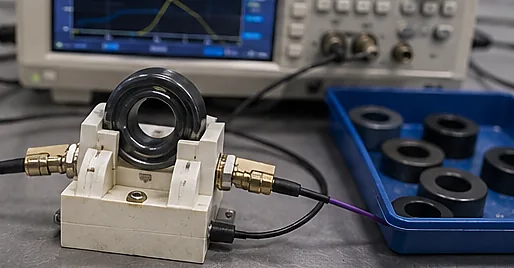
A B-H curve plots magnetic flux density B against magnetic field strength H. Its shape is the most useful way to understand why ferromagnetic permeability is not constant.
At low fields, the material may respond steeply as magnetic domains move. At higher fields, the slope changes. As the material approaches saturation, a large increase in H produces a smaller increase in B. The permeability relevant to the design therefore depends on where the component operates on that curve.
Secant permeability vs. differential permeability
If you divide B by H at one point, you obtain a secant-type permeability for that operating point. If you look at the local slope, dB/dH, you obtain differential permeability. These values can be very different in a nonlinear ferromagnetic material.
Hysteresis adds another boundary
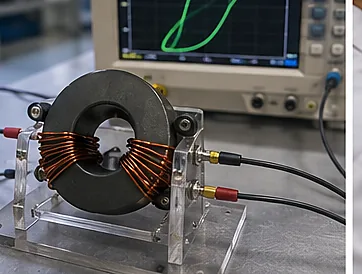
When the magnetizing field cycles, the B-H path does not generally retrace itself. That hysteresis means magnetic history and loss matter. For AC applications, the relevant material data normally need to include frequency and waveform conditions rather than one DC number.
Why Permeability Matters in Magnetic Circuits
A simplified magnetic reluctance can be written as:
ℛ = l / (μA)Higher permeability can reduce reluctance in a return path, but saturation, air gaps, leakage, fringing, joints, geometry, losses, and mechanical constraints still control the finished result.
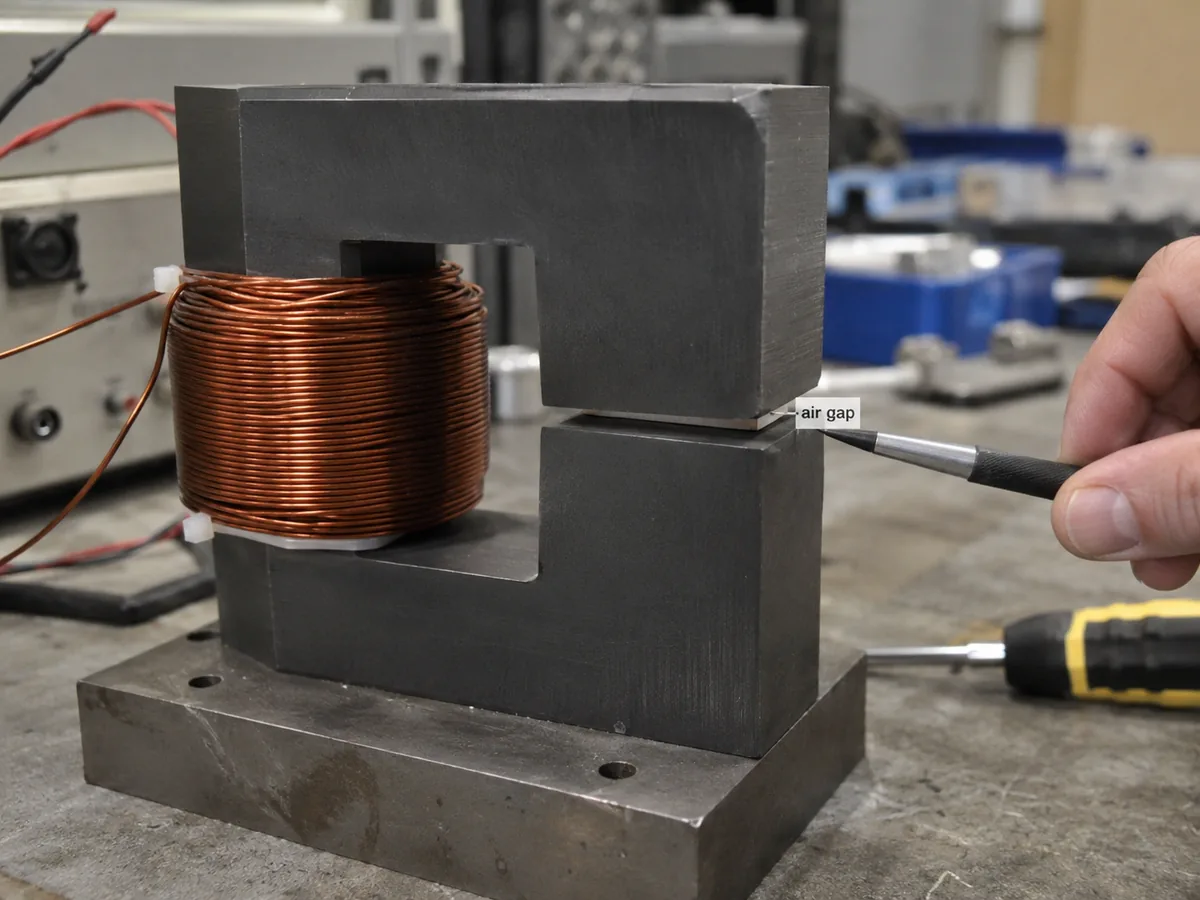
Why an air gap can dominate the circuit
Air has μr close to 1. A steel path may have much higher permeability before saturation, so even a short gap can contribute much of the total reluctance. Working distance and air gap therefore cannot be ignored when predicting field or force.
Steel yokes, pole pieces, and backing plates
Ferromagnetic steel can redirect flux, but only within its B-H and geometry limits. If a section saturates, a nominally high-permeability material does not fix the design.
Where permeability enters a permanent-magnet assembly
Steel yoke
Closes the return path; cross-section, path length, joints, and saturation matter.
Pole piece
Redirects or concentrates flux; geometry and local saturation set the result.
Backing plate
Changes the return path and leakage; thickness, material state, and gaps matter.

For broader background, see OSENC’s guides to magnets and magnetism and types of magnets.
How Magnetic Permeability Is Actually Measured
Permeability measurement has to match the material form, field range, frequency, geometry, and permeability definition required by the design.
Material or core samples
Toroidal specimens provide a closed magnetic path and can be used to characterize B-H behavior. Depending on the purpose, the result may be initial, maximum, incremental, differential, or complex permeability rather than one generic μr.

NIST has described low-frequency measurements on wound toroidal metal specimens while accounting for conductivity, skin depth, frequency, and magnetic field strength.
Reference: NIST relative permeability measurement research.
Sheet steel and ferromagnetic metals
Exact alloy, heat treatment, forming history, stress state, field range, and sample direction can change the result. Do not transfer one measured value to a different processed condition without justification.
Finished components and effective permeability
A gapped core, yoke, shield, pole piece, or assembly also contains joints, leakage, fringing, demagnetizing effects, and local saturation. Its effective magnetic behavior can differ greatly from the intrinsic material value.
What should accompany a permeability value?
- Exact alloy and processing condition
- Permeability definition
- DC or AC method and frequency
- Field level or bias condition
- Temperature and sample geometry
- Relevant magnetic history, stress, heat treatment, or cold work
- Uncertainty or acceptance tolerance when critical
Magnetic Permeability Is Not the Same as Magnet Strength
Permeability is often confused with the strength of a permanent magnet. They are different properties.
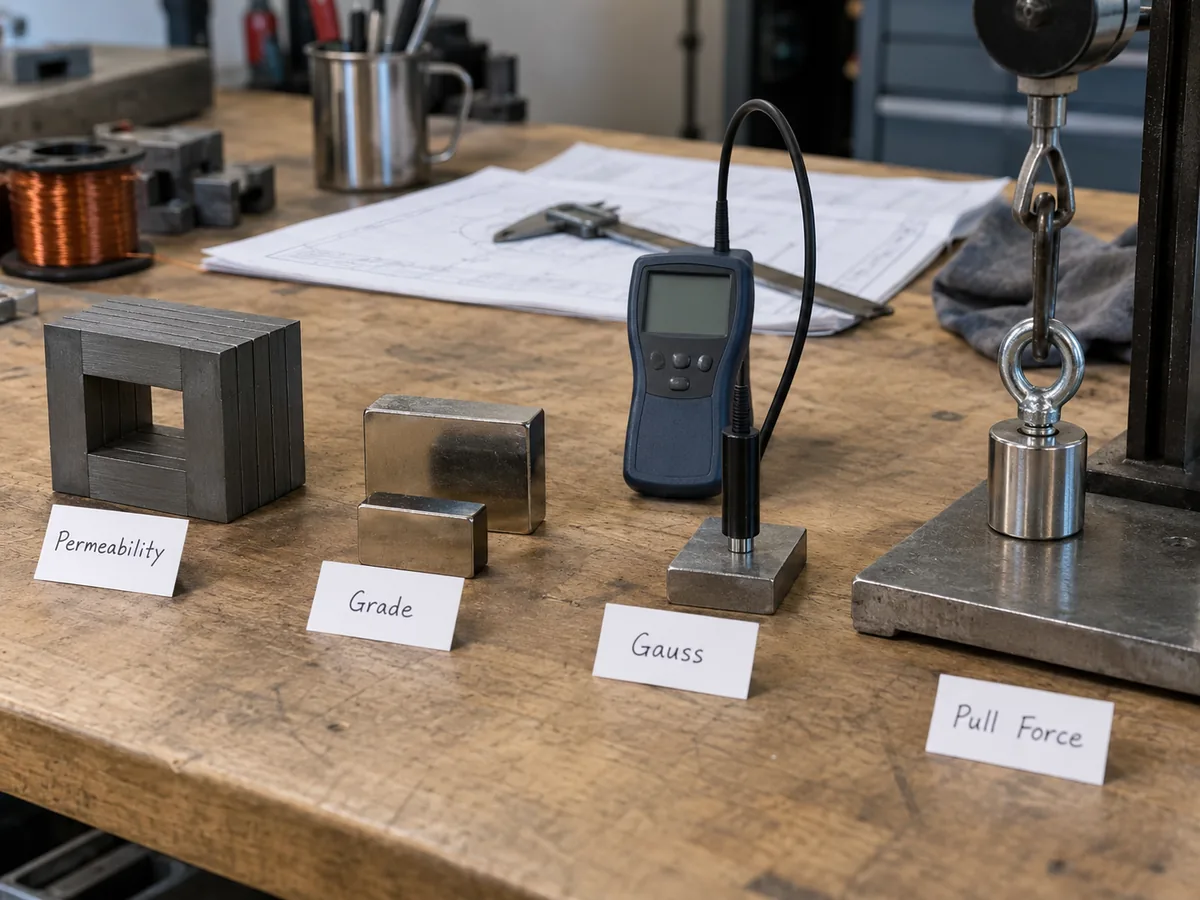
For a permanent magnet such as NdFeB, grade-related magnetic properties include remanence (Br), intrinsic coercivity (Hcj), coercivity (Hcb), and maximum energy product ((BH)max). Permeability is especially important when evaluating the surrounding ferromagnetic path, target material, pole pieces, or yoke.
A higher magnet grade also does not automatically guarantee a higher pull force or a stronger field at the required working distance. Magnet geometry, magnetization direction, mating steel, air gap, magnetic circuit, temperature, and assembly construction all contribute to finished performance.
For grade terminology, see OSENC’s magnet grade guide.
What Information Changes a Magnetic-Circuit Design?
For a permanent-magnet assembly with a steel return path, pole piece, backing plate, or ferromagnetic target, these inputs are more useful than one isolated μr value.
| Input | Why It Matters |
|---|---|
| Drawing and key dimensions | Set path length, cross-section, gap, leakage, and saturation risk. |
| Magnet material / grade, size, and magnetization | Define the magnet’s available properties and flux direction. |
| Yoke, pole piece, backing plate, or target material | Controls return-path behavior and saturation. |
| Air gap / working distance | Can dominate reluctance and sharply change field or force. |
| Required field or force condition | Must be tied to a location, gap, target geometry, and test condition. |
| Temperature, assembly, and acceptance constraints | Can change material behavior, construction, and verification. |
Magnetic Permeability FAQ
What is the magnetic permeability of free space?
Vacuum has relative permeability μr = 1. The 2022 CODATA recommended absolute vacuum permeability is μ0 = 1.25663706127(20) × 10−6 H/m. The familiar 4π × 10−7 H/m remains an excellent approximation, but since the 2019 SI redefinition it is no longer an exact defined value.
What is the magnetic permeability of air?
Air has relative permeability extremely close to 1, so it is commonly approximated as μ ≈ μ0 in engineering calculations. That does not make an air gap magnetically unimportant; because ferromagnetic return paths may have much higher permeability, the air gap can dominate total magnetic reluctance.
What is the magnetic permeability of copper?
Copper is diamagnetic, so its relative permeability is slightly below 1. Published data for high-purity annealed oxygen-free copper place μr at roughly 0.99999 near room temperature, but a precision value should specify purity and temperature.
What is the magnetic permeability of iron or steel?
There is no single reliable permeability value for “iron” or “steel.” Ferromagnetic permeability changes with alloy, processing, stress, magnetic history, field level, and proximity to saturation. For engineering work, use the exact material’s B-H curve or a defined permeability value measured under relevant conditions.
What is the magnetic permeability of stainless steel?
It depends on the stainless-steel family, exact grade, and processing condition. Some austenitic stainless steels can be close to nonmagnetic in an annealed condition, while cold work or phase transformation can increase magnetic response. Do not assign one generic μr value to all stainless steel.
What is the SI unit and dimensional formula of magnetic permeability?
The SI unit is henry per meter (H/m), equivalent to N/A² or T·m/A. Its dimensional formula is [M L T−2 I−2]. Relative permeability μr is dimensionless.
Is higher magnetic permeability always better?
No. High permeability can reduce reluctance in a ferromagnetic path, but a useful design must also account for saturation, losses, bias, air gaps, geometry, stability, mechanical requirements, and cost. In some gapped or energy-storage magnetic circuits, deliberately lower effective permeability is part of the design.
What is the difference between permeability and permittivity?
Magnetic permeability describes a material’s magnetic response, while electric permittivity describes its electric-field response. They are different electromagnetic properties with different units and should not be used interchangeably.
Send a More Complete Magnetic-Circuit RFQ
If your permanent-magnet assembly includes a steel yoke, pole piece, backing plate, or ferromagnetic target, one permeability number is not enough to define the finished result. A useful inquiry should describe the magnetic requirement together with the geometry and operating conditions that control it.
Include the drawing, magnet material or grade if already selected, magnet dimensions, magnetization direction or pole layout, return-path or target material, working gap, required field or force condition, operating temperature, assembly constraints, and acceptance method when available.
Review custom neodymium magnets or Send Your Project Details