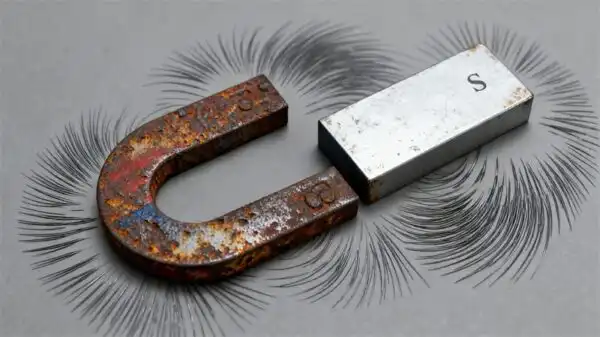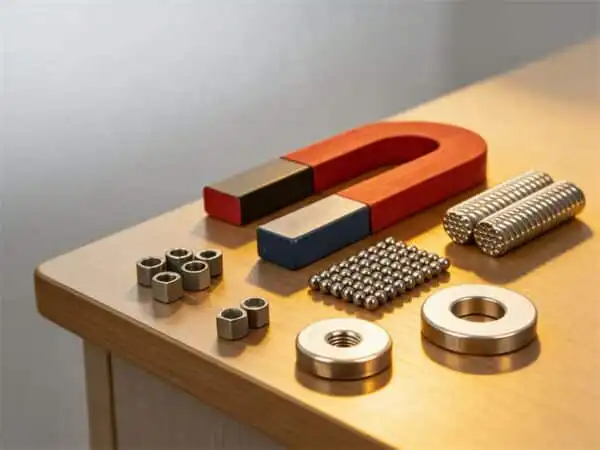
A magnet is an object or material that produces a magnetic field. Magnetism is the physical phenomenon behind magnetic fields and the attraction, repulsion or other magnetic effects they can produce. A magnetic interaction can act across a distance; direct contact is not required.
For engineering work, the important point is that a magnet’s material or grade does not determine finished performance by itself. Geometry, magnetization direction, working distance or air gap, target material, nearby steel, temperature and the test method all affect the usable result.
Magnets and Magnetism in 5 Points
- A magnet produces a magnetic field; magnetism describes the broader physical behavior associated with that field.
- Magnetic effects can act across a distance, but the field generally changes as the working distance and surrounding geometry change.
- Permanent, temporary or induced, and electromagnetic systems produce or retain magnetism in different ways.
- Useful magnetic performance is a system result, not a grade name or a single surface-Gauss number.
- For selection, define the real operating and test conditions before choosing material, grade, size, magnetization, coating or assembly details.

What Is the Difference Between a Magnet and Magnetism?
The terms magnet and magnetism describe different things. A magnet is the physical object or material. Magnetism is the broader phenomenon that explains the magnetic field and the forces associated with it.
| Term | Meaning | Engineering relevance |
|---|---|---|
| Magnet | A material or object that produces a magnetic field. | You specify its material, grade, dimensions, magnetization, coating and tolerances. |
| Magnetism | The physical behavior associated with magnetic fields and magnetic interactions. | You evaluate how the field behaves in the real geometry, gap, target material and magnetic circuit. |
| Magnetic field | The field in which magnetic interactions can occur. | Its magnitude and direction depend on position, geometry, magnetization and nearby magnetic materials. |
| Magnetic force | The mechanical effect produced by a magnetic interaction. | Holding or pull force depends on more than a single Gauss value. |
This distinction matters because procurement errors often begin when a material property is mistaken for finished-device performance. A grade name, a Br value or a surface Gauss reading describes only part of the magnetic system.
What Causes Magnetism?
Magnetism begins with the magnetic behavior of electrons inside matter. In many materials, tiny magnetic contributions point in different directions and largely cancel. In ferromagnetic materials, groups of magnetic moments can organize into regions called magnetic domains. When enough domains align in a favorable direction, the material can produce a strong net magnetic effect.
That simple picture is enough for practical selection: the internal magnetic structure creates the potential for magnetism, while material processing, magnetization and the final magnetic circuit determine how much of that potential becomes useful outside the part.
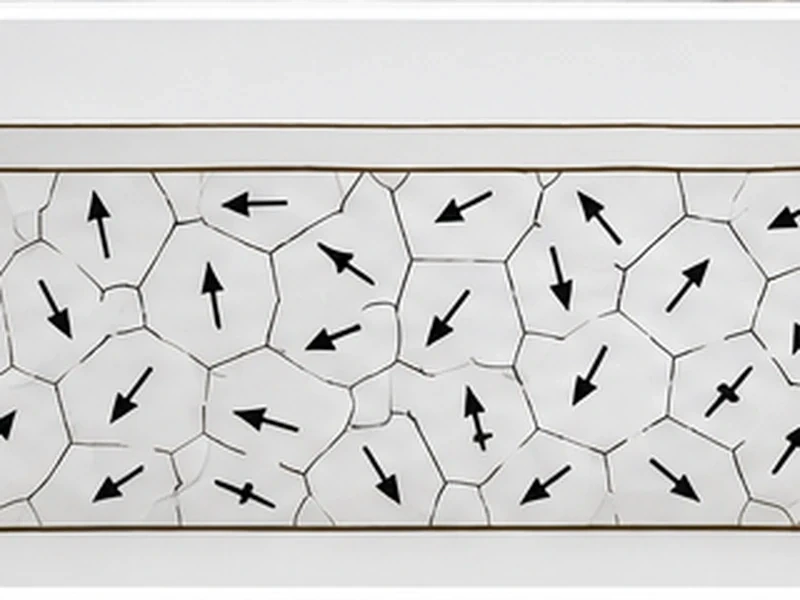
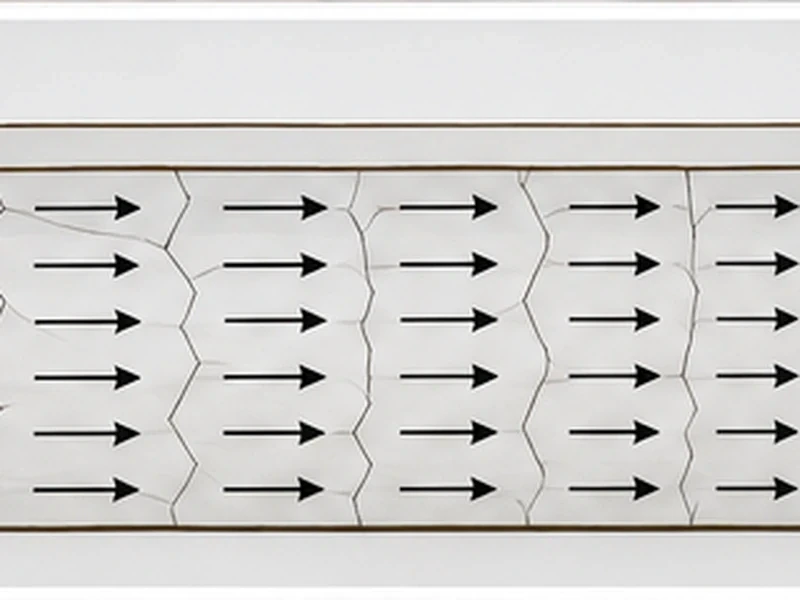
OpenStax describes ferromagnetic materials as containing domains whose magnetic dipoles can align with an applied field, while the National High Magnetic Field Laboratory explains permanent magnetism in terms of the internal structure and aligned magnetic contributions within the material. For deeper background, see OpenStax: Magnetism in Matter and the National MagLab permanent magnet reference.
Permanent-magnet materials are engineered so that useful magnetization remains after the magnetizing field is removed. A temporary or induced magnetic material responds strongly to an external magnetic field but may retain little magnetization after that field is removed. An electromagnet is different again: electric current in a conductor or coil produces the field.
Magnetic Fields, Poles, Attraction and Repulsion
Every ordinary permanent magnet behaves as a magnetic dipole with a north-seeking pole and a south-seeking pole. Like poles repel and unlike poles attract. If a magnet is broken, each remaining piece still behaves as a smaller dipole rather than producing a usable isolated north or south pole.
Magnetic field lines are a visualization tool, not physical wires in space. By convention, the field direction outside a permanent magnet is shown from the north pole toward the south pole. Field lines form continuous loops, and their pattern changes when magnets, air gaps, steel parts or other magnetic materials are introduced.
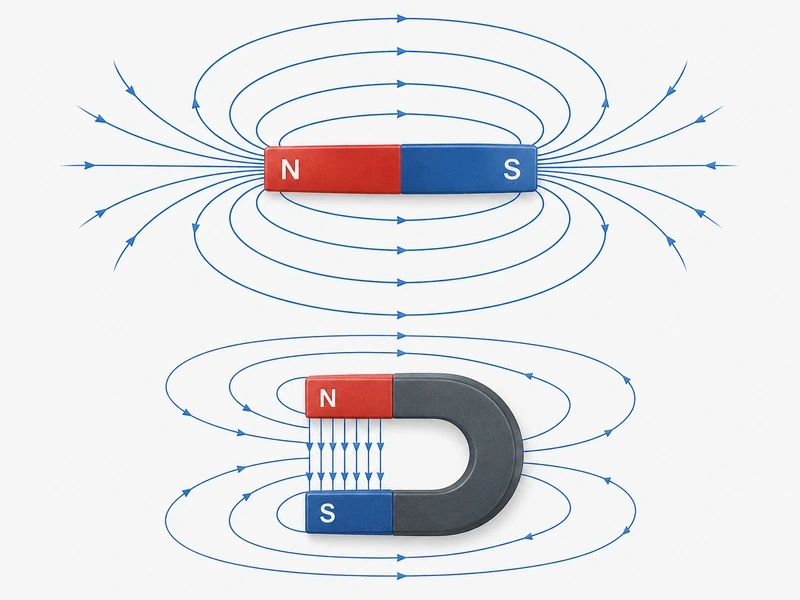
For a focused explanation of polarity and field direction, see OSENC’s direction of the magnetic field guide.
What Are the Main Types of Magnets?
For basic magnets and magnetism discussions, three broad classes are useful: permanent magnets, temporary or induced magnets, and electromagnets. These classes describe how magnetism is produced or retained, not simply the shape of the part.
| Type | How the field is produced or retained | Typical design reason |
|---|---|---|
| Permanent magnet | Retains useful magnetization without continuous electrical power. | Compact passive magnetic field for motors, sensors, speakers, couplings, holding systems and many other devices. |
| Temporary / induced magnet | Becomes magnetized mainly in response to an external field. | Useful as a magnetic core, flux path or target material where low retained magnetization may be desirable. |
| Electromagnet | Electric current produces the magnetic field. | Useful when field strength or on/off behavior needs electrical control. |
Common permanent-magnet material families include NdFeB, SmCo, ferrite and Alnico. They differ in magnetic properties, temperature behavior, corrosion behavior, mechanical characteristics, cost and manufacturability. The material family therefore comes before the grade number in a sensible selection process.
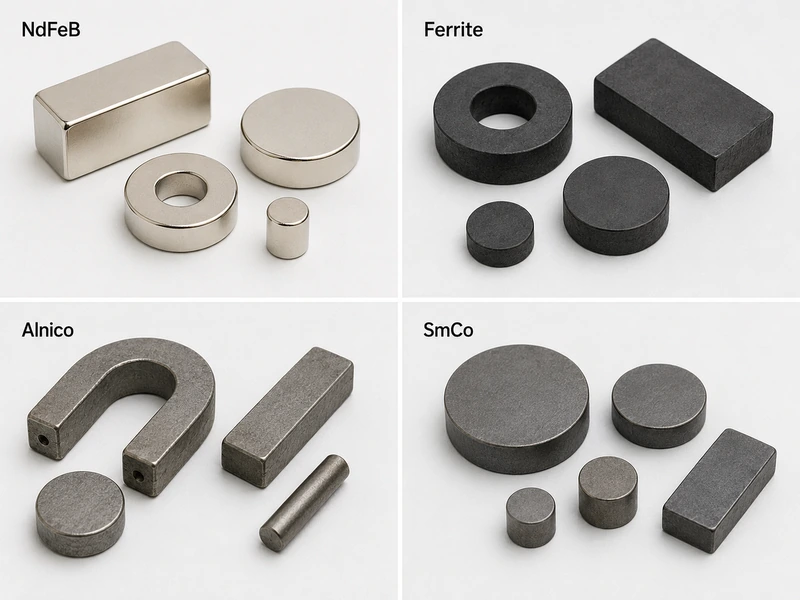
For a deeper comparison, use the dedicated types of magnets page rather than turning this fundamentals guide into another material catalog.
What Causes Magnetism and What Determines a Magnet’s Strength?
There is no single engineering number called “magnet strength.” Different measurements answer different questions, and confusing them is one of the fastest ways to specify the wrong magnet.
| Property or test | What it tells you | What it does not tell you by itself |
|---|---|---|
| Br (remanence) | A material-level indication of residual magnetic flux density after magnetization under defined conditions. | The exact surface field, field at a working distance or pull force of a finished part. |
| Hcb | The reverse field associated with reducing magnetic flux density B to zero on the demagnetization curve. | The same thing as intrinsic coercivity. |
| Hcj | Intrinsic coercivity, which is important when assessing resistance to irreversible demagnetization. | A universal operating-temperature guarantee. |
| BHmax | The maximum energy product and a useful material-efficiency indicator. | The finished force or field of an arbitrary geometry. |
| Surface Gauss | Magnetic flux density at the probe location near or on a surface. | Pull force or the field at another distance. |
| Pull force | Mechanical force under a defined test geometry and contact/gap condition. | A universal force value for every mating part or air gap. |
B, H, Magnetic Flux and Permeability Are Related but Different
B, H, magnetic flux and permeability describe different parts of magnetic behavior. Treating them as interchangeable can lead to the wrong material or test requirement.
| Term | What it describes | Why a buyer may care |
|---|---|---|
| B, magnetic flux density | The local magnetic flux density at a defined point or within a material; commonly expressed in tesla or gauss. | Used when a field value is required at a surface or working position, but the measurement location and direction must be defined. |
| H, magnetic field strength | The magnetizing or demagnetizing field strength; it is not the same quantity as B. | Important when evaluating magnetization conditions and resistance to reverse or demagnetizing fields. |
| Magnetic flux | The magnetic flux through a defined area, related to the distribution of B over that area. | Helps describe how much flux is carried through a pole, target or magnetic circuit rather than only the value at one point. |
| Permeability | A material property describing the relationship between magnetic flux density and magnetic field strength; in ferromagnetic materials it can vary with operating condition and magnetic history. | Strongly affects how steel or another magnetic material carries and redirects flux in the magnetic circuit. |
For the narrower material topic, see what magnetic permeability means. These terms help describe the system, but none of them alone replaces a finished-part field or force requirement.
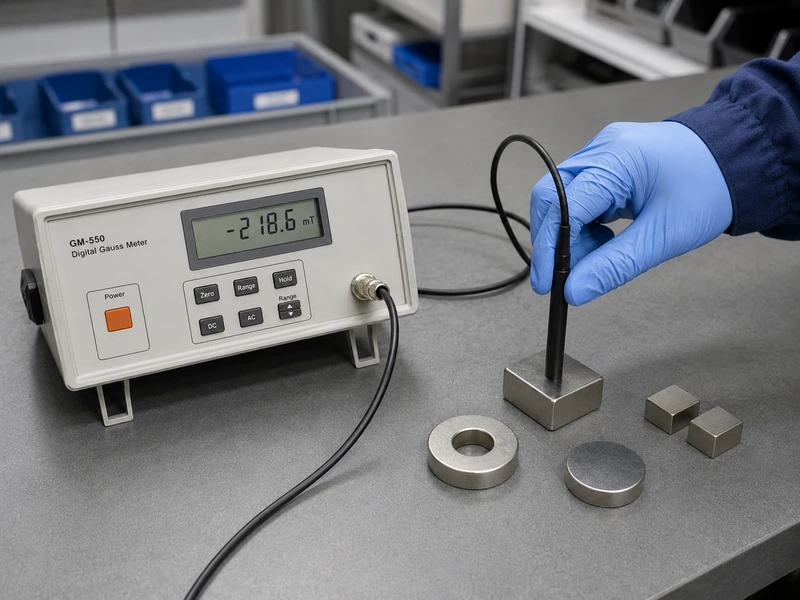
A higher surface reading does not automatically mean higher force at the actual working distance. Geometry, pole area, magnetization direction, gap and the return path through steel can change the result.

Likewise, a higher NdFeB grade is not automatically the better design choice. A higher grade may offer different Br or BHmax, but the final selection also has to survive the actual temperature, reverse field, geometry, coating, assembly and acceptance test. See grades of magnets and magnet Gauss for the narrower topics.
Why Working Distance, Air Gap and the Magnetic Circuit Matter
Magnetic performance changes as soon as the magnet leaves an idealized material-data sheet and enters a real product. The field decreases with distance, and the exact rate depends on geometry, magnetization and the surrounding magnetic circuit.
An air gap is especially important because air has much lower magnetic permeability than ferromagnetic steel. Adding a gap can increase magnetic reluctance and reduce the useful flux delivered to the target. Paint, plating, adhesive, a plastic wall, mechanical clearance or a curved mating surface can all become part of the effective gap.
Steel geometry matters too. A suitable steel back plate, pole piece or housing can redirect flux and change the field distribution. If the steel section saturates, however, simply adding more magnet material may produce much less benefit than expected.

If the requirement is “X Gauss at 5 mm” or “Y holding force through a cover,” specify the measurement point, gap stack, target material, target thickness, contact area and test orientation. Then evaluate the complete magnetic circuit rather than shopping by grade alone.
For designs where the field distribution is difficult to infer from simple geometry, OSENC’s confirmed project workflow allows magnetic-circuit review and magnetic field simulation for suitable projects.
How Temperature, Corrosion and Demagnetizing Fields Change Performance
Working temperature and Curie temperature are not interchangeable. The Curie temperature describes a fundamental material transition, while a practical magnet can suffer unacceptable reversible or irreversible magnetic loss well below that point depending on material, grade, geometry, permeance coefficient, opposing field and thermal history.
This is why “the application reaches 120°C” is not enough to finalize a grade. The design also needs the magnet geometry, magnetic circuit, duty cycle, surrounding field and acceptable change in performance. For the dedicated topic, see how temperature affects magnet strength.
Environment can create a different failure mode. Sintered NdFeB is normally protected with a coating or other surface treatment because corrosion can damage the magnet when moisture or chemicals reach the substrate. Coating choice therefore depends on exposure, abrasion, edges, dimensions, assembly process and temperature. Corrosion resistance is not the same as corrosion immunity.
See OSENC’s neodymium magnet coating guide when humidity, salt, chemicals or coating thickness can affect the design.
Can a Permanent Magnet Lose Its Magnetism?
Yes. A permanent magnet can lose useful magnetic performance, temporarily or irreversibly, if the operating condition pushes the magnetic system outside an acceptable range. Excessive temperature can reduce magnetic output and, depending on the material, grade and operating point, can cause irreversible loss. A sufficiently strong opposing magnetic field can also demagnetize the magnet.
Corrosion creates a different problem: material loss or coating failure can physically degrade the magnet and therefore change its usable performance. Severe mechanical damage can chip or fracture a brittle magnet or alter the assembly geometry; that does not automatically mean the magnetic material itself has been demagnetized, but the finished system may no longer meet its field or force requirement.
For a dedicated discussion of long-term loss mechanisms and what “permanent” really means, see Do Magnets Wear Out?
Magnetization Direction and Shape Are Not the Same Thing
A disc magnet is not automatically axially magnetized, and a ring is not automatically radial. Shape describes geometry. Magnetization describes the direction or pole pattern imposed on the magnet.
Depending on the design and manufacturing route, axial, diametrical, radial, multipole and other suitable custom magnetization patterns may be evaluated. The required pole layout should therefore be shown on the drawing instead of left to assumption.

Assembly can also change the real result. NdFeB and many other hard permanent-magnet materials are brittle. Clamping loads, impact, press fits, adhesive cure, coating damage, housing tolerance and magnet-to-magnet attraction can create mechanical failures even when the magnetic calculation is correct.
Show the magnetization direction, mating steel, adhesive or retention method and the critical assembly gaps on the same drawing. That gives the magnet supplier enough information to evaluate both the magnetic and mechanical interfaces.
Common Magnetism Misconceptions That Cause Specification Errors
Many magnet-selection mistakes begin with a statement that is partly true but incomplete. The engineering question is always what the statement means under the actual geometry, gap, temperature and test condition.
| Common misconception | Better engineering interpretation |
|---|---|
| “A higher grade always gives a stronger finished magnet.” | Higher material properties can help, but geometry, magnetization, air gap, magnetic circuit, temperature and available pole area can dominate the finished field or force. |
| “A high surface-Gauss value guarantees high pull force.” | Surface Gauss and pull force are different quantities. Pull force also depends on pole area, target steel, contact or gap, alignment and the test fixture. |
| “A nonmagnetic cover blocks the magnetic field.” | Many nonmagnetic layers do not act as magnetic shields, but they add working distance. That added gap can sharply reduce the usable field or force at the target. |
| “A permanent magnet cannot lose performance.” | Temperature, strong opposing fields, corrosion and unsuitable operating conditions can reduce usable magnetic performance; mechanical damage can also make the finished assembly fail its requirement. |
| “The magnet shape tells you its magnetization direction.” | Shape and magnetization are separate specifications. A disc, ring or block can require different pole directions or pole patterns depending on the application. |
How to Turn Magnetism Requirements Into a Purchasable Magnet Specification
For a real project, the useful question is not “Which magnet is strongest?” It is “Which magnetic system produces the required result under the real operating and acceptance conditions?”
- Part drawing, shape and dimensions.
- Critical dimensional tolerances and assembly clearances.
- Magnet material or grade target, if already specified.
- Required magnetization direction or pole layout.
- Working distance, air gap and nonmagnetic layers between magnet and target.
- Target or mating material, thickness and contact geometry.
- Operating temperature range and thermal cycle.
- Humidity, salt, chemicals, abrasion or other environmental exposure.
- Target field or force together with the exact measurement or pull-test condition.
- Assembly method, housing constraints and mechanical loads.
- Inspection or acceptance requirements and expected quantity.
OSENC can review drawings, samples and application requirements for suitable custom NdFeB magnet and magnetic-assembly projects. Depending on project scope, that review may include material/grade, coating, tolerances, magnetization, magnetic-circuit design, simulation, assembly and relevant inspection or magnetic testing.
How OSENC Can Validate a Magnetic Requirement
Depending on project scope, OSENC may use or discuss dimensional inspection, surface-field/Gauss checks, pull-force testing, coating inspection, salt-spray testing, magnetic-circuit review or FEA/simulation for suitable custom magnet and magnetic-assembly projects. A test name by itself is not an acceptance criterion: the method and condition must be defined before the result is meaningful.
| Requirement | Possible validation method | Define before validation |
|---|---|---|
| Dimensions and fit | Dimensional inspection | Drawing revision, critical dimensions, tolerances and measurement points. |
| Surface or working-position field | Gauss / field check | Probe type, probe position, orientation, air gap, temperature and magnet condition. |
| Holding or pull requirement | Pull-force testing | Target material and thickness, contact area, gap, pull direction, alignment and fixture. |
| Coating requirement | Coating inspection; salt-spray testing where applicable | Coating system, exposure or test condition, acceptance criteria and any dimensional effect. |
| Field distribution in an assembly | Magnetic-circuit review or FEA/simulation | Geometry, material assumptions, magnetization, air gaps, operating condition and the output that must be evaluated. |
Validation scope is project-specific. It should be agreed from the drawing, application requirement and acceptance criteria rather than inferred from a generic article.
For OSENC’s broader inspection and testing context, see Quality Management.
FAQ About Magnets and Magnetism
What is the difference between a magnet and magnetism?
A magnet is a material or object that produces a magnetic field. Magnetism is the physical phenomenon associated with magnetic fields and magnetic forces. In engineering, the magnet is the component you specify, while magnetism describes how that component interacts with its surroundings.
What causes magnetism in a permanent magnet?
Permanent magnetism comes from the magnetic behavior of electrons and the ordered magnetic structure of the material. In ferromagnetic materials, magnetic moments can align in domains, and suitable permanent-magnet materials are processed so useful magnetization remains after the external magnetizing field is removed.
What determines how strong a magnet is?
There is no single strength value. Material properties such as Br, Hcb, Hcj and BHmax matter, but finished performance also depends on geometry, magnetization, working distance, air gap, target material, steel return path, temperature and the test method.
Does a higher neodymium grade always produce a better magnet?
No. A higher grade may provide higher magnetic material properties, but it is not automatically the best choice for every design. Temperature resistance, coercivity, geometry, available space, magnetic circuit, coating, assembly and the required acceptance test must also be considered.
Is surface Gauss the same as pull force?
No. Surface Gauss is a magnetic flux-density reading at a defined probe location. Pull force is a mechanical result under a defined contact or gap condition. Two magnets with similar surface readings can produce different pull forces because geometry, pole area, air gap, steel thickness and the test setup are different.
Can a permanent magnet lose its magnetism?
Yes. Excessive temperature, a sufficiently strong opposing magnetic field, corrosion or an unsuitable operating condition can reduce useful magnetic performance. Mechanical damage can also chip or fracture a brittle magnet or change the assembly geometry, even when the magnetic material itself has not been demagnetized.
Need to Convert a Magnetic Requirement Into a Custom Magnet Specification?
Send the drawing, dimensions, working gap, target material, temperature, environment, magnetization direction and the field or force acceptance condition. OSENC can use those inputs to review the magnetic design before quotation or sample validation.
Request an Engineering Review