What Are the Main Types of Magnets?
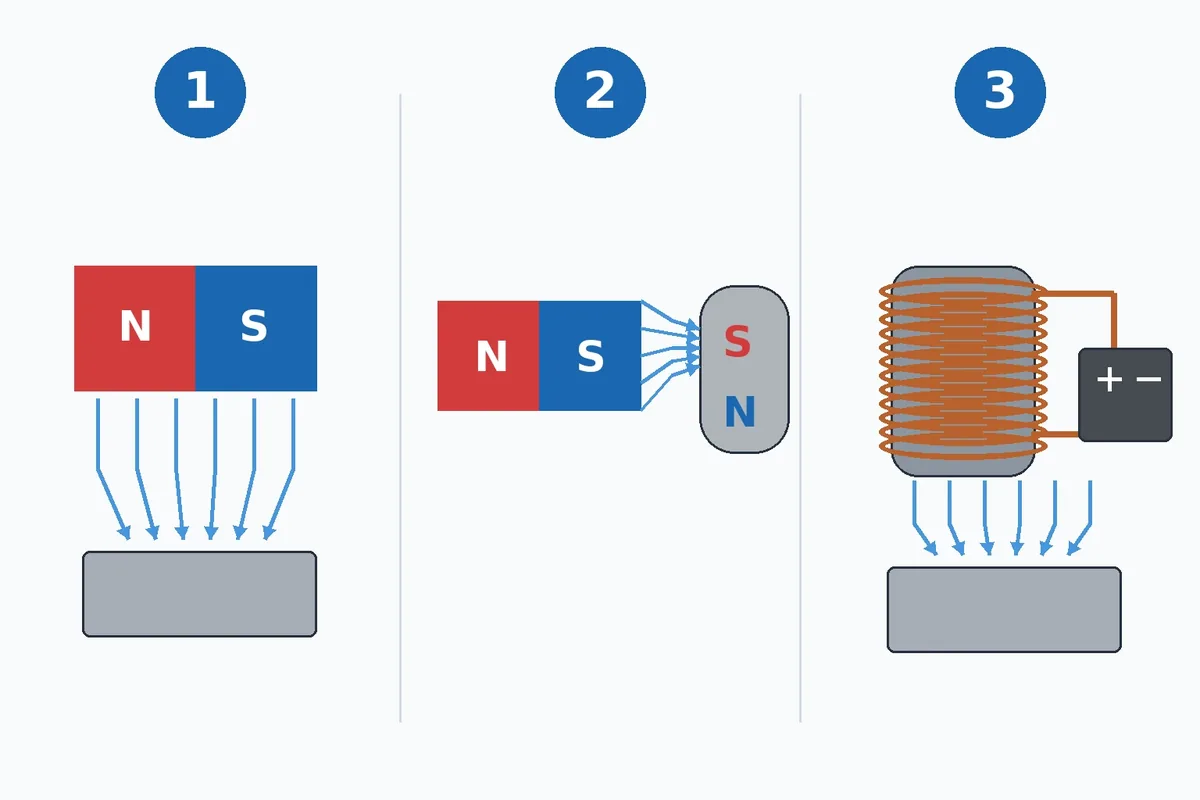
Most practical explanations group magnets into three main types based on how the magnetic field is produced or retained: permanent magnets, temporary or induced magnets, and electromagnets.
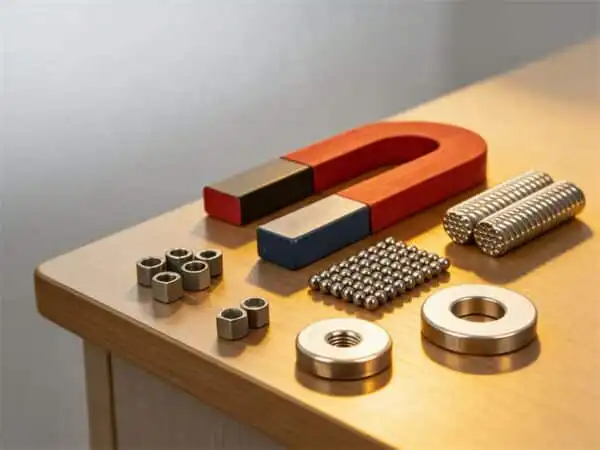
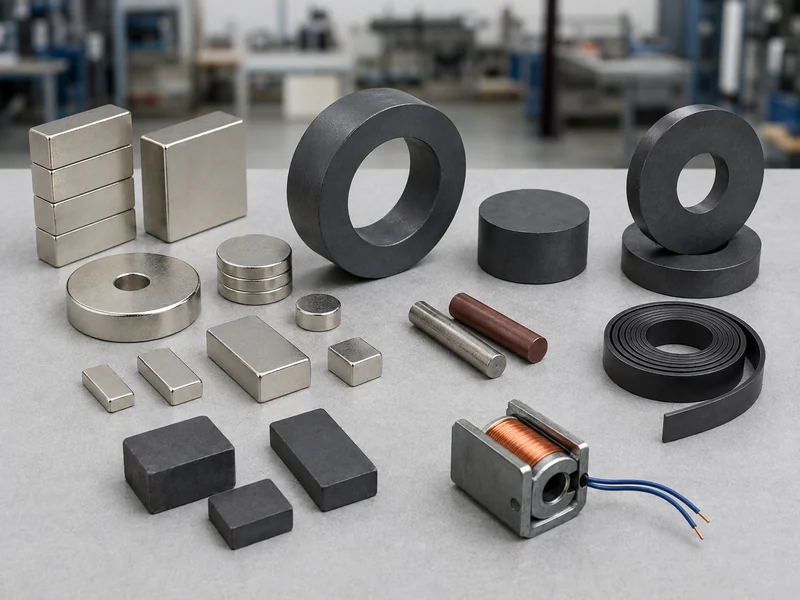
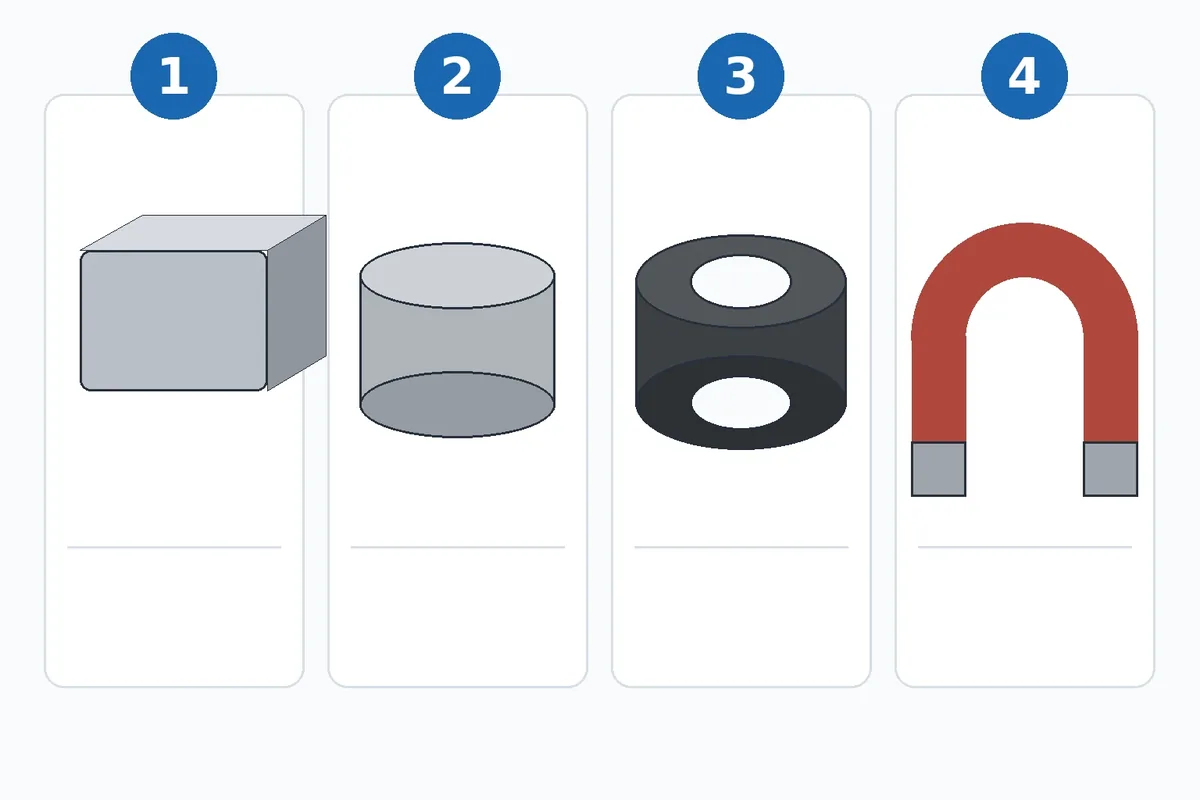
For engineering and purchasing, permanent magnets are then divided by material. The four major commercial permanent magnet families are neodymium iron boron (NdFeB), samarium cobalt (SmCo), ferrite or ceramic, and Alnico.
These are different classification systems. A disc, ring, block, bar, or horseshoe magnet describes shape, not a fundamental magnet type. Likewise, “artificial magnet” describes origin rather than a single engineering material.
How Many Types of Magnets Are There?
There is no useful single number until the classification method is defined.
If the question is about magnetic behavior, three categories are the clearest starting point:
- Permanent magnets
- Temporary or induced magnets
- Electromagnets
If the question is about commercial permanent magnet materials, buyers usually compare four families: NdFeB, SmCo, ferrite, and Alnico.
Some lists claim five, seven, or even ten types of magnets because they mix material families, shapes, magnetic systems, and applications into one list. That may be convenient for a classroom chart, but it is a poor way to make an engineering decision.
The National MagLab explains the distinction between permanent, temporary, and electromagnet-based magnetic behavior. For procurement, the next step is not to count more categories. It is to identify which field source and permanent-magnet material fit the working conditions.
The 3 Main Types of Magnets by Magnetic Behavior
| Magnet type | How the field is produced | What happens without the source | Engineering reason to use it |
|---|---|---|---|
| Permanent magnet | Magnetized hard magnetic material retains remanence | Continues producing a field, but can still be demagnetized by adverse conditions | Compact, passive magnetic field without continuous electrical power |
| Temporary / induced magnet | A magnetically soft material becomes magnetized in an external field | Most induced magnetization falls away when the external field is removed, although some remanence can remain | Flux guidance, cores, and systems where low coercivity is useful |
| Electromagnet | Electric current in a coil creates the field, often with a ferromagnetic core | Field drops when current is removed; residual magnetism may remain in the core | Switchable or controllable field where power, heat, and controls are acceptable |
Permanent Magnets
A permanent magnet retains useful magnetization after the magnetizing field is removed. “Permanent” does not mean impossible to demagnetize. Excessive temperature, a strong opposing magnetic field, an unfavorable magnetic circuit, mechanical damage, or material degradation can reduce performance.
For an OEM project, the material family is only the first decision. Geometry, grade, magnetization direction, air gap, return path, coating, assembly method, and acceptance test can all change the finished result.
For a deeper definition, see OSENC’s guide to permanent magnets.
Temporary or Induced Magnets
Temporary magnetism is produced when a magnetically soft material is exposed to an external magnetic field. The material is selected to magnetize and demagnetize relatively easily, which is useful in cores and flux-guiding components.
This should not be confused with an electromagnet. A temporary or induced magnet describes the behavior of the magnetic material. An electromagnet describes a system in which electric current creates the magnetic field.
Electromagnets
An electromagnet uses current flowing through a coil to create a magnetic field. The field can be controlled by electrical input and by the magnetic circuit, including the coil geometry, core, air gap, and return path.
The advantage is controllability, not a universal promise of “more strength.” Current, coil turns, heat generation, duty cycle, power electronics, core saturation, and the working gap all limit the usable field. Permanent magnets remain preferable where a passive field, compact packaging, or zero continuous electrical power is more important.
The 4 Main Permanent Magnet Material Families
For B2B selection, this is where “types of magnets” becomes commercially useful.
| Permanent magnet material | Relative magnetic performance | Temperature / demagnetization behavior | Corrosion behavior | Typical decision logic |
|---|---|---|---|---|
| NdFeB | Highest magnetic performance among common commercial permanent magnets | Grade, geometry, operating point, temperature, and opposing fields must be reviewed together | Usually needs suitable surface protection in corrosive or humid service | Strong candidate when space is limited and high magnetic output is required |
| SmCo | High magnetic performance | Often selected for demanding temperature stability and coercivity requirements | Generally strong corrosion resistance, but environment still matters | Evaluate when thermal stability or harsh service outweighs material cost |
| Ferrite / ceramic | Lower energy density than rare-earth magnets | Stable in many common environments, but geometry and very low temperature can affect demagnetization margin | Inherently corrosion resistant in many environments | Strong candidate when cost, corrosion resistance, and larger available volume matter more than compact power density |
| Alnico | High remanence with excellent temperature stability | Lower coercivity than modern rare-earth magnets makes magnetic-circuit design important | Generally corrosion resistant | Useful where temperature stability and a favorable closed magnetic circuit matter more than high demagnetization resistance |
The U.S. Department of Energy’s Ames Laboratory identifies NdFeB as the strongest widely used permanent magnet family, with SmCo next in magnetic strength. That does not mean NdFeB is automatically the best material for every project.
Neodymium Iron Boron (NdFeB)
NdFeB is usually the first material evaluated when a design needs high magnetic output in limited space. Its high energy density can reduce magnet volume compared with lower-energy materials.
The limiting factors are just as important as the strength advantage. NdFeB is brittle, its corrosion resistance often requires a suitable coating or protective design, and temperature-related demagnetization depends on the specific grade and operating point. A higher N-number is not a substitute for checking coercivity, temperature exposure, geometry, and the magnetic circuit.
Use the OSENC magnet grade guide and neodymium magnet coating guide for the next layer of selection.
Samarium Cobalt (SmCo)
SmCo combines high magnetic performance with strong temperature stability and generally good corrosion resistance. It is often evaluated when an NdFeB design has insufficient thermal or demagnetization margin.
The tradeoff is not merely price. SmCo is also brittle, and the exact material grade, geometry, mechanical support, and service temperature still need engineering review. “High-temperature magnet” is not a complete specification.
Ferrite or Ceramic Magnets
Ferrite magnets are widely used because the raw materials are comparatively economical and the magnet is naturally resistant to corrosion in many environments. The main cost of choosing ferrite is usually magnetic volume. Lower energy density often means the design needs a larger magnet or a different magnetic circuit to reach the same working-field target.
Ferrite is also brittle. In addition, some ferrite designs can lose demagnetization margin at very low temperature, so cold service should not be treated as automatically harmless.
Alnico Magnets
Alnico is valued for high remanence, very good temperature stability, and corrosion resistance. Its major engineering limitation is relatively low coercivity compared with modern rare-earth permanent magnets.
That means geometry and magnetic-circuit conditions matter strongly. An open circuit, short magnetic length, or strong opposing field can push an Alnico design toward demagnetization. Alnico can be an excellent choice in the right circuit, but selecting it only because “it handles high temperature” skips the most important design constraint.
When Is Each Permanent Magnet Material a Strong Candidate?
A useful comparison should not stop at “stronger,” “cheaper,” or “higher temperature.” The better question is whether a material family fits the magnetic job, available geometry, environment, demagnetization risk, and cost structure of the project.
| Material | Strong candidate when | Reconsider when |
|---|---|---|
| NdFeB | Compact packaging and high magnetic output are important, and the design can manage the required temperature, corrosion protection, and demagnetization margin. | The environment is highly corrosive, the thermal or opposing-field margin is unfavorable, or the application has enough volume that a lower-energy material may meet the requirement more economically. |
| SmCo | Thermal stability, coercivity, and corrosion resistance are important enough to justify a higher material cost. | The application does not need those advantages, or brittleness, cost, and manufacturing constraints outweigh the magnetic benefit. |
| Ferrite / ceramic | Cost and corrosion resistance matter, and the design has enough volume to work with a lower energy density. | Space is tight, working-distance field is demanding, or the assembly needs high magnetic output from a small magnet volume. |
| Alnico | Temperature stability is important and the magnetic circuit can support a material with high remanence but comparatively low coercivity. | The magnet will operate with a large open circuit, strong opposing fields, or conditions where irreversible demagnetization resistance is the dominant requirement. |
Natural vs. Artificial Magnets
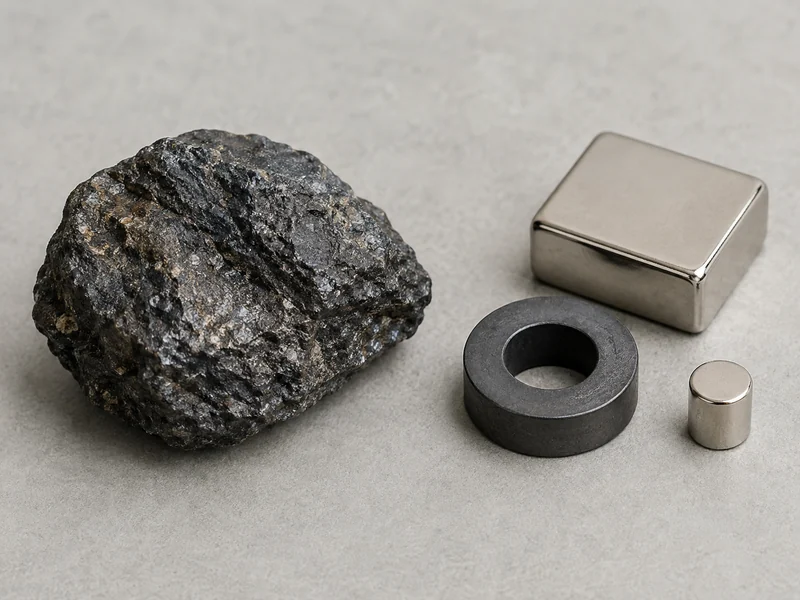
A natural magnet occurs in nature, with lodestone or magnetite being the classic example. An artificial magnet is a human-made magnetic material or device.
This origin-based classification is useful for basic education, but it is not precise enough for purchasing. An engineered permanent magnet can be artificial, and an electromagnet is also human-made. A buyer still needs to specify the actual material, geometry, magnetization, operating condition, and required magnetic result.
Are Disc, Ring, Block, Bar, and Horseshoe Magnets Different Types?
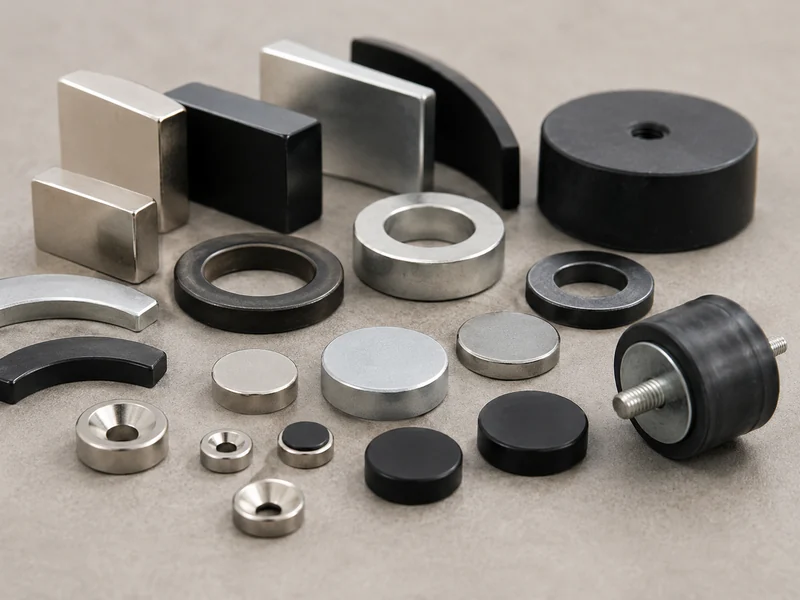
They are different shapes, not different fundamental magnetic material classes.
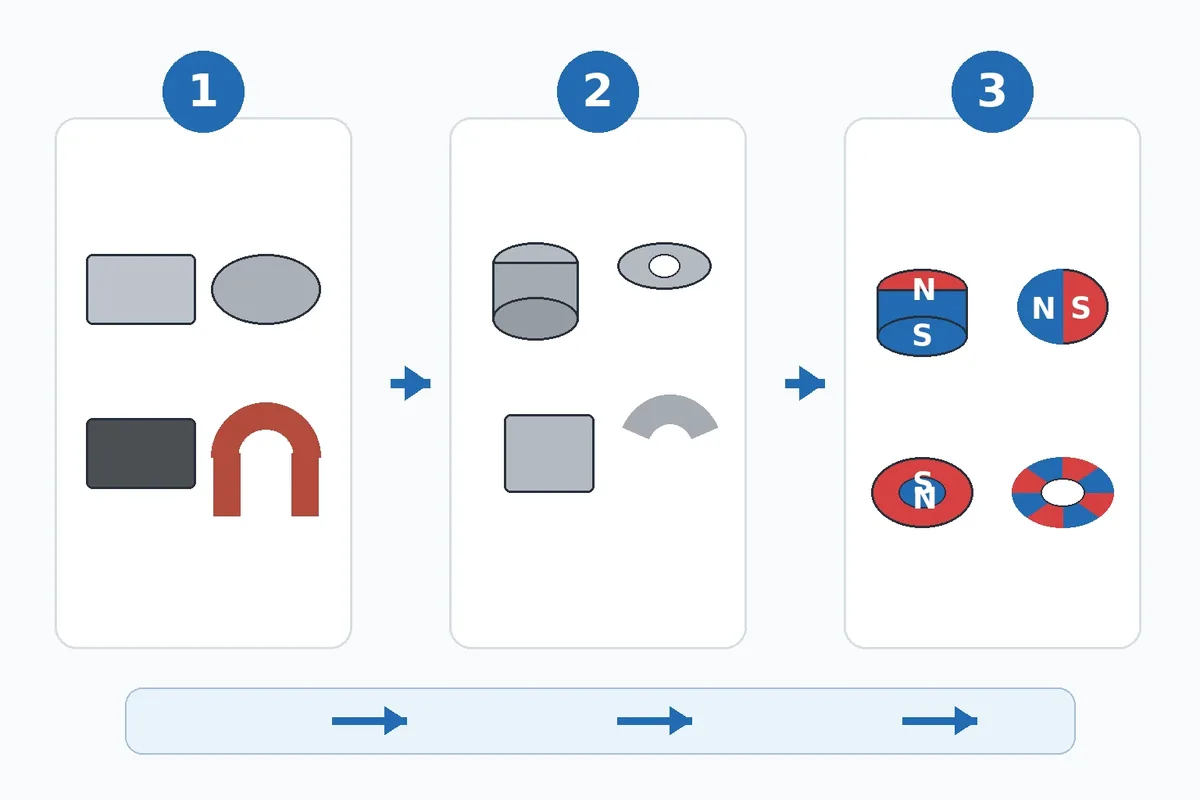
Shape still matters because geometry changes the magnetic circuit and field distribution. A thin disc, long bar, ring, arc segment, and block made from the same grade can produce very different surface fields and working-distance fields.
Magnetization direction is a separate variable again. A ring magnet may be axially, diametrically, radially, or multipole magnetized depending on the design. See OSENC’s guide to magnetic field and magnetization direction.
For common NdFeB geometries, see disc magnets, block magnets, and ring magnets.
What Actually Determines Magnet Performance?
The material name is only the beginning. Finished magnetic performance comes from the interaction of material properties and the complete magnetic circuit.
Grade is not finished performance
For NdFeB, a grade identifies a material-performance band. It does not directly specify the finished magnet’s pull force, surface field, working-distance field, or temperature margin.
- Br (remanence): residual flux density after magnetization under defined conditions.
- Hcb (normal coercivity): coercive field related to the normal demagnetization curve.
- Hcj (intrinsic coercivity): resistance to irreversible demagnetization and especially important when temperature or opposing fields are concerns.
- BHmax (maximum energy product): a material figure of merit that describes energy density on the demagnetization curve.
Higher BHmax can help reduce magnet volume, but a higher grade is not automatically the better design if Hcj, temperature margin, geometry, or cost moves in the wrong direction.
A U.S. Department of Energy technical report describes remanent induction as a measure of permanent-magnet strength, intrinsic coercivity as resistance to demagnetization, and energy product as an indicator related to magnet sizing. Those are material properties, not finished-assembly performance values.
Surface Gauss is not pull force
Surface Gauss measures magnetic flux density at or near a defined point. Pull force measures mechanical force under a specific fixture and target condition. Working-distance field measures flux density at the actual gap where the system operates.
A magnet with a high surface reading can still perform poorly at the required distance if geometry, pole layout, air gap, or the return path is unfavorable. Likewise, two pull-force numbers are not comparable unless target steel, thickness, contact condition, pull direction, air gap, magnet geometry, and test method are sufficiently similar.
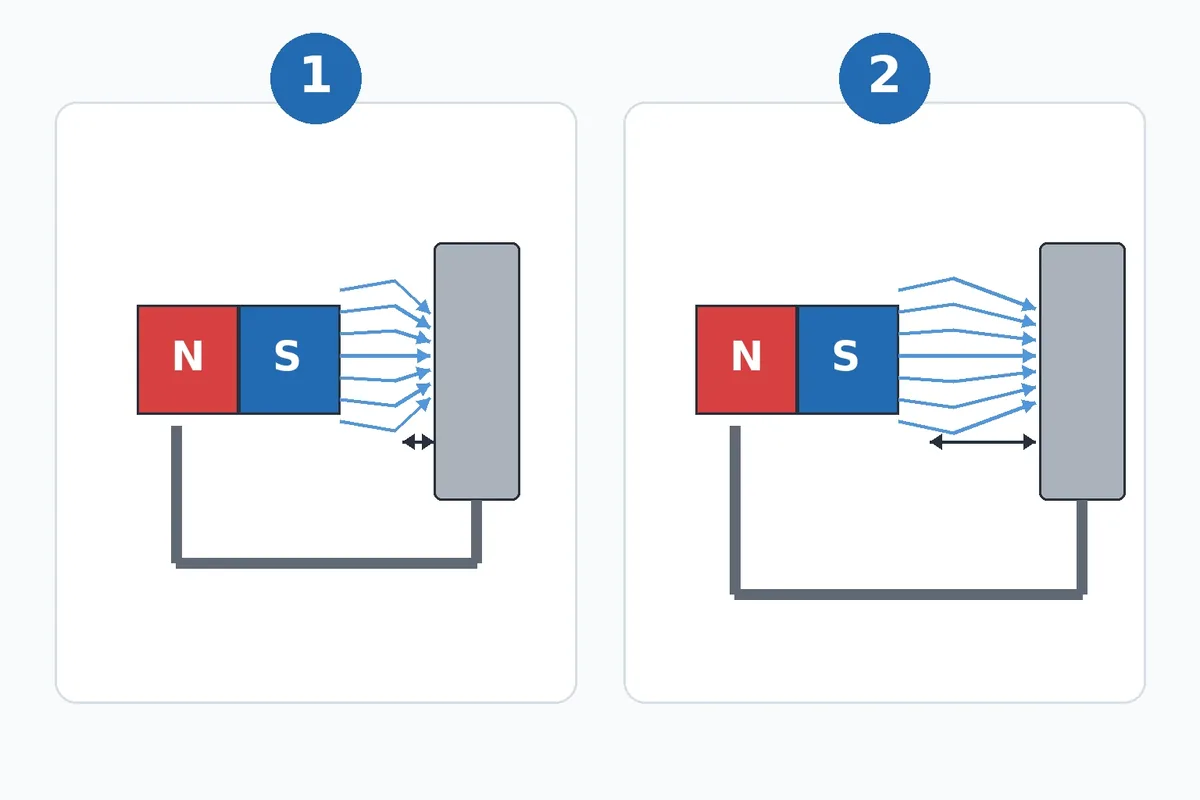
Air gap and magnetic circuit can dominate the result
Paint, adhesive, plastic walls, coatings, assembly clearances, rough contact surfaces, and mechanical spacers all create effective air gap. Even a small gap can reduce usable force substantially.
MIT magnetic-circuit notes model a permanent magnet driving an air gap and show why gap geometry and circuit reluctance materially affect the operating point and usable flux. This is why air gap belongs in the selection process rather than being treated as a minor installation detail.
- Define the required field or force at the real working position.
- Define the available geometry and target material.
- Estimate the magnetic circuit and air gap.
- Select the material family and candidate grade.
- Check temperature, opposing fields, corrosion, and assembly risk.
- Verify with simulation, samples, or a defined test method as appropriate.
How to Choose the Right Type of Magnet for an Engineering Project
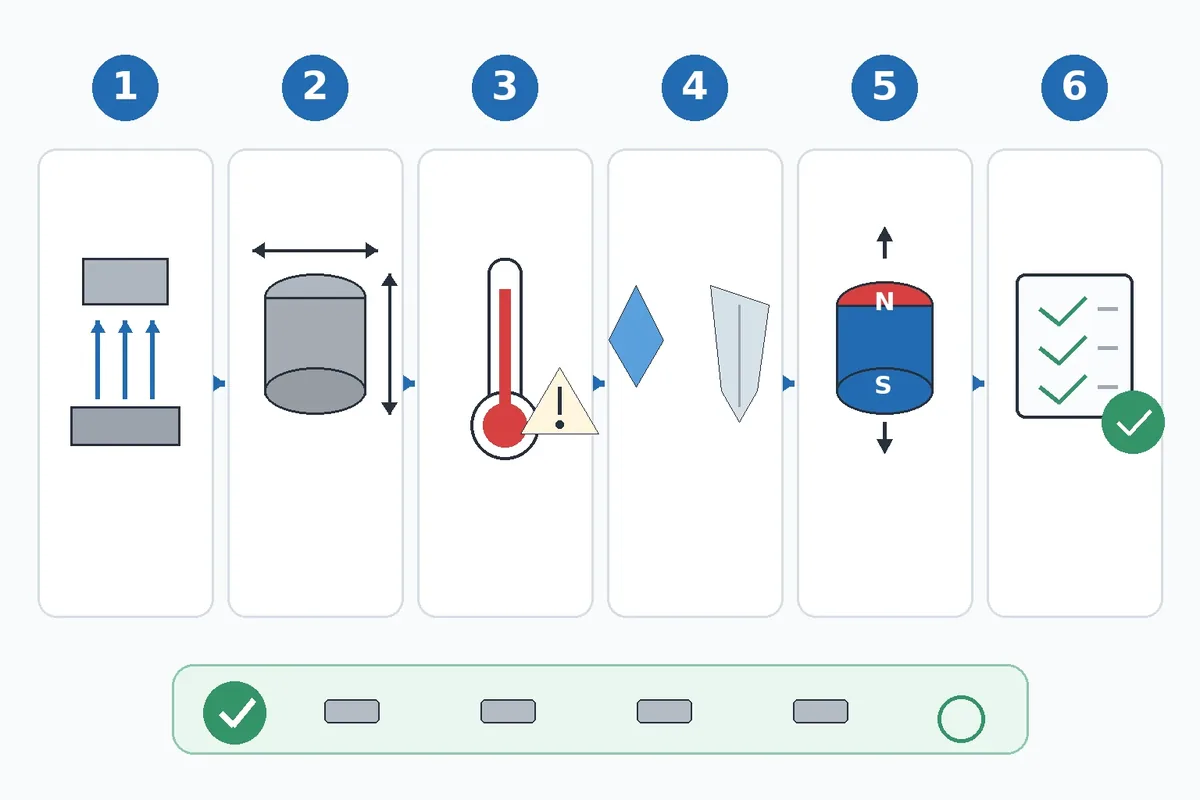
A reliable selection starts from the operating condition, not from a favorite grade.
1. Define the magnetic job
Specify whether the magnet must hold, sense, actuate, couple, separate, position, or create a field across a gap. If force matters, define the load direction and target material. If field matters, define the measurement location and working distance.
2. Check space and geometry
Available diameter, thickness, length, hole position, pole face, and steel return path can eliminate otherwise attractive materials. Geometry also changes the operating point and demagnetization margin.
3. Define the thermal and magnetic environment
Record normal operating temperature, peak temperature, duration, thermal cycling, and any opposing magnetic field. Curie temperature is not the same as a safe working temperature. The actual grade, geometry, operating point, and exposure history determine the usable margin.
For deeper temperature selection, see how temperature affects magnet strength.
4. Define corrosion and protection requirements
Humidity, salt, chemicals, abrasion, sterilization, cleaning processes, and coating damage can change the material or coating decision. A coating reduces corrosion risk only when the coating system and finished-part integrity match the environment. It does not make every magnet corrosion-proof.
Open-access research on sintered NdFeB magnets and anticorrosion coatings describes the corrosion susceptibility of Nd-rich phases and the role of protective coatings. The suitable coating still depends on the actual environment and lifecycle requirements.
If corrosion is a concern, OSENC’s guide on why neodymium magnets rust explains the failure path in more detail.
5. Define magnetization and assembly
Magnetization direction and pole layout must match the final magnetic circuit. Adhesive bond lines, press fits, steel housings, plastic overmolding, and assembly clearances can also change magnetic and mechanical performance.
Sintered NdFeB, SmCo, ferrite, and many Alnico forms are brittle materials. Assembly loads should be designed to avoid edge chipping, cracking, uncontrolled snap-together impact, and coating damage.
6. Define how success will be verified
The verification method should match the failure mode. Depending on the project, useful checks can include dimensional inspection, magnetic field measurement at a defined point, pull-force testing under defined conditions, coating inspection, corrosion testing, or assembly-level validation.
A catalog number or a surface Gauss target alone cannot create a final magnet specification.
What Information Can Change the Magnet Specification?
The application name alone is not enough to determine an exact magnet. The inputs below are more useful because each one can change material family, grade, geometry, coating, magnetization, assembly, or verification.
| Engineering input | Why it matters | What to provide |
|---|---|---|
| Magnetic job | Holding, sensing, coupling, actuation, separation, or field generation can require different field shapes and acceptance methods. | Required function, load direction, sensing point, or target condition. |
| Working distance / air gap | Usable field and force can change sharply as the gap and magnetic circuit change. | Installed gap, nonmagnetic layers, coatings, adhesive thickness, and target material. |
| Available geometry | Diameter, thickness, length, pole area, holes, and steel return paths affect the operating point and magnet volume. | Drawing, dimensional envelope, interfaces, and surrounding ferromagnetic parts. |
| Temperature profile | Normal temperature, peak temperature, duration, thermal cycling, and opposing fields affect irreversible demagnetization margin. | Normal and peak temperature, exposure duration, and relevant magnetic or thermal cycling. |
| Environment | Humidity, salt, chemicals, abrasion, and cleaning conditions affect material and surface-protection decisions. | Exposure conditions and expected service environment. |
| Magnetization | Axial, diametrical, radial, or multipole layouts create different field directions and may change manufacturing feasibility. | Required pole orientation, pole count, and relationship to the final assembly. |
| Assembly method | Steel housings, adhesives, press fits, overmolding, clearances, and impact loads can change magnetic and mechanical performance. | Housing material, bond line, fit, overmolding, and assembly process. |
| Verification target | A specification is only useful when the acceptance method matches the actual failure mode. | Field measurement position, pull-force fixture, dimensional criteria, coating criteria, or assembly-level test condition. |
What to Send OSENC for a Custom NdFeB Review
OSENC focuses on custom neodymium magnets and magnetic assemblies. To make a project inquiry technically useful, start with the conditions that can change the finished specification rather than selecting a grade from the application name alone.
1. Geometry & Magnetic Circuit
Send the drawing or dimensional envelope, working gap, target material, nearby steel parts, and critical assembly interfaces.
2. Magnetic Requirement
Define the required field or force at the real working position, including measurement location, load direction, and target condition.
3. Environment & Assembly
Include normal and peak temperature, corrosion exposure, coating constraints, magnetization direction, housing, adhesive, overmolding, or press-fit conditions.
4. Acceptance Condition
State how the project will be accepted: dimensions, field at a defined point, pull-force fixture, coating requirement, sample comparison, or assembly-level result.
A final magnet specification should be confirmed against project-specific drawings, samples, calculations, or test evidence as appropriate. A surface Gauss target or a grade name by itself is not enough.
Send Your Drawing for Custom NdFeB ReviewRelated Engineering Guides
Use these guides when the project moves from general magnet type to a specific engineering decision.
Magnet Grades
Understand what grade labels do and do not tell you about finished performance.
Temperature & Magnet Strength
Review working temperature, irreversible loss, coercivity, and why Curie temperature is not a safe-use limit.
Neodymium Magnet Coatings
Compare surface-protection choices against the actual corrosion and assembly environment.
Magnetization Direction
Separate axial, diametrical, radial, and multipole magnetization from material family and geometry.
FAQ
What are the three main types of magnets?
The three main types are permanent magnets, temporary or induced magnets, and electromagnets. This classification is based on how the magnetic field is produced or retained.
What are the four main types of permanent magnet materials?
The four major commercial families are NdFeB, SmCo, ferrite or ceramic, and Alnico. They differ in magnetic performance, coercivity, temperature behavior, corrosion resistance, cost, and design constraints.
Why do some sources list 5, 7, or 10 types of magnets?
Those lists usually mix different classification systems. They may count shapes, materials, natural versus artificial magnets, flexible magnets, superconducting systems, or application-specific magnetic devices as separate “types.” For engineering work, keep material, shape, field source, and magnetization as separate variables.
What is the strongest type of permanent magnet?
NdFeB offers the highest magnetic performance among common commercial permanent magnet materials. But “strongest” does not automatically mean “best.” Temperature, demagnetization margin, corrosion, available space, air gap, assembly, and cost can change the correct choice.
Is magnet shape the same as magnet type?
No. Disc, ring, block, arc, bar, and horseshoe describe geometry. NdFeB, SmCo, ferrite, and Alnico describe permanent-magnet material families. Axial, diametrical, radial, and multipole describe magnetization. Keeping those variables separate makes selection and sourcing more precise.
Is an artificial magnet the same as a permanent magnet?
No. “Artificial” only means human-made. An artificial magnet may be a manufactured permanent magnet or another engineered magnetic device. The term does not identify the material or magnetic performance.
Which magnet type is best for high temperature?
There is no universal answer from temperature alone. SmCo and Alnico are often evaluated for demanding temperature conditions, while high-coercivity NdFeB grades can also be suitable in many elevated-temperature designs. The correct choice depends on the actual temperature profile, geometry, operating point, opposing field, required magnetic output, and environment.