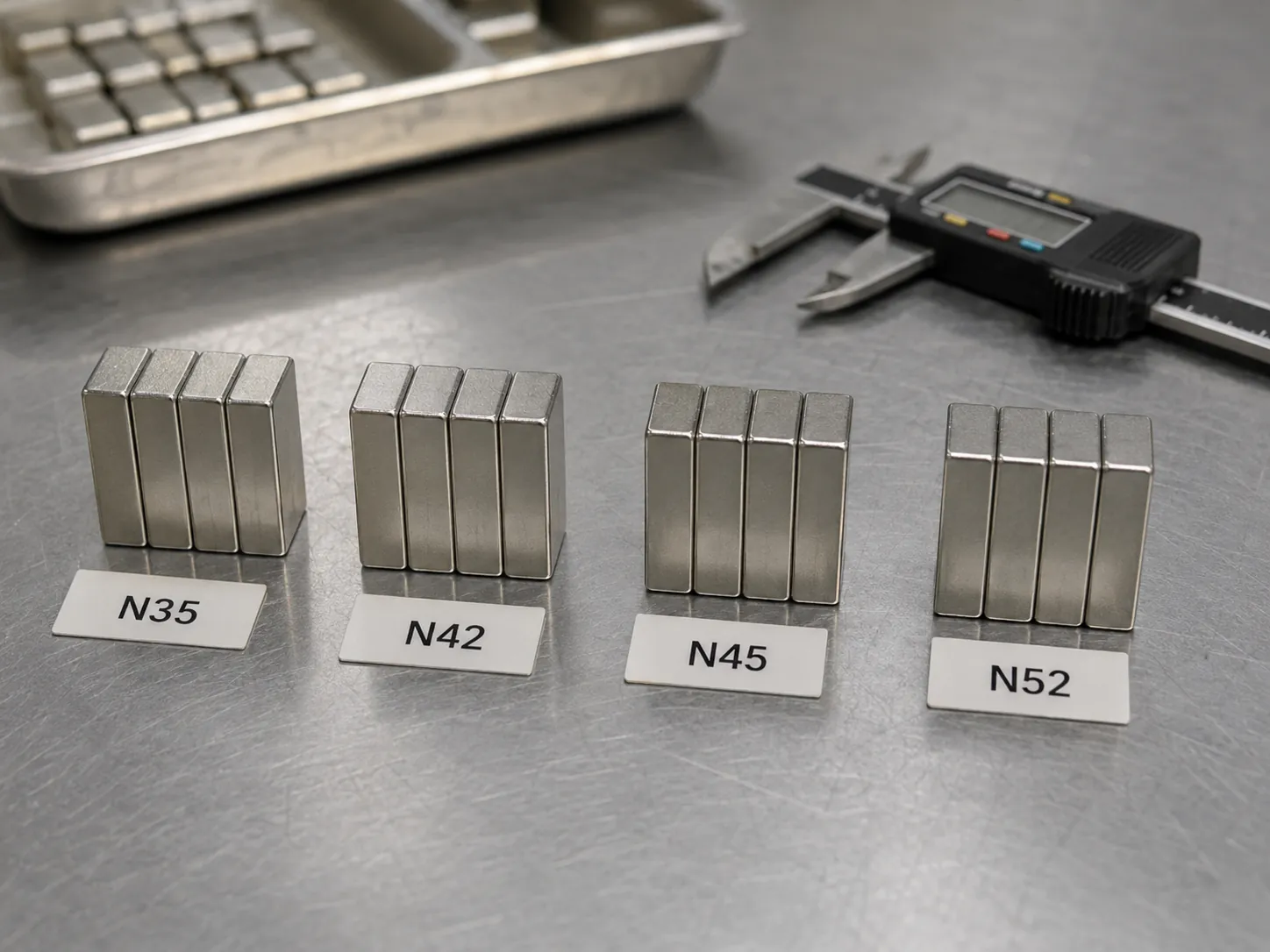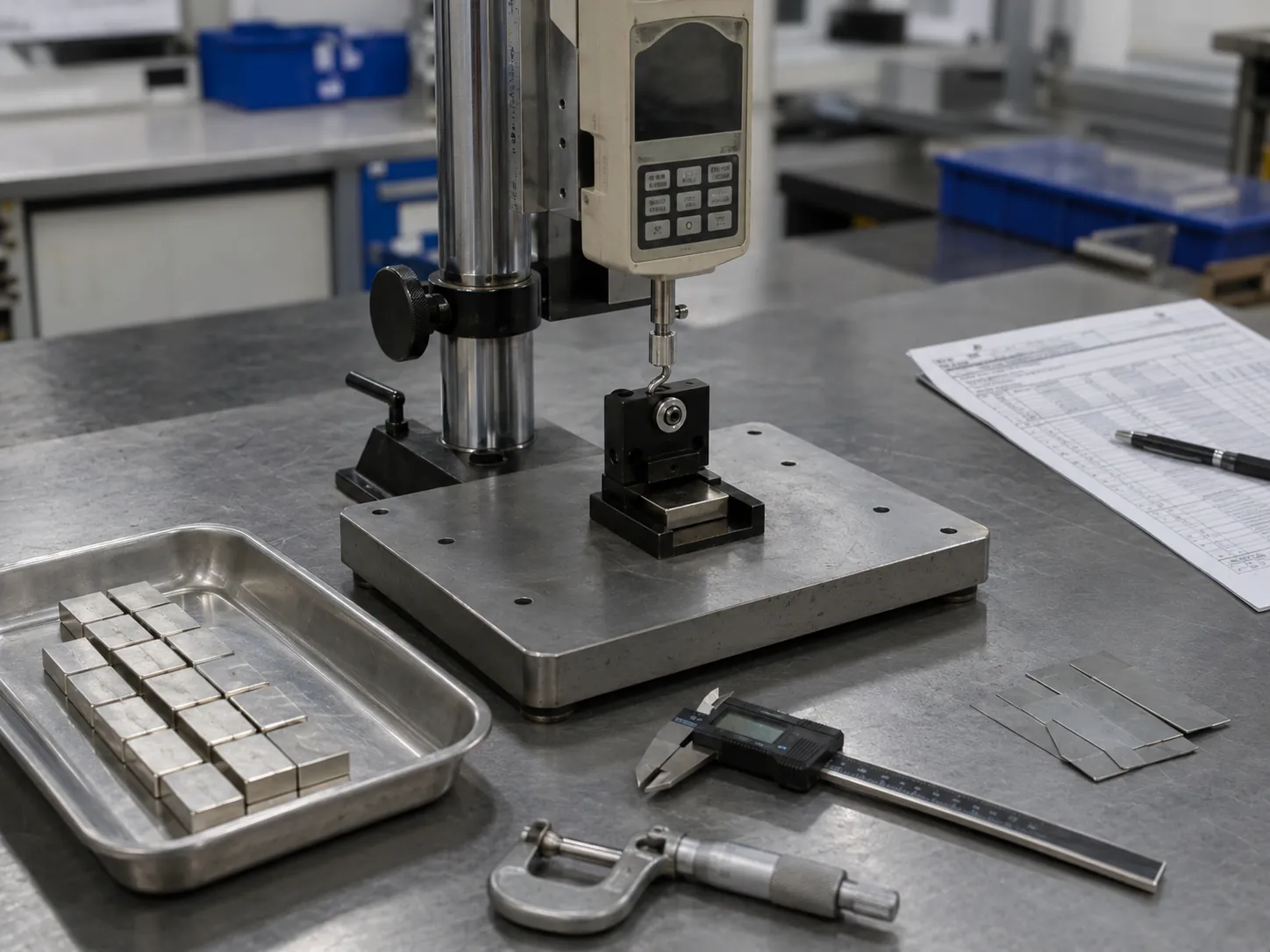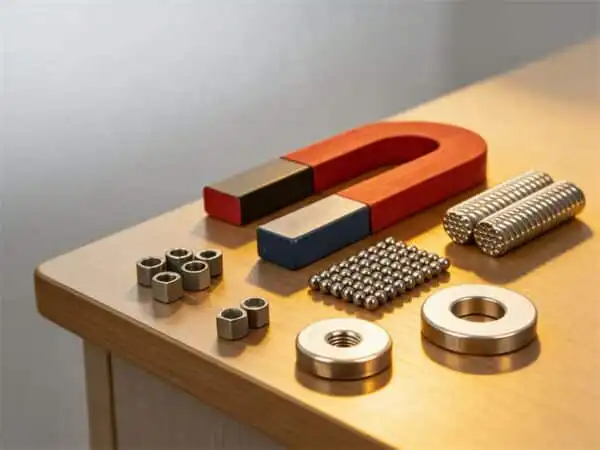
Magnets come in various grades, especially for neodymium magnets (NdFeB). The term “magnet grades” typically refers to the material’s (BH)max or maximum energy product, which is a key value for comparing the strength of neodymium magnet grades. While magnet grades are a reliable indicator of material strength, they do not directly equate to pull force, as other factors such as geometry and surface conditions play a significant role.
In practical applications, I use the grade as an initial filter, then refine the choice based on the magnet’s volume, air gap, coating thickness, and the steel surface’s condition. A “high-grade” magnet may still underperform if the contact conditions differ from the test standards.
Quick Answer: Magnet Grades Explained
Neodymium magnets (NdFeB) are graded by their (BH)max (maximum energy product, MGOe). Higher grades, such as N42 or N52, indicate stronger material, but actual pull force depends on factors like geometry, air gap, coating thickness, and the steel surface condition (e.g., flat, clean steel vs. thin or painted steel).
If you see suffix letters like M / H / SH / UH / EH / AH, those are magnet temperature grades. They primarily increase resistance to irreversible demagnetization in hot environments. In my experience, temperature is the #1 reason a magnet that “passed bench tests” later disappoints in real equipment—especially near motors, enclosed housings, or anything that heat-soaks over time.
What Are Magnet Grades?
Magnet grades are a standard way to describe the material performance level of a magnet. For neodymium magnets (NdFeB), grades are usually written as N + a two-digit number, sometimes with extra letters (for example: N42SH).
A common misunderstanding: “N” is a naming convention used for NdFeB grades in the market (it’s not a physics unit), and the number is tied to the magnet’s (BH)max range, usually shown in MGOe. As a general rule, a higher number often means a stronger magnetic material for the same magnet volume, but each grade has an allowed range, not a single fixed value.
From a sourcing/testing angle, treat “grade” like a material spec band—then use real pull force tests (or FEA) for the final design decision.
Neodymium Magnet Grades Chart
| Grade | Typical (BH)max Range (MGOe) | Typical Max Operating Temp (Standard) | Practical Selection Tip |
|---|---|---|---|
| N35 | 33–35 | ≤ 80°C | Good baseline for general use |
| N42 | 40–42 | ≤ 80°C | Best balance for most designs |
| N45 | 43–46 | ≤ 80°C | More strength without jumping to N52 |
| N52 | 49–52 | ≤ 80°C | Use when space is tight and max strength matters |
Real-world note: This chart compares neodymium magnet grades by their material strength. If your product operates above ~60–70°C, don’t just upgrade to N52—choose the appropriate magnet temperature grade (e.g., H/SH/UH/EH/AH) to prevent irreversible loss.

How to Choose the Right Neodymium Magnet Grade for Your Application
When selecting the right magnet grade, it’s essential to match the grade to your application. For example, if space is tight, N52 is the best choice as it provides maximum strength in a compact form. However, for general use, N35 or N42 may be more suitable. If high temperatures are involved, ensure to select a magnet temperature grade like N42H or N52H, which provides greater resistance to irreversible demagnetization.
| Your Application | Recommended Magnet Grade | Why |
|---|---|---|
| Standard use, no heat | N35, N42 | Cost-effective, good strength-to-size ratio |
| Small space, high strength | N52 | Maximizes strength in tight spaces |
| High heat environment | N42H, N52H | Temperature stability is critical |
| Moderate heat and space | N45, N50 | Balanced strength and size for most applications |
If space is tight → choose N48–N56
If air gap exists → reduce gap first / increase contact area
If temperature is uncertain → move up suffix grade first (M/H/SH/UH/EH/AH) and test sample.
How to Read a Neodymium Magnet Grades Chart
When you compare neodymium magnet grades (or any magnet grades chart), these three values matter most:
1) (BH)max (Maximum Energy Product, MGOe)
This is the key value behind Nxx grades. Higher (BH)max generally means the NdFeB material can deliver more magnetic energy per unit volume.
2) Br (Remanence, typically in Tesla or Gauss)
Br reflects how much magnetic flux density the material can produce at full magnetization. In practice, higher Br often correlates with stronger surface field trends (all else equal).
3) Hcj (Intrinsic Coercivity, kOe or kA/m)
Hcj shows resistance to demagnetization—especially important with heat, vibration, and opposing magnetic fields. In real assemblies (motors, speakers, compact mechanisms), coercivity is often the hidden limiter, not the headline grade number.
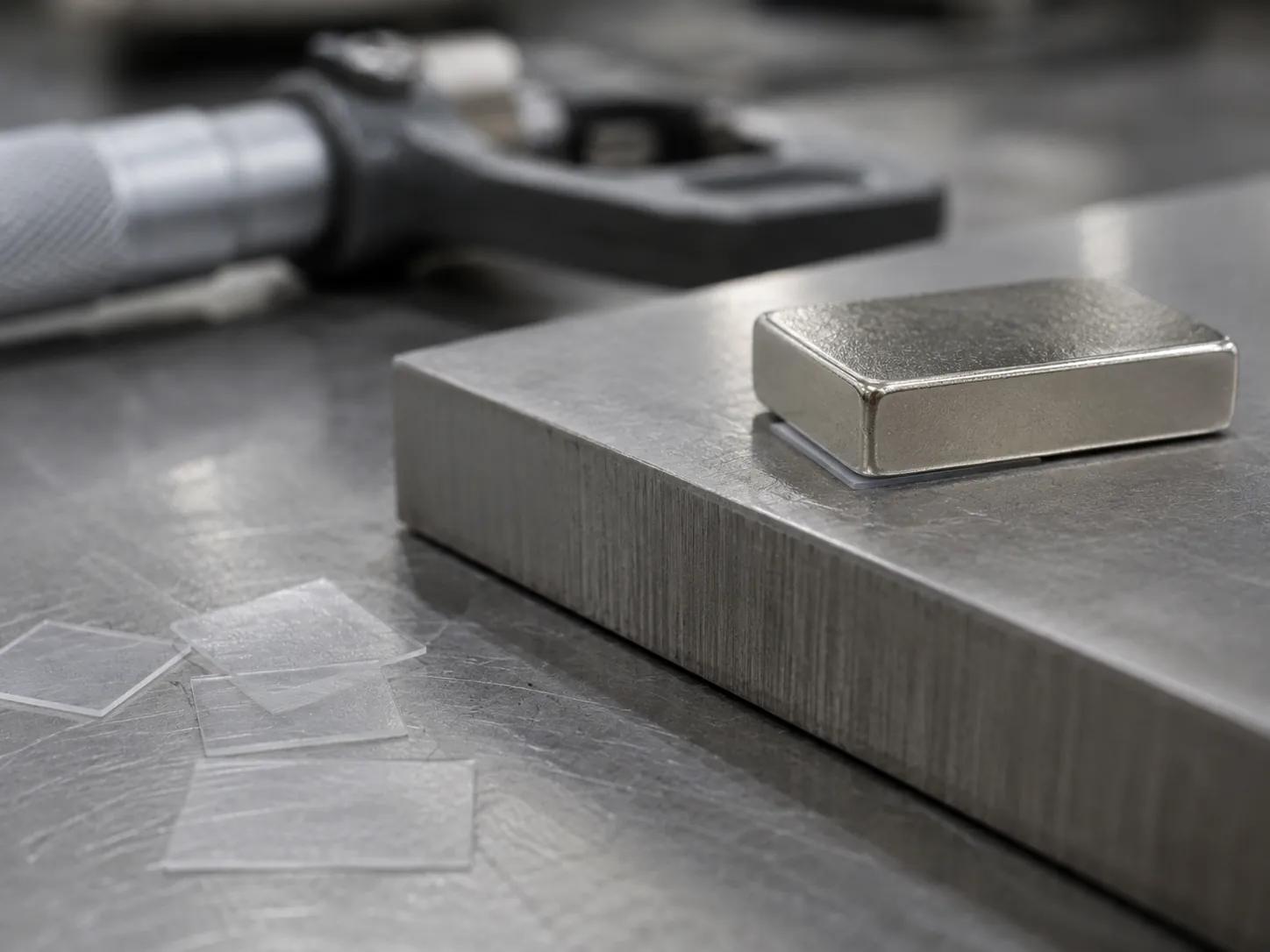
Real-world tip: even a 0.2–1.0 mm air gap (paint, plating, tape, rubber pads, coating build) can reduce pull force more than a few grade steps. This is why I usually solve “not strong enough” by reducing gap or increasing contact area before paying for a higher grade.
N45 vs N52: What’s the Difference?
When comparing N45 and N52 magnets, the main difference is their (BH)max range. N45 typically ranges from 43–46 MGOe, while N52 ranges from 49–52 MGOe. N52 magnets tend to be stronger in the same size and shape, but a larger N45 magnet might outperform a smaller N52 if the volume is increased. Always consider magnet grades and the contact condition when making your final selection.
In my experience, I only push to N52 when space is truly tight or when I can’t change the geometry. If you can increase size slightly, an N45 magnet with more volume can outperform a small N52 (and it may be easier to source consistently in volume production).
Practical buying tip: when comparing N45 vs N52, always look at your actual contact condition—if you have paint, plating, rubber, or a small stand-off, your “gain” from N52 can be smaller than expected. (Related: n35 vs n52 magnet, n45 vs n52 magnets)

N50 vs N52 Magnets
Grade N50 magnets are slightly lower in rated strength than N52, typically falling in the 47–51 MGOe range. In real production, the top end of N50 can overlap with the lower end of N52 because grades are ranges, not single numbers.
If you need the most consistent “top performance” within a compact design, N52 is usually the safer call. But in procurement, I’ve also seen projects pick N50 when availability and cost are better—then confirm performance with sample testing under the real air gap and steel condition.

How Do Magnet Grades Affect Magnet Strength?
Magnet performance depends on several factors—size, shape, air gap, coating thickness, and the steel surface the magnet contacts—not just grade. Grade matters because it reflects the strength of the NdFeB material, but it does not automatically equal real holding force in your application.
For two magnets with the same size and shape, different grades might show an improvement of roughly 10–20% under ideal pull-test conditions (clean, thick steel plate, near-zero air gap). In real assemblies, the performance gap often shrinks once you introduce paint, plating, rubber pads, rough surfaces, thin steel, or even a small stand-off.
A practical engineering approach I use: if the design allows it, first try to reduce the air gap or increase contact area; only then upgrade the grade. This is also why a larger N45 can easily pull harder than a smaller N52.
Related: How strong are neodymium magnets

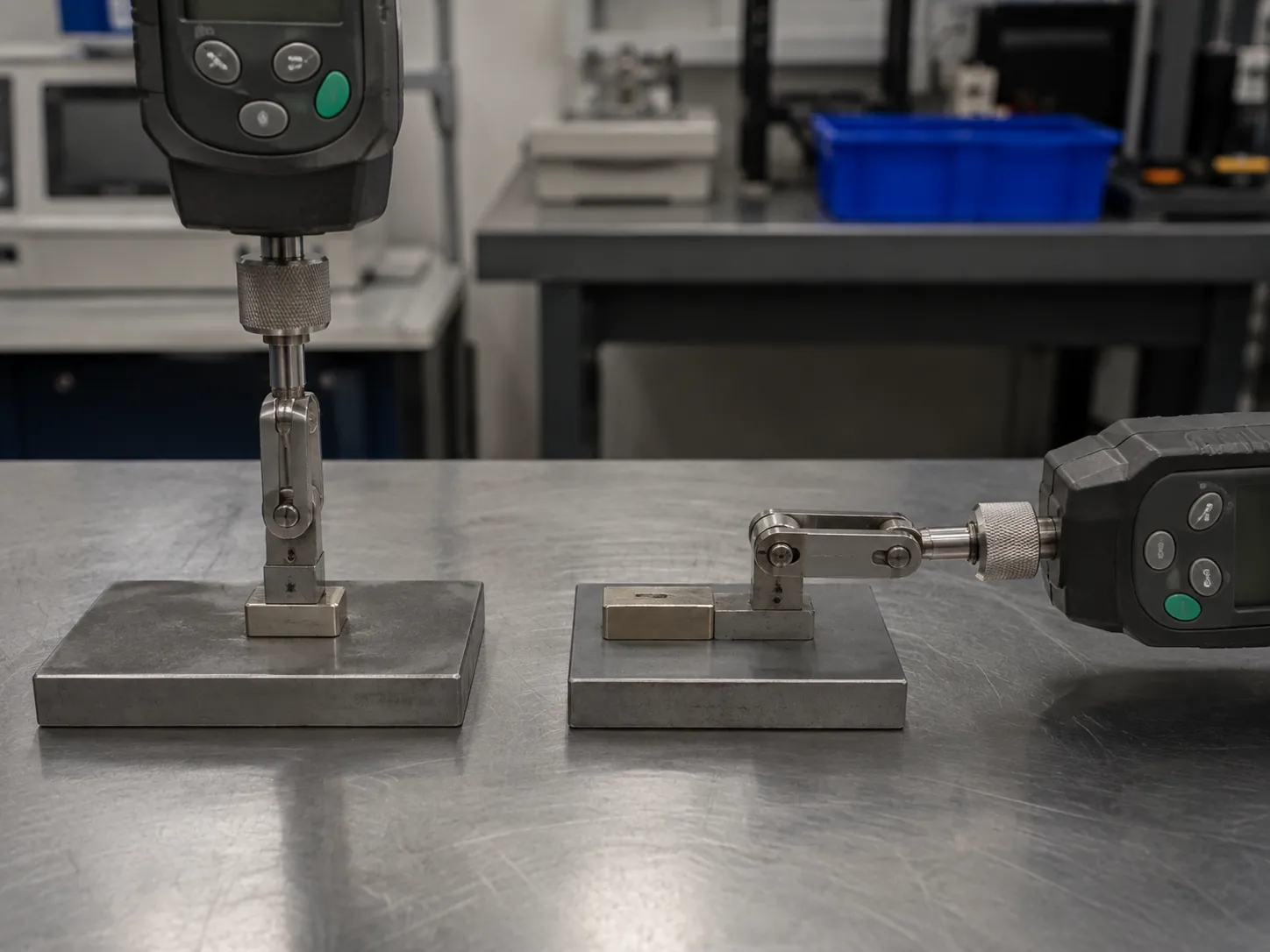
Pull Force vs Shear Force (Why Your Magnet Slides)
- Pull Force vs Shear Force: Key Differences
- Pull Force: The vertical pull force, typically stronger.
- Shear Force: The lateral sliding force, usually weaker.
- Shear Force is Highly Affected by Surface Friction
- Surface condition: Rough, coated, or rubber-padded surfaces can significantly increase friction, reducing sliding ability.
- Solution: You can improve performance by increasing contact area, adding friction, or using mechanical stops.
- Example: Real-World Applications
- In actual use, if a magnet is mounted on a rough surface, the shear force is typically 30%–50% lower than the pull force.
Pull Force vs Grade: Why Test Conditions Change Everything
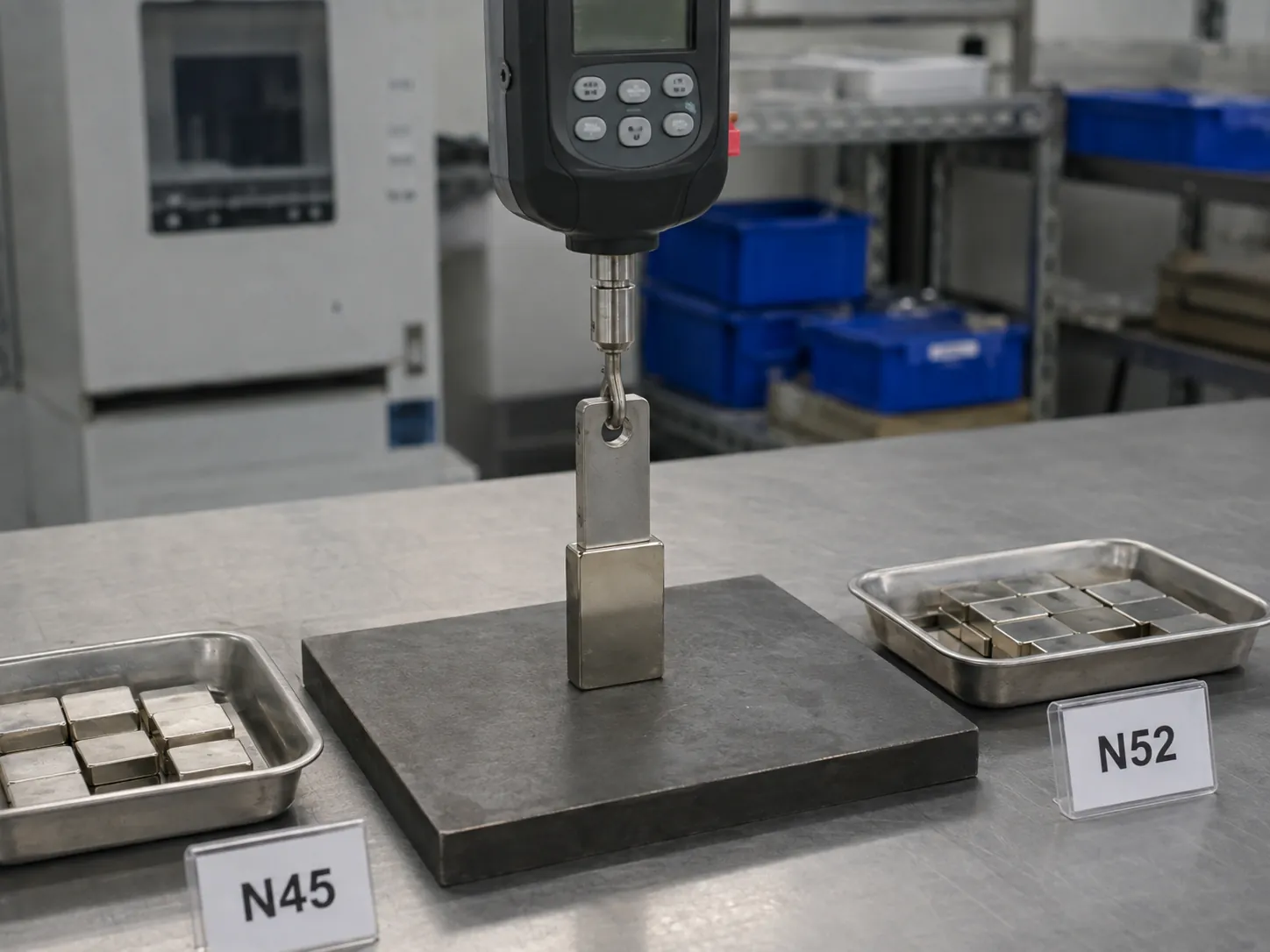
Typical Pull Force Test Setup (What Most Suppliers Use)
- Steel Plate Thickness
Most suppliers use standard steel plates, typically 5–10 mm thick. The thickness of the steel plate affects the pull force test strength, as it changes the contact area between the magnet and the steel surface. - Steel Surface Condition
- Smooth steel surface: Generates higher contact force.
- Rough steel surface: Increases friction and reduces pull force.
- Coatings/Paint: Coatings or painted layers can introduce air gaps, resulting in reduced pull force.
- Air Gap (0, 0.2, 0.5, 1.0 mm)
Air gap is a key factor affecting pull force. Even a small air gap (0.2 mm) can significantly reduce a magnet’s actual pull force. Common air gap cases include coatings, paints, or rubber pads. - Contact Area and Alignment
- Larger contact area increases pull force, especially when the magnet has more contact area with the steel surface.
- Alignment: Whether the magnet is perfectly aligned with the steel surface is another factor that influences pull force. Misalignment reduces pull force.
- Pull Direction (Vertical vs Shear)
- Vertical pull: The most common test method, where the magnet is pulled straight up from the steel surface.
- Shear pull: When the magnet is not pulled vertically, the shear force is typically lower because the friction and contact area are not optimized.
What to Confirm from Your Supplier:
Ask suppliers to provide pull force test conditions (including steel surface condition, air gap, pull direction, etc.).
When purchasing magnets, request detailed test conditions from your suppliers, such as the thickness of the steel plate, the surface condition, whether there’s any coating, and the direction of pull during the test.
Confirm supplier test data to ensure alignment with your real-world conditions.
You can ask the supplier for real-world pull force test data and perform application validation. For example, if your application involves coatings or rough surfaces, ask the supplier for relevant test data to verify the magnet’s pull force under those conditions.
Do all magnets use the same grade system?
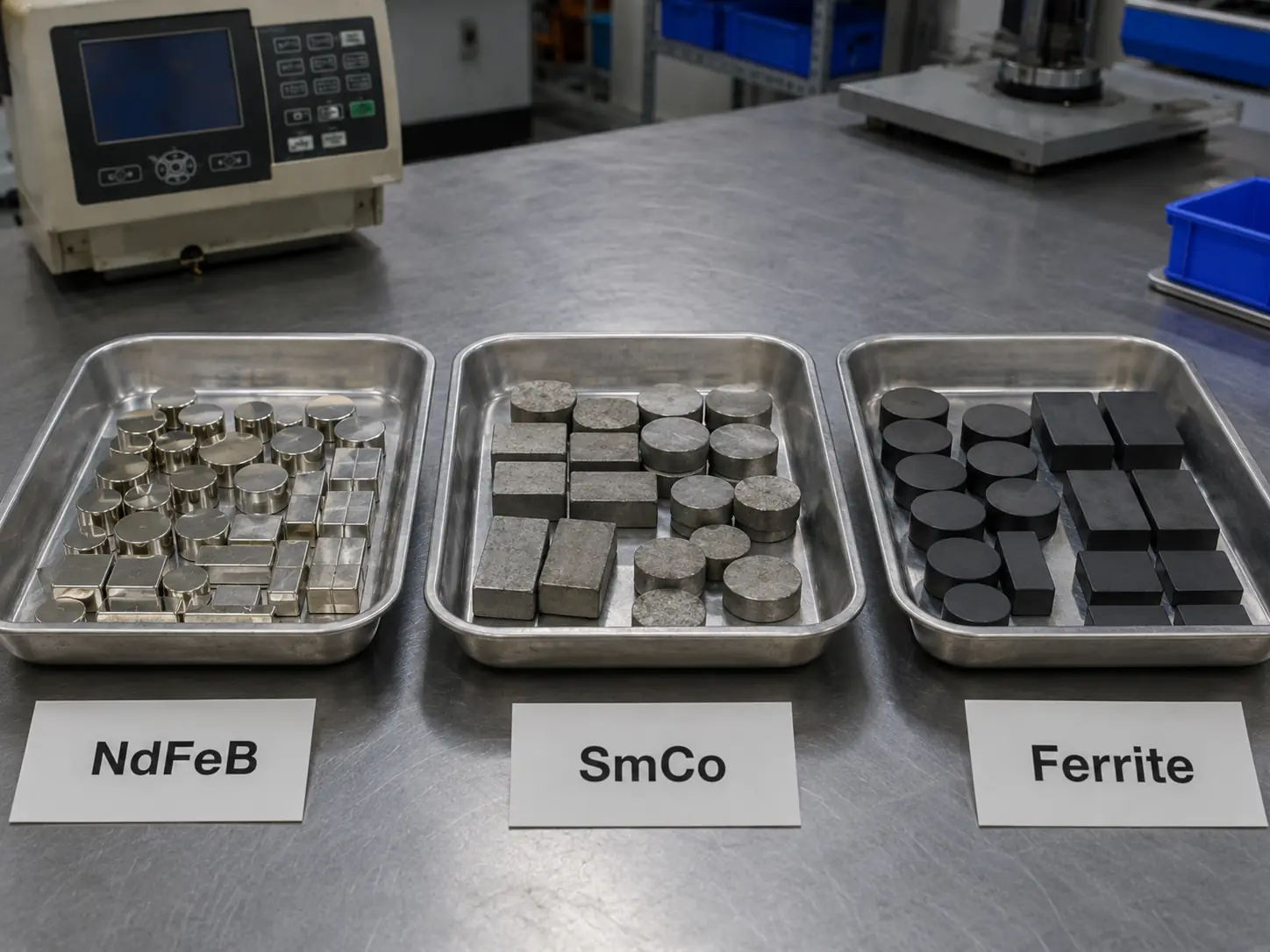
No. Ferrite, SmCo, and NdFeB (neodymium) magnets do not share the same grade system. “Grades of magnets” depend on the material family and the standards used—typically involving (BH)max, coercivity, remanence, and temperature stability.
For NdFeB (NdFeB magnet grades), grades like N35 / N42 / N52 are tied mainly to (BH)max, so higher grades generally mean stronger material. For SmCo (another rare earth magnet), grading tends to emphasize high-temperature stability and coercivity. For ferrite, the grade naming differs and often focuses on properties within its own standard.

In real sourcing, the safest approach is to start from your application requirements (temperature, environment, size limits, target pull force), then choose the matching magnet type and grade—rather than forcing a “one chart fits all” approach.

NdFeB vs SmCo vs Ferrite: Which Magnet Family to Choose?
| Material | Strength (typical) | Temperature Resistance | Corrosion Resistance | Cost | Best-fit Applications |
|---|---|---|---|---|---|
| NdFeB (Neodymium) | High | Moderate (80–230°C) | Low (needs coating) | Moderate | High-performance, compact spaces |
| SmCo (Samarium Cobalt) | High | Very High (up to 350°C) | High | High | High-temperature applications, aerospace |
| Ferrite (Ceramic) | Moderate | Moderate (up to 250°C) | Moderate | Low | Cost-effective, low-power applications |
Extra Letters On Neodymium Magnet Grades
Sometimes, neodymium magnet grades include extra letters at the end (for example: N42H, N42SH, N42UH). These letters mainly indicate temperature resistance—how well the magnet can handle heat without irreversible demagnetization. Standard NdFeB magnets are commonly rated for ≤ 80°C, but “ambient temperature” is often not the real story.
In real applications, temperature is one of the most common hidden killers. I’ve seen magnets that looked perfect in room-temperature pull tests lose strength quickly once installed near motor stators, brake components, heaters, or enclosed housings where heat builds up and can’t escape. If your design has unknown heat exposure, selecting the correct magnet temperature grade is often more important than chasing the highest N-number.
🌡️ Neodymium Magnet Temperature Grades (Suffix Letters)
Standard NdFeB magnets are commonly rated for ≤ 80°C. If your application runs hot (motors, enclosed housings, near heaters), choose a temperature suffix grade.
| Suffix | Typical Max Operating Temp | When to Use |
|---|---|---|
| M | ≤ 100°C | Mild heat, basic safety margin |
| H | ≤ 120°C | Warm environments near motors/appliances |
| SH | ≤ 150°C | Higher heat, enclosed equipment, steady operation |
| UH | ≤ 180°C | High-heat industrial conditions |
| EH | ≤ 200°C | Very high heat, strict demag resistance needed |
| AH | ≤ 230°C | Extreme heat; verify by datasheet/testing |
Practical rule I use: if the magnet sits near a heat source and you’re not 100% sure about the real peak temperature, move up at least one temperature class (for example: from standard to H, or from H to SH) and validate with a quick sample test.
Note: temperature limits are typical industry guidance. Always confirm with your supplier’s datasheet and test if the application is critical.

What Does “Max Operating Temp” Actually Mean?
Operating Temperature and Magnet Failure:
- The temperature grade (M/H/SH/UH/EH/AH) indicates the magnet’s maximum operating temperature over prolonged periods, not its peak temperature.
- Continuous operating temperature: The maximum temperature the magnet can withstand during continuous operation.
- Peak temperature: The maximum temperature the magnet can withstand for short periods before experiencing irreversible demagnetization.
How to Avoid Incorrect Temperature Grade Selection:
- If the magnet is located near a heat source (such as motors, heaters, or enclosed equipment), ambient temperature may be 20–40°C higher than the actual surface temperature of the magnet.
- When selecting the temperature grade, it is advisable to choose a grade one level higher if unsure about the temperature conditions. If possible, conduct sample testing to confirm.
Magnet Specifications (Reference Table for NdFeB Magnet Grades)
Below is a reference table showing typical property ranges for common NdFeB magnet grades. When engineers use a neodymium magnet grades chart, the most practical columns to focus on are Br (remanence), Hcj (intrinsic coercivity), and (BH)max (energy product).
How I use this table in real projects:
- Use (BH)max to compare grade strength bands (N35 vs N42 vs N52).
- Check Hcj if heat, vibration, or opposing fields exist (this is where temperature suffix grades matter).
- Treat all values as ranges and confirm with a supplier’s datasheet for the exact batch/material system.
|
Material | Remanence | Coercivity | Energy- product | Max. Temperature | |||||
|---|---|---|---|---|---|---|---|---|---|
| Br | bHc | iHc | (BxH)max | ||||||
| Gauss (G) | Tesla (T) | kOe | k/m | kOe | k/m | MGOe | kJ/m³ | °C | |
| N30 | 10800-11200 | 1.08-1.12 | 9.8-10.5 | 780-836 | ≥ 12 | ≥ 955 | 28-30 | 223-239 | ≤ 80 |
| N33 | 11400-11700 | 1.14-1.17 | 10.3-11.0 | 820-876 | ≥ 12 | ≥ 955 | 31-33 | 247-263 | ≤ 80 |
| N35 | 11700-12100 | 1.17-1.21 | 10.8-11.5 | 860-915 | ≥ 12 | ≥ 955 | 33-35 | 263-279 | ≤ 80 |
| N38 | 12200-12600 | 1.22-1.26 | 10.8-11.5 | 860-915 | ≥ 12 | ≥ 955 | 36-38 | 287-303 | ≤ 80 |
| N40 | 12600-12900 | 1.26-1.29 | 10.5-12.0 | 860-955 | ≥ 12 | ≥ 955 | 38-40 | 303-318 | ≤ 80 |
| N42 | 12900-13200 | 1.29-1.32 | 10.8-12.0 | 860-955 | ≥ 12 | ≥ 955 | 40-42 | 318-334 | ≤ 80 |
| N45 | 13200-13700 | 1.32-1.37 | 10.8-12.5 | 860-995 | ≥ 12 | ≥ 955 | 43-45 | 342-358 | ≤ 80 |
| N48 | 13700-14200 | 1.37-1.42 | 10.8-12.5 | 860-995 | ≥ 12 | ≥ 955 | 45-48 | 358-382 | ≤ 80 |
| N50 | 14000-14600 | 1.40-1.46 | 10.8-12.5 | 860-995 | ≥ 12 | ≥ 955 | 47-51 | 374-406 | ≤ 80 |
| N52 | 14200-14700 | 1.42-1.47 | 10.8-12.5 | 860-995 | ≥ 12 | ≥ 955 | 48-53 | 380-422 | ≤ 80 |
Conclusion
The grade of a magnet is a crucial indicator of NdFeB material performance, but it’s not the only factor that determines real holding strength. When choosing a neodymium magnet, I recommend starting with grade as a baseline (using a magnet grades chart), then verifying the final performance based on magnet size/shape, air gap, coating thickness, and the steel surface condition.
Neodymium magnets are typically much stronger than ferrite magnets, and the grade number links to the (BH)max range in MGOe. Finally, temperature suffix letters (M/H/SH/UH/EH/AH) matter a lot in real equipment—if temperature exposure is uncertain, choosing the right magnet temperature grade (or testing a sample under real conditions) is usually the fastest way to avoid performance surprises later.
FAQ
Neodymium magnet n52 strength
N52 neodymium magnets typically fall in the 49–52 MGOe range for maximum energy product. In practice, N52 is one of the highest commonly available neodymium magnet grades, but the real holding force still depends heavily on magnet size, shape, air gap, and the steel surface condition used in testing.
How are magnets rated
Magnets are commonly rated by material type, grade, and measured performance. For NdFeB (NdFeB magnet grades), the grade (N35, N42, N52) mainly relates to (BH)max, so higher grades generally indicate stronger magnetic material at the same volume.
Real holding force is usually reported as pull force, but that number depends heavily on test conditions (steel thickness, surface finish, and especially air gap). Surface field can be measured in Gauss, and temperature rating matters because NdFeB can lose strength if overheated—this is why magnet temperature grades (H/SH/UH/EH/AH) are important in many applications. In procurement, I always ask for the supplier’s test condition for pull force, because “same magnet” can look very different under different test setups.
N52 magnet meaning
An N52 magnet is a high-grade neodymium (NdFeB) magnet. The “52” links to its (BH)max range (about 49–52 MGOe), which is why it appears near the top of most neodymium magnet grades charts. In general, a higher grade provides stronger material performance, but the real holding force still depends on magnet size, shape, and the contact conditions in your application—especially air gap and the steel surface.
What is the best neodymium magnet grade for most applications?
N52 is the best for high-performance applications due to its superior strength. However, N42 and N35 are often sufficient for less demanding uses, offering a good balance between strength, cost, and availability.
Does N42SH mean stronger than N52?
No, N42SH is not stronger than N52. N42SH refers to the grade (N42) and temperature tolerance (SH). N52 has a higher magnetic strength, while SH indicates heat resistance up to 150°C.
Why does my magnet feel weaker after installation?
Magnets feel weaker after installation due to air gaps or material interference. Misalignment or non-ferrous materials between the magnet and surface can reduce the effective strength, making it feel less powerful.
What pull-force test condition should I compare?
Test pull-force on a flat, clean steel surface. Ensure no gaps, coatings, or debris between the magnet and steel, as these can reduce the strength measured, affecting the accuracy of the pull-force test.
I’m Ben, with over 10 years in the permanent magnet industry. Since 2019, I’ve been with Osenc, specializing in custom NdFeB magnet shapes, magnetic accessories, and assemblies. Leveraging deep magnetic expertise and trusted factory resources, we offer one-stop solutions—from material selection and design to testing and production—streamlining communication, accelerating development, and ensuring quality while reducing costs through flexible resource integration.