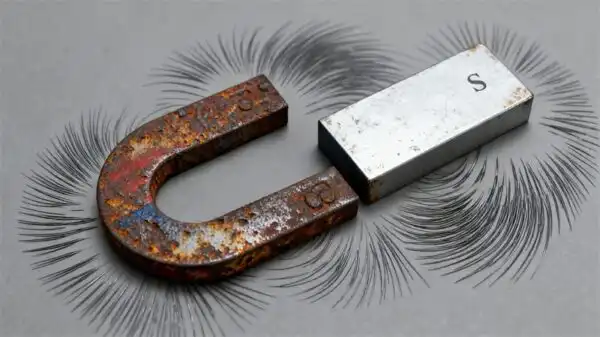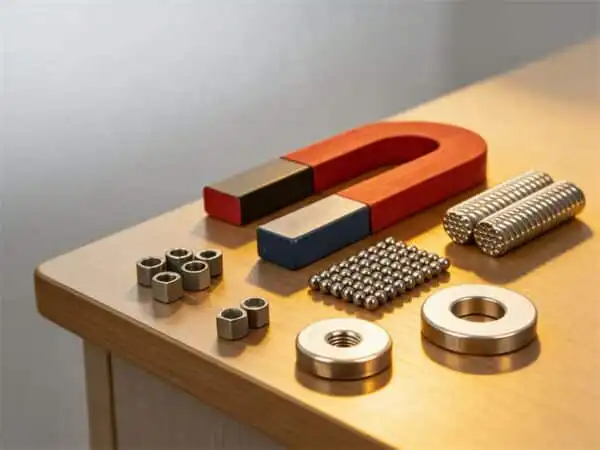
Magnets do not run out of power like batteries, but permanent magnets can lose magnetic output when operating conditions push them beyond their magnetic, thermal, environmental, or mechanical limits.
Do Magnets Wear Out With Use?
No, not in the way a battery discharges or a cutting edge becomes dull. A permanent magnet creates its field from its magnetized material state. Repeatedly attaching it to steel, removing it, or using it as a holding component does not consume a stored supply of magnetic “charge.”
That does not mean the magnet or the assembly is immortal. The magnet can gradually change with time, and it can lose useful performance much faster when the application exposes it to high temperature, a strong reverse field, corrosion, or mechanical damage.
TDK notes that magnets can experience gradual demagnetization over time, but the amount depends on the magnet material, operating temperature, permeance coefficient, size, and shape. That is why a useful service-life answer cannot be reduced to one universal percentage-per-decade rule. See TDK’s technical FAQ on demagnetization over time.
How Long Do Magnets Last?
A correctly specified permanent magnet can remain useful for many years or decades, but there is no universal expiration date. The relevant question is not simply “How old is the magnet?” It is “Has the magnet stayed inside a safe magnetic, thermal, environmental, and mechanical operating window?”
For neodymium magnets specifically, OSENC has a separate guide on neodymium magnet lifespan. This page keeps the broader ownership: why permanent magnets appear to wear out, what actually causes loss, and how to diagnose it.
Do Magnets Slowly Lose Strength Even Without Damage?
Small time-dependent magnetic changes can occur even when a permanent magnet is stored or operated under stable conditions. Technical literature may describe this as magnetic aging, magnetic viscosity, or magnetic creep. The important engineering point is that there is no single annual loss rate that applies to every permanent magnet.
The long-term change depends on the magnet material, grade and coercivity, temperature history, geometry, permeance coefficient, magnetic circuit, external field, and whether corrosion or physical damage is present. Arnold Magnetic Technologies separately discusses time-dependent magnetic viscosity alongside reversible, irreversible, and permanent magnetization losses in its magnetization-loss technical paper.
| Observed problem | Is the magnet necessarily demagnetized? | First engineering check |
|---|---|---|
| Holding force is lower | No | Air gap, contact area, target steel, surface contamination, alignment, and test direction |
| Surface field reads lower when hot | Not necessarily | Repeat the measurement at the same temperature and position; some thermal loss is reversible |
| Performance remains lower after cooling | Possibly | Check operating temperature, grade/coercivity, magnetic circuit, and reverse-field exposure |
| Coating is blistered, rusted, or flaking | Material loss is likely | Inspect corrosion depth, dimensional change, coating damage, and remaining magnetic output |
| Magnet is chipped or cracked | Not always magnetically demagnetized | Check lost magnetic volume, changed geometry, coating breach, and assembly alignment |
| Magnet is simply old | Age alone is weak evidence | Compare against a controlled baseline before concluding natural aging caused the problem |
Why Do Magnets Become Weaker?
Heat
Higher temperature reduces magnetic output and, more importantly for NdFeB, reduces resistance to demagnetization. If the operating point moves beyond a safe part of the demagnetization curve, some loss may remain after cooling.
Opposing magnetic fields
A sufficiently strong reverse field can partially demagnetize a permanent magnet. The risk depends on intrinsic coercivity, temperature, geometry, and the magnetic circuit, not merely on the fact that two magnets face one another.
Corrosion
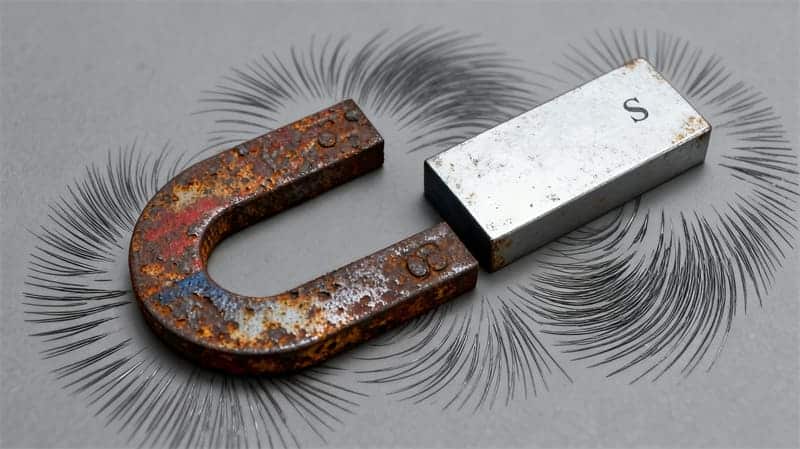
Corrosion can remove or damage magnetic material and change geometry. Sintered NdFeB is especially dependent on suitable environmental protection. A coating reduces exposure risk; it does not make the magnet immune to every environment.
Mechanical damage
Sintered permanent magnets are brittle. Chipping and cracking can reduce effective magnetic volume, damage protective coating, alter the air gap, or shift the magnet in the assembly.

Do Different Permanent Magnet Materials Wear Out Differently?
Yes. Permanent-magnet materials do not share the same dominant failure risks. The useful comparison is not “Which material lasts longest?” but “Which failure mechanism is most likely under this temperature, environment, geometry, and magnetic circuit?”
| Magnet material | Typical long-term concern | Engineering consequence | Buyer action |
|---|---|---|---|
| NdFeB | Corrosion if protection is damaged; temperature-sensitive demagnetization margin; brittle edges | Material loss, coating failure, chipping, or irreversible magnetic loss can reduce useful output | Specify environment, coating/housing, real temperature profile, Hcj/grade family, geometry, air gap, and acceptance test |
| SmCo | Mechanical brittleness; high-temperature applications still require grade-specific review | Generally strong temperature stability and better corrosion resistance than NdFeB, but cracking/chipping remains a design concern | Use when elevated-temperature stability is valuable, then verify geometry, handling, magnetic circuit, and actual grade limits |
| Alnico | Can be more sensitive to demagnetizing operating conditions depending on geometry and circuit | High-temperature capability does not remove the need to control the magnetic operating point | Review length-to-diameter ratio, magnetic circuit, external fields, and assembly conditions |
| Ferrite | Brittleness and circuit-dependent performance rather than corrosion | Good corrosion resistance does not mean the assembly is immune to fracture, gap changes, or unsuitable field requirements | Check geometry, mechanical handling, target field/force, temperature, and circuit design |
Arnold’s permanent-magnet material guidance notes that NdFeB is prone to corrosion and is comparatively temperature-sensitive, while SmCo offers better temperature stability and corrosion resistance but requires careful handling because it is brittle. Material family alone still cannot determine service life; grade, geometry, and the application remain decisive.
Temperature, Working Limits, and Curie Temperature Are Not the Same Thing
This distinction matters because the old version of this page treated typical NdFeB working-temperature numbers too much like Curie-temperature limits. They are different engineering boundaries.
Reversible temperature change
Magnetic output changes as temperature changes. If the magnet remains within a safe operating region, much of that change can recover when temperature returns to the original condition.
Irreversible demagnetization
If temperature and the magnetic circuit push the magnet’s working point beyond the knee of its demagnetization curve, some magnetic output may not return after cooling.
Irrecoverable material change
Severe heat, corrosion, or other structural damage can permanently alter the material. In that case, simply remagnetizing the part may not restore the original component performance.
Curie temperature
The Curie temperature is where ferromagnetic order collapses. It is not a recommended operating temperature. Practical working limits are lower and depend on grade, geometry, magnetic circuit, temperature profile, and required performance margin.
Reversible change
Temperature rises → output changes → magnet cools → output largely recovers.
This is a temperature-dependent change, not proof of permanent damage.
Irreversible demagnetization
Temperature + operating point exceed safe margin → magnet cools → some loss remains.
Risk depends on coercivity, geometry, magnetic circuit, and the actual temperature profile.
Curie boundary
Extreme thermal exposure → ferromagnetic ordering collapses.
Curie temperature is a material boundary, not a recommended working-temperature target.
Arnold Magnetic Technologies separates reversible, irreversible, and permanent magnetization losses and discusses temperature, external fields, time-dependent magnetic viscosity, and structural damage in its magnetization-loss technical paper. Its NdFeB guidance also notes that real use-temperature decisions depend on required magnetic output and application conditions, while corrosion protection is important in humid environments. See Arnold’s NdFeB technical overview.
A Weak Magnet May Be an Assembly Problem, Not a Magnet Problem
In B2B applications, a perceived loss of “magnet strength” often comes from the complete magnetic and mechanical system. A small increase in working distance can reduce usable field or holding force even if the magnet material itself has not changed.
Common causes include a thicker coating, adhesive creep, paint or debris between surfaces, a shifted magnet, a different steel target, a thinner back plate, a changed air gap, or a different pull-force test direction. Surface Gauss, working-distance field, and holding force are related, but they are not interchangeable measurements.
If you are comparing readings, OSENC’s Magnet Gauss guide explains why the measurement point and test setup matter.
Small, controlled air gap
Result: Higher usable field and holding interaction at the target because the magnetic path is tighter.
Larger working air gap
Result: Lower usable field or force even though the magnet material may be unchanged. Adhesive, coating, debris, housing, or position can create the extra gap.
How to Test Whether a Magnet Has Actually Weakened
- Define the baseline. Use the original drawing, magnet grade if known, magnetization direction, operating temperature, and a previous approved measurement or sample.
- Inspect the part. Look for corrosion, coating damage, cracks, chips, swelling, or dimensional change.
- Check the assembly. Confirm air gap, target material, steel thickness, contact area, alignment, adhesive thickness, and mechanical position.
- Measure under controlled conditions. If using a Gauss meter or flux measurement, keep the temperature, probe orientation, fixture, distance, and measurement location the same.
- Repeat force testing consistently. Pull force should be compared using the same target steel, contact condition, load direction, surface state, and fixture.
- Review the operating point. If real magnetic loss is suspected, compare the magnet’s geometry and circuit against its demagnetization characteristics at the actual operating temperature.
Magnet Weakness Diagnostic Decision Tree
If yes, check the air gap, adhesive thickness, coating, housing, position, target steel, and contact area before treating the problem as demagnetization.
If yes, record peak temperature and exposure duration, then review the grade/coercivity, geometry, and magnetic operating point at that temperature.
If yes, physical material loss or a changed assembly may be reducing performance even if the remaining material is still magnetized.
If yes, evaluate whether the reverse field, temperature, coercivity, geometry, and magnetic circuit could have moved the magnet into an irreversible region.
Match the temperature, measurement point, probe orientation, fixture, air gap, target steel, surface condition, and load direction. Only then compare field or force against the baseline.
For applications where field at a working distance or assembly behavior is critical, a magnetic-circuit review or simulation can reduce guesswork. OSENC’s confirmed project scope includes suitable magnetic field simulation and engineering review projects, subject to the drawing and application inputs provided.
When Should You Retest a Permanent Magnet?
A magnet does not need repeated testing merely because another year has passed. Retesting becomes more valuable after a known risk event, after the assembly changes, or when measured performance moves without an obvious explanation.
After abnormal overheating
Record peak temperature and dwell time. Compare those conditions with the magnet grade, Hcj, geometry, and magnetic circuit before deciding whether irreversible loss is plausible.
After a major impact
Inspect for chipping, cracks, coating damage, movement, and a changed gap. Impact does not automatically mean demagnetization, but it can change the component or assembly enough to reduce usable output.
After visible corrosion or coating failure
Blistering, peeling, pitting, edge corrosion, or material loss justify a controlled comparison because the magnet geometry and protected surface may already have changed.
After an assembly revision
New adhesive, paint, plating, housing thickness, target steel, or magnet position can change working-distance field or holding force without changing the magnet material.
After unexplained field or force decline
Reproduce the baseline test before replacing the magnet. If the lower result remains under matched conditions, investigate thermal, field-induced, corrosion-related, or material-loss mechanisms.
For critical preventive-maintenance applications
Set inspection intervals from the actual process risk, operating environment, acceptance criteria, and consequence of failure. Do not invent one universal calendar interval for every permanent-magnet application.
Can a Weak Magnet Be Remagnetized?
Sometimes. If the magnet has suffered a recoverable magnetic loss without destructive corrosion, major material loss, or irreversible structural damage, industrial remagnetization may restore magnetic output. If the magnet body has corroded, cracked, lost material, or been structurally damaged by extreme heat, remagnetization cannot repair the physical component.
Remagnetization also does not fix a bad application design. If the same magnet is returned to the same unsafe temperature and demagnetizing field condition, the loss can happen again. The engineering fix may require a different grade family, geometry, magnetic circuit, thermal path, coating, or assembly design.
How to Make Permanent Magnets Last Longer
- Control the real temperature profile. Specify steady-state and transient peak temperatures, including dwell time and nearby heat sources.
- Maintain demagnetization margin. Evaluate grade/coercivity together with geometry, air gap, magnetic circuit, and any opposing field.
- Protect NdFeB from the actual environment. Match coating or housing strategy to humidity, condensation, salt, chemicals, abrasion, and assembly damage. See OSENC’s neodymium magnet coating guide.
- Prevent impact and edge loading. Use assembly features that keep brittle magnets from slamming together or carrying structural load they were not designed to bear.
- Control the working gap. Include adhesive, plating, housing, paint, tolerances, and wear layers in the magnetic stack-up.
- Define an acceptance test. Specify what will be measured, where it will be measured, at what temperature, and with what fixture or target.
What Should a Buyer Specify if Magnet Life Matters?
For a custom NdFeB project, “I need a magnet that lasts 20 years” is not enough to select an exact magnet. A supplier needs the conditions that can actually change the design and validation route.
| Input to provide | Why it matters to magnet-life risk |
|---|---|
| Drawing, magnet dimensions, and tolerances | Geometry changes the operating point, field distribution, manufacturability, and assembly gap. |
| Current material/grade, if known | Br, Hcb/Hcj, and temperature behavior cannot be inferred from application name alone. |
| Normal and peak operating temperature, with duration | Temperature changes magnetic output and demagnetization margin. |
| Working distance/air gap and target steel | These strongly affect usable field and force, and can make a healthy magnet appear weak. |
| Humidity, salt, chemicals, condensation, abrasion | These determine corrosion-protection and coating/housing requirements. |
| Magnetization direction or pole layout | The magnetic circuit and opposing-field exposure depend on the real pole arrangement. |
| Target field or force with test condition | Performance must be tied to a defined point, gap, target, fixture, and load direction. |
| Current failure symptom and before/after measurements | This helps separate true demagnetization from corrosion, damage, or assembly drift. |
| Sample validation and acceptance requirement | Project-specific evidence is needed before treating a long-life design as verified. |
OSENC’s confirmed project scope may support drawing/sample/application review, custom grade/coating/tolerance/magnetization discussion, magnetic-circuit design, simulation, assembly, and testing for suitable custom neodymium magnet projects. Final selection still requires project-specific inputs and validation.
Frequently Asked Questions
Do magnets lose their magnetism over time?
They can. Gradual change with time is possible, but the rate depends on material, temperature, geometry, permeance coefficient, and operating conditions. In a properly specified application, age-related loss is often much smaller than loss caused by overheating, corrosion, a demagnetizing field, or physical damage.
Do magnets wear out with normal use?
Normal attraction, holding, and release cycles do not consume magnetism like a battery charge. A magnet may still fail because of heat, corrosion, chipping, an opposing field, or changes in the surrounding assembly.
How long do permanent magnets last?
There is no single expiration time. Permanent magnets can remain useful for many years or decades when used inside their magnetic, thermal, environmental, and mechanical limits.
How long do neodymium magnets last?
NdFeB magnets can provide long service life when the grade, temperature margin, coating, geometry, magnetic circuit, and handling are appropriate. For the NdFeB-specific search task, see OSENC’s neodymium magnet lifespan guide.
Does heat permanently weaken a magnet?
It can. Some temperature-related output change is reversible, but a magnet can suffer irreversible demagnetization if its operating point crosses an unsafe part of the demagnetization curve. Curie temperature is a separate, much more severe material boundary and should not be treated as a normal operating limit.
Can a weak magnet be remagnetized?
Possibly, if the loss is magnetic rather than structural. Industrial remagnetization cannot repair missing material, corrosion damage, cracks, or other permanent physical changes, and it will not correct an application that repeatedly exposes the magnet to the same unsafe condition.
What is magnetic creep in a permanent magnet?
Magnetic creep is a term sometimes used for small time-dependent magnetic changes caused by the magnet gradually responding to internal and external demagnetizing influences. It is not a universal fixed loss rate; material, temperature, coercivity, geometry, permeance coefficient, circuit, and environment all matter.
When should a permanent magnet be retested?
Retest after abnormal heat, impact, corrosion or coating failure, an assembly change, or an unexplained reduction in field or force. For critical applications, define a preventive-maintenance interval from the actual process risk and acceptance requirement rather than using one generic schedule.
Need to Diagnose Magnet Strength Loss?
Send the drawing, magnet dimensions, operating and peak temperature, working gap, target material, environment, magnetization direction, and your current field or force test condition. That is enough to turn “the magnet feels weaker” into an engineering review.