
Does heat affect magnets? Yes. Heating a permanent magnet usually reduces its magnetic output while it is hot. In neodymium magnets, moderate loss can be reversible, but excessive temperature can push the magnet into irreversible demagnetization. The Curie temperature is not the safe working-temperature limit.
For NdFeB, the safe temperature is determined by the hot operating point, not by the N-grade or Curie temperature alone. Intrinsic coercivity (Hcj), geometry, magnetization direction, air gap, steel return path, reverse-field exposure and the required hot-state output all affect the decision.
- Why heat weakens magnets
- How Br and Hcj change with temperature
- Reversible loss vs irreversible loss vs Curie temperature
- How hot is too hot for neodymium magnets?
- How to choose NdFeB for higher temperature
- Does cold make magnets stronger?
- Why geometry and the magnetic circuit change temperature capability
- Why Gauss or pull force alone can mislead you
- NdFeB vs SmCo vs ferrite vs Alnico
- How to verify thermal performance
- When to use simulation or thermal validation
- What to send for a temperature-critical magnet
- FAQ
Why Does Heat Weaken Magnets?
Heat changes the magnetic properties of a permanent-magnet material. In a simplified picture, rising temperature increases thermal agitation and makes it harder for the material to maintain the same magnetic order. The result is usually lower magnetic output as temperature rises.

That answer is correct, but it is still too crude for selecting a neodymium magnet. A magnet can become weaker while hot and then recover after cooling, or it can lose part of its magnetization permanently. The difference depends on where the magnet operates on its demagnetization curve at the highest temperature.
It is: “At the hottest real operating condition, will the magnet still have enough flux and enough coercivity margin to stay away from irreversible demagnetization?”
How Do Br and Hcj Change With Temperature?
What Happens to Br?
When buyers say “magnet strength,” they often mix several different properties. For temperature design, two of the most important are remanence (Br) and intrinsic coercivity (Hcj).
Why Hcj Matters for Irreversible Demagnetization
Br is closely related to the magnetic flux the material can provide. Hcj measures resistance to irreversible demagnetization. In representative sintered NdFeB data published by Arnold Magnetic Technologies, both decrease as temperature rises, but the temperature coefficient of Hcj has a much larger magnitude than the coefficient of Br. That is why a magnet can still show useful magnetic output while its safety margin against irreversible loss has already become much smaller.
Source for representative NdFeB temperature-coefficient behavior: Arnold Magnetic Technologies technical note.
| Variable | Typical effect of rising temperature in NdFeB | Why it matters | Procurement / design action |
|---|---|---|---|
| Br | Decreases | Hot-state flux and field are lower than at room temperature. | Define the minimum acceptable performance at the actual operating temperature. |
| Hcj | Decreases, often more strongly than Br | Resistance to irreversible demagnetization becomes weaker. | Check the hot demagnetization curve and operating point instead of relying only on room-temperature grade. |
| BHmax | Changes with the material curve | Room-temperature energy product does not describe hot-state system performance. | Do not assume a higher N-number automatically gives better thermal performance. |
| Operating point | Moves as the curve changes | A design with weak permeance-coefficient margin can cross the knee at elevated temperature. | Review geometry, air gap, steel return path and any opposing magnetic field. |
A representative sintered NdFeB material can have a reversible Br temperature coefficient around -0.11% per °C. That is useful for a first estimate, not a finished design calculation. The coefficient varies with grade and temperature range, and a change in Br does not translate directly into the same percentage change in pull force or assembly output.
Worked Example: Estimate the Reversible Br Change
Illustrative calculation only: normalize Br at the reference temperature to 100%. Assume a representative reversible Br coefficient of -0.11% per °C and an 80°C temperature rise.
Br(T) ≈ Br(Tref) × [1 + αBr × (T − Tref)]Using αBr = -0.0011/°C and ΔT = 80°C:
Relative Br ≈ 100% × [1 − (0.0011 × 80)] = 91.2%This is not an OSENC test result and not a grade guarantee. It is a normalized example showing how a temperature coefficient is used. The exact coefficient must come from the material data for the selected grade and temperature range.
Why an 8.8% Br Drop Does Not Mean an 8.8% Pull-Force Drop
Pull force is a system output, not a direct copy of Br. It also depends on magnet geometry, working gap, target steel, contact area, saturation and the complete magnetic circuit. A reversible Br estimate can therefore help predict a trend, but it cannot be converted into an equal-percentage pull-force loss without a circuit calculation or controlled test.
Reversible Loss, Irreversible Demagnetization and Curie Temperature Are Different
1. Reversible temperature loss
When the magnet stays within a suitable operating region, magnetic output falls as temperature rises and largely returns when the magnet cools. This is the behavior described by a reversible temperature coefficient.
2. Irreversible demagnetization
If the hot operating point moves beyond the knee of the demagnetization curve, part of the magnetic loss remains after the magnet cools. The magnet may still work, but its room-temperature flux can be lower than before the heat exposure.
Some irreversible loss can be recoverable by remagnetization if the material has not suffered permanent structural damage. That does not fix a bad design. If the same magnet is returned to the same thermal and magnetic conditions, the loss can happen again.
3. Curie temperature
The Curie temperature is the much higher material transition where normal long-range magnetic order collapses. A representative sintered NdFeB material has a Curie temperature around 310°C. That does not mean a standard neodymium magnet can work continuously at 310°C.
General heat/magnetization background: NASA GSFC. Representative NdFeB material values vary by grade; use the exact supplier data for final design.
Maximum operating temperature is an application limit. It depends on the exact material, geometry, permeance coefficient, external field and acceptable irreversible loss.
How Hot Is Too Hot for Neodymium Magnets?
There is no single temperature that is “too hot” for every NdFeB magnet. Published data for common standard N grades often show maximum-use values around the lower end of the neodymium temperature range, while higher-coercivity materials can be rated substantially higher. But those published numbers are not universal guarantees.
Even within the same nominal grade family, the allowable temperature can change with magnet shape and operating point. A thin magnet working in a weak magnetic circuit can be more vulnerable than a thicker magnet made from the same material.
Continuous temperature
The temperature the magnet actually reaches during normal steady operation.
Peak temperature
Short excursions during curing, startup, overload, cleaning, sterilization or nearby heat sources.
Magnet temperature, not ambient
A motor, coil, metal housing or adhesive cure can make the magnet hotter than the surrounding air.
Is N52 More Heat Resistant?
N52 is an energy-product grade designation, not a temperature rating. It does not tell you the hot-state Hcj margin or the safe operating temperature of the finished magnet. A lower-energy grade with higher intrinsic coercivity can be the better choice in a hot magnetic circuit.
The selection sequence should be: required hot-state output → continuous and peak magnet temperature → Hcj and hot demagnetization curve → geometry / permeance coefficient → reverse-field exposure → validation method. Choosing the highest N-number first reverses the engineering logic.
How Should You Choose an NdFeB Magnet for Higher Temperature?
A temperature class or grade suffix is only a starting point. Final thermal capability depends on how the magnet operates inside the real magnetic circuit. The table below converts common buyer conditions into the physical mechanism, engineering consequence, validation step and procurement action.
| Buyer condition | Physical mechanism / limiting factor | Engineering consequence | How to verify | Buyer action |
|---|---|---|---|---|
| Higher continuous magnet temperature | Br and Hcj decrease as temperature rises. | Hot-state output falls and demagnetization margin narrows. | Review hot material data and the hot operating point. | Specify the actual magnet temperature and required hot-state output. |
| Short high-temperature peak | Peak temperature and dwell can expose the magnet to a less favorable demagnetization curve. | A short event may still create irreversible loss if the operating point crosses the knee. | Reproduce the peak condition, then cool and remeasure. | Provide peak temperature, approximate dwell time and event frequency. |
| Thin magnet or unfavorable aspect ratio | Geometry can reduce the permeance coefficient. | The operating point can move closer to the knee even when the material grade is unchanged. | Calculate the load line / Pc using the real magnetization direction and circuit. | Do not copy a supplier temperature limit from a different geometry. |
| Large air gap or weak return path | The magnetic circuit becomes less favorable. | Field at the load can fall and irreversible-loss margin can shrink. | Model the real air gap, steel path and working position. | Send the assembly geometry, not only the bare-magnet dimensions. |
| Opposing field from a coil or nearby magnet | Reverse magnetic stress increases while Hcj may already be lower at temperature. | Demagnetization risk can rise sharply during hot operation or fault conditions. | Include the maximum reverse-field condition in the operating-point review. | Specify normal and worst-case opposing fields. |
| Required pull force or field while hot | Finished output depends on both material properties and the magnetic circuit. | A room-temperature pass can become a hot-state functional failure. | Measure field / flux / pull force or assembly output under defined hot conditions. | Write the acceptance requirement at the actual operating temperature. |
The procurement specification should define the real thermal profile, magnetic circuit and acceptance condition. Only then should the material grade route be finalized.
Does Cold Make Magnets Stronger?
For neodymium magnets, remanence generally increases as temperature falls through ordinary industrial ranges. So a magnet can measure somewhat stronger when it is cold than when it is hot.
That does not mean “the colder, the better” without limit. NdFeB exhibits additional low-temperature behavior around cryogenic temperatures, including spin reorientation near roughly 140 K in representative material. Ferrite has a different problem: its coercivity can decrease as temperature falls, so deep cold can make some ferrite designs more vulnerable to demagnetization.
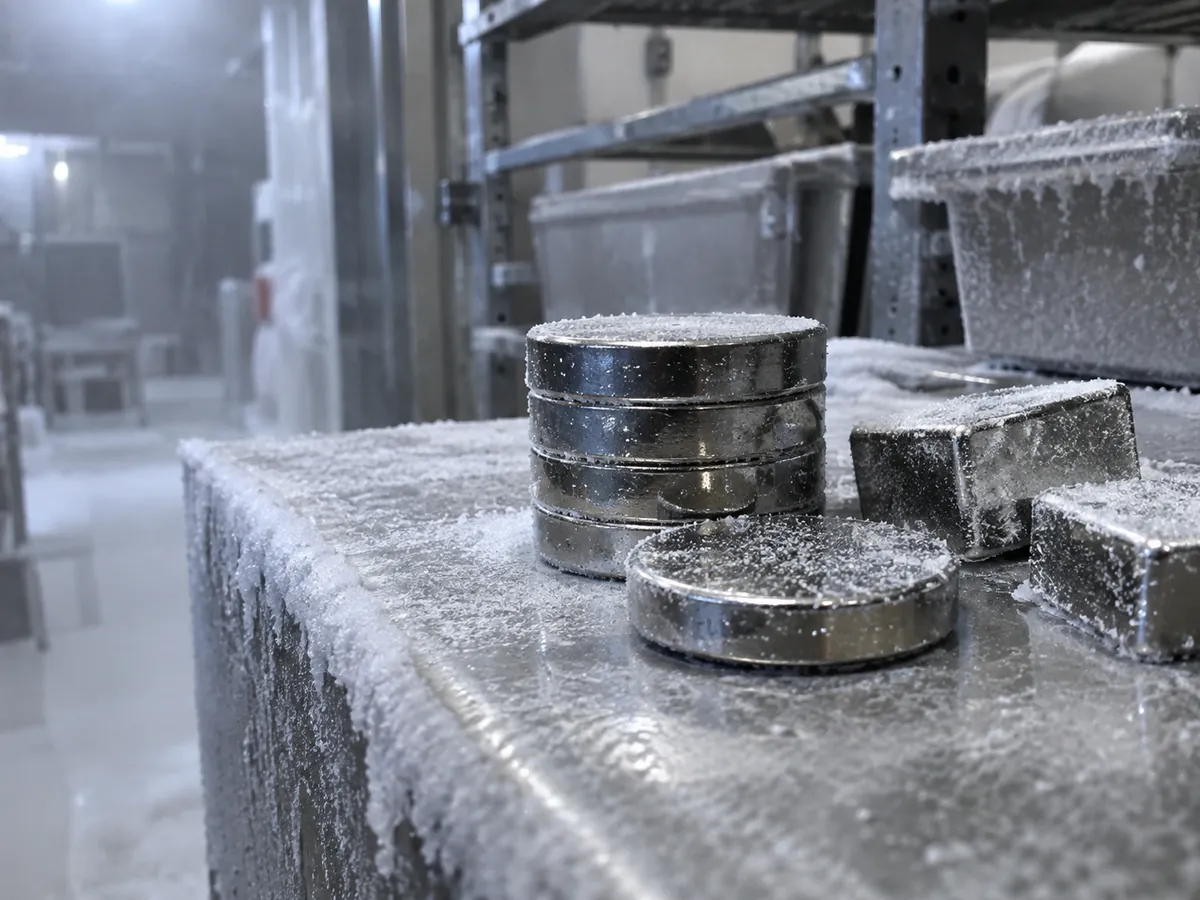
If your application works below normal industrial temperatures, specify the actual minimum magnet temperature and verify the selected material instead of extrapolating a room-temperature coefficient indefinitely.
Why Geometry and the Magnetic Circuit Change Temperature Capability
Two magnets made from the same material grade can behave differently at the same temperature because the permeance coefficient (Pc) and load line depend on geometry and the surrounding magnetic circuit. The same Hcj value can therefore provide very different thermal margin in two assemblies.
A thin magnet in the magnetization direction, a larger effective air gap, a weak steel return path or an opposing field can move the operating point toward the knee of the hot demagnetization curve. That is the mechanism behind the warning that “maximum operating temperature” is not one hard number for every magnet made from the same material.
- Magnet dimensions: thickness in the magnetization direction can materially change the operating point.
- Air gap: a larger effective gap usually makes the magnetic circuit less favorable.
- Steel return path: the surrounding ferromagnetic circuit can change flux distribution and operating margin.
- Opposing field: a coil or another magnet can add demagnetizing stress at exactly the time Hcj is reduced by heat.
- Magnetization direction: shape alone does not prove the pole direction, and the correct geometry calculation requires the actual magnetization orientation.
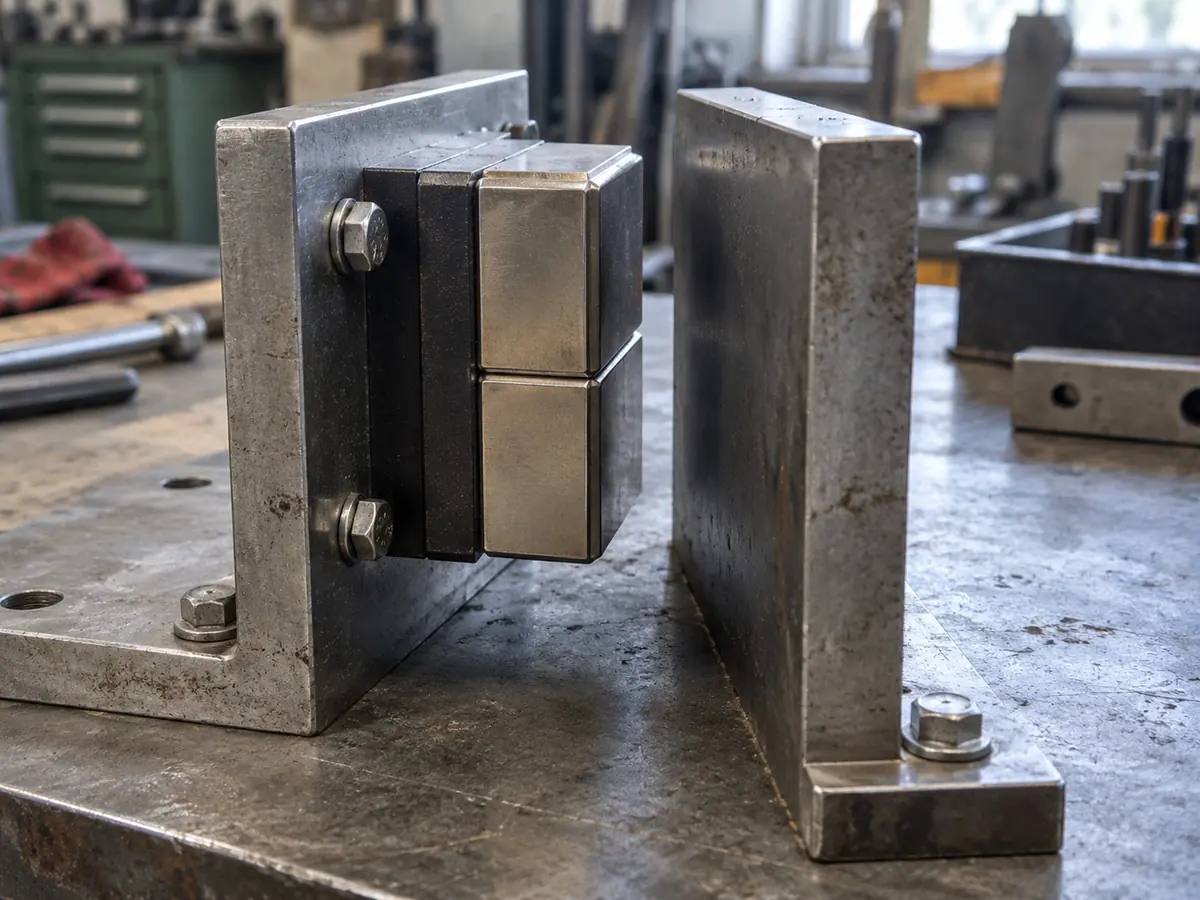
For projects where the thermal and magnetic margins are close, a magnetic field simulation can be useful for evaluating the magnetic circuit before the design is frozen.
Why Surface Gauss or Pull Force Alone Can Mislead You at Temperature
A surface Gauss measurement is not the same thing as field at the real working distance, and neither one is automatically equal to pull force. This distinction becomes more important when temperature changes.
If Br falls while the magnet is hot, the field distribution changes. The resulting force depends on geometry, gap, target steel, contact condition and magnetic saturation. A simple “Br fell 6%, therefore pull force fell 6%” calculation is not generally valid.
For a holding application, define the pull-force test conditions. For a sensor or motor application, define field or flux at the real working position. For an assembly, the best acceptance metric may be the assembly’s functional output rather than a bare-magnet surface reading.
For more on this distinction, see Magnet Gauss and How Strong Is a Neodymium Magnet?.
How Do NdFeB, SmCo, Ferrite and Alnico Compare at Temperature?
| Material | Temperature behavior | Main design advantage | Main caution |
|---|---|---|---|
| NdFeB | High magnetic output near room temperature, with negative temperature coefficients for Br and Hcj. | High energy density in compact designs. | Thermal demagnetization margin can become the limiting factor. |
| SmCo | Lower reversible temperature coefficient than typical NdFeB and strong high-temperature stability. | Useful when thermal stability is more important than maximum room-temperature energy density. | Material choice must still be based on the complete application, not temperature alone. |
| Ferrite | Br falls as temperature rises, while coercivity commonly moves in the opposite direction. | Stable, widely used and cost-effective in many applications. | Low-temperature demagnetization can become more important in some circuits. |
| Alnico | Very small reversible change in flux with temperature compared with common commercial magnet materials. | Excellent flux stability over temperature. | Relatively low coercivity means magnetic-circuit design is critical. |
How to Verify Magnet Performance Before and After Heat Exposure
A useful thermal verification plan separates hot-state reversible change from room-temperature irreversible loss. The measurement quantity should match the real function: field or flux at a defined location, pull force under a controlled setup, or assembly-level output.
- Define the reference condition. Record the magnet or assembly at a controlled reference temperature with a fixed fixture and measurement method.
- Heat to the specified magnet temperature. Use the real continuous or peak condition that matters to the design.
- Measure the hot-state performance when required. This may be flux, field at a stated location, pull force under stated conditions or assembly-level output.
- Cool back to the reference condition. Repeat the same measurement with the same gap, orientation, fixture and instrument setup.
- Separate reversible from irreversible change. The hot-state drop that returns after cooling is different from permanent loss that remains after cooling.

For buyer acceptance, keep the fixture, gap, orientation and reference temperature controlled so the before / hot / after comparison is meaningful. OSENC’s published Magnet Gauss guide explains field-measurement context, while Quality Management provides the site-level quality and inspection context. The test method should be selected from the final function, not from whichever instrument is easiest to use.
When Should You Use Magnetic Simulation or Thermal Validation?
Simulation or temperature validation becomes more valuable when the design has little thermal or magnetic margin. It is not required for every simple magnet purchase, but it is the safer route when a room-temperature specification cannot predict the hot operating point with enough confidence.
- the operating temperature is close to the supplier’s application limit;
- the magnet is thin in the magnetization direction or the Pc margin is weak;
- the working air gap is large or the return path is uncertain;
- a coil or adjacent magnet creates a significant opposing field;
- hot-state field, pull force or assembly output is function-critical.
What Information Should You Send for a Temperature-Critical Magnet?
For a useful first engineering review, send only the inputs that can change the material route, operating point, validation method or final acceptance condition:
- magnet drawing, dimensions and tolerances;
- magnetization direction or pole pattern;
- normal continuous magnet temperature;
- short-duration peak temperature and approximate dwell;
- minimum service temperature if low-temperature operation matters;
- working distance or air gap;
- steel return path, housing and nearby ferromagnetic parts;
- reverse field from coils, adjacent magnets or fault conditions;
- required field, flux, pull force or assembly output at the hot condition;
- environment and coating requirements;
- the test method and acceptable change before and after thermal exposure.
These inputs are more useful than an application name, an N-grade request or a room-temperature surface-Gauss target by itself. For suitable custom projects, use Custom Neodymium Magnets or send the project through the OSENC contact page.
FAQ About Heat, Cold and Magnet Strength
Does heat affect magnets?
Yes. Heating a permanent magnet usually reduces its magnetic output while it is hot. For neodymium magnets, part of that loss can be reversible, but excessive temperature can also cause irreversible demagnetization.
Does heat permanently weaken a magnet?
Not always. If the magnet stays within a suitable operating region, much of the temperature-related loss can recover after cooling. If heat pushes the operating point past the knee of the demagnetization curve, some loss can remain after the magnet returns to room temperature.
At what temperature do neodymium magnets lose their magnetism?
There is no single demagnetization temperature for every neodymium magnet. Standard sintered NdFeB grades are often associated with relatively modest maximum operating temperatures, while higher-coercivity grades can operate hotter. The Curie temperature of a representative sintered NdFeB material is around 310°C, but Curie temperature is not a safe working-temperature limit.
Does cold make magnets stronger?
Within ordinary industrial temperature ranges, neodymium magnets generally show higher remanence as temperature falls. That trend should not be extrapolated indefinitely because NdFeB has additional low-temperature behavior at cryogenic temperatures.
Is Curie temperature the same as maximum operating temperature?
No. Maximum operating temperature is an application limit intended to avoid unacceptable irreversible loss. Curie temperature is a much higher material transition where normal permanent-magnet order collapses.
What temperature is too hot for an N52 magnet?
N52 identifies an energy-product grade, not a universal temperature rating. The safe temperature depends on the exact material specification, intrinsic coercivity, magnet geometry, magnetic circuit, reverse fields and the acceptable performance loss. Use the supplier demagnetization curves for the exact grade rather than a generic N52 number.
Can an overheated neodymium magnet recover?
Reversible loss can recover after cooling. Irreversible demagnetization does not fully recover by cooling alone and may require remagnetization if the material has not suffered permanent structural damage. If the same magnetic circuit and temperature exposure are unchanged, the loss can occur again.
Technical References
This article uses representative permanent-magnet data for explanation. Final allowable temperature must come from the exact material specification and the real magnetic circuit.
Send Your Magnet Drawing and Temperature Conditions
Send the magnet drawing, magnetization direction, continuous and peak magnet temperature, peak dwell, working gap, nearby steel or reverse field, and the field / flux / pull-force / assembly output that must be maintained while hot. Those inputs are enough to start a meaningful engineering review without pretending that one generic temperature limit can select the magnet.