






엔지니어링 비교 가이드
영구 자석 대 전자석: 어떤 자기장 발생원이 여러분의 설계에 적합할까요?
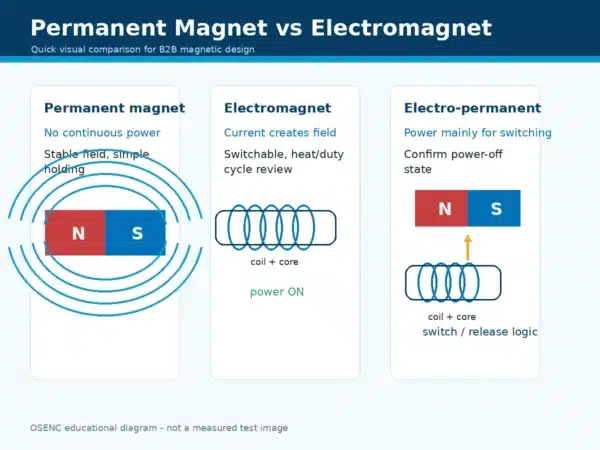
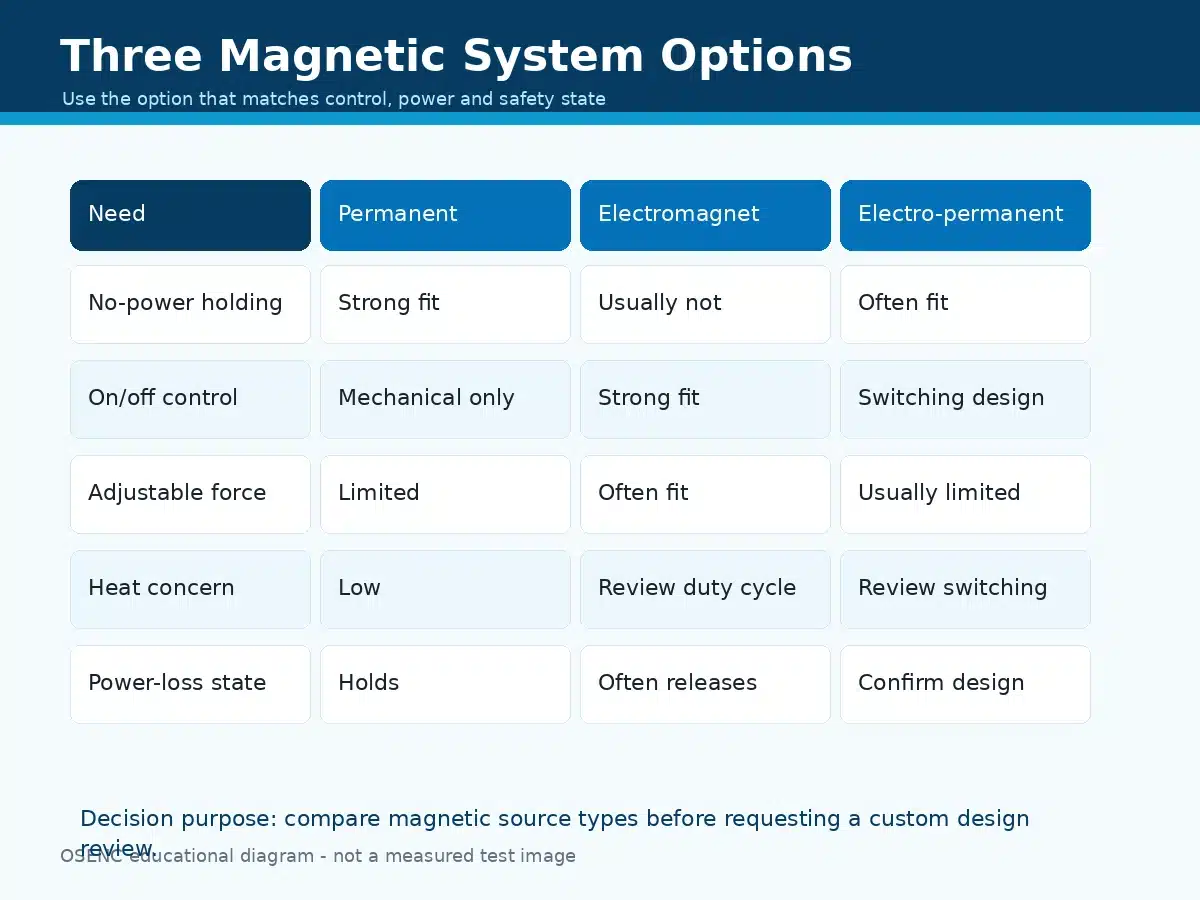
If you are comparing a permanent magnet vs electromagnet, the simple difference is this: a permanent magnet provides a magnetic field without continuous electrical power, while a conventional electromagnet creates its magnetic field when current flows through a coil. For real product design, the better question is whether you need a constant field, an electrically switchable field, adjustable force, or a defined power-off holding state.
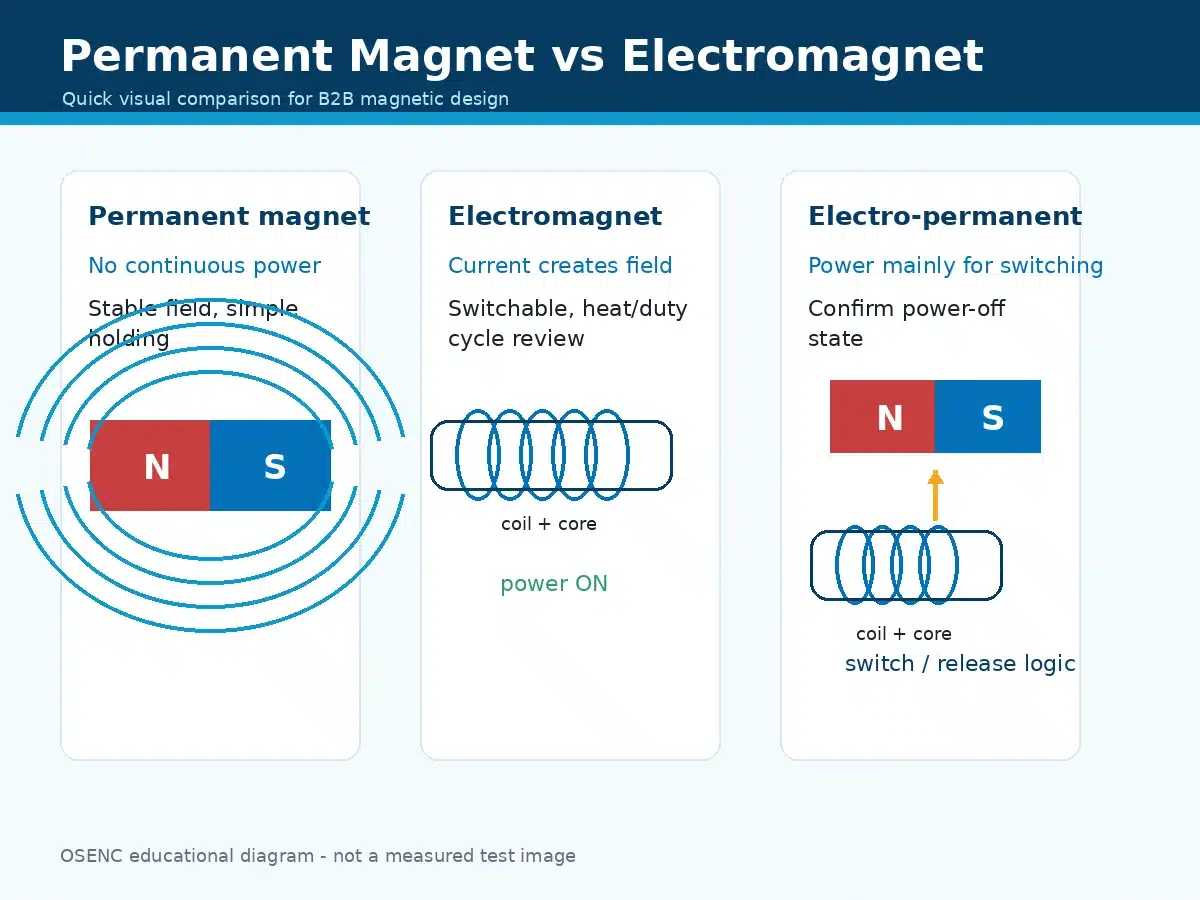
Permanent Magnet vs Electromagnet: Quick Comparison
For an engineering project, the comparison should include three options: permanent magnet, conventional electromagnet, and electro-permanent magnet. Each option can be correct when it matches the working distance, control requirement, power condition, target material, and safety state.
| 팩터 | 영구 자석 | Conventional Electromagnet | Electro-Permanent Magnet |
|---|---|---|---|
| Power needed to hold magnetic force | No continuous power | Usually needs continuous power | Usually power is used mainly for switching or release, depending on design |
| Field control | Not electrically adjustable in normal use | Can be switched and often adjusted by current | Switchable, but control method depends on structure |
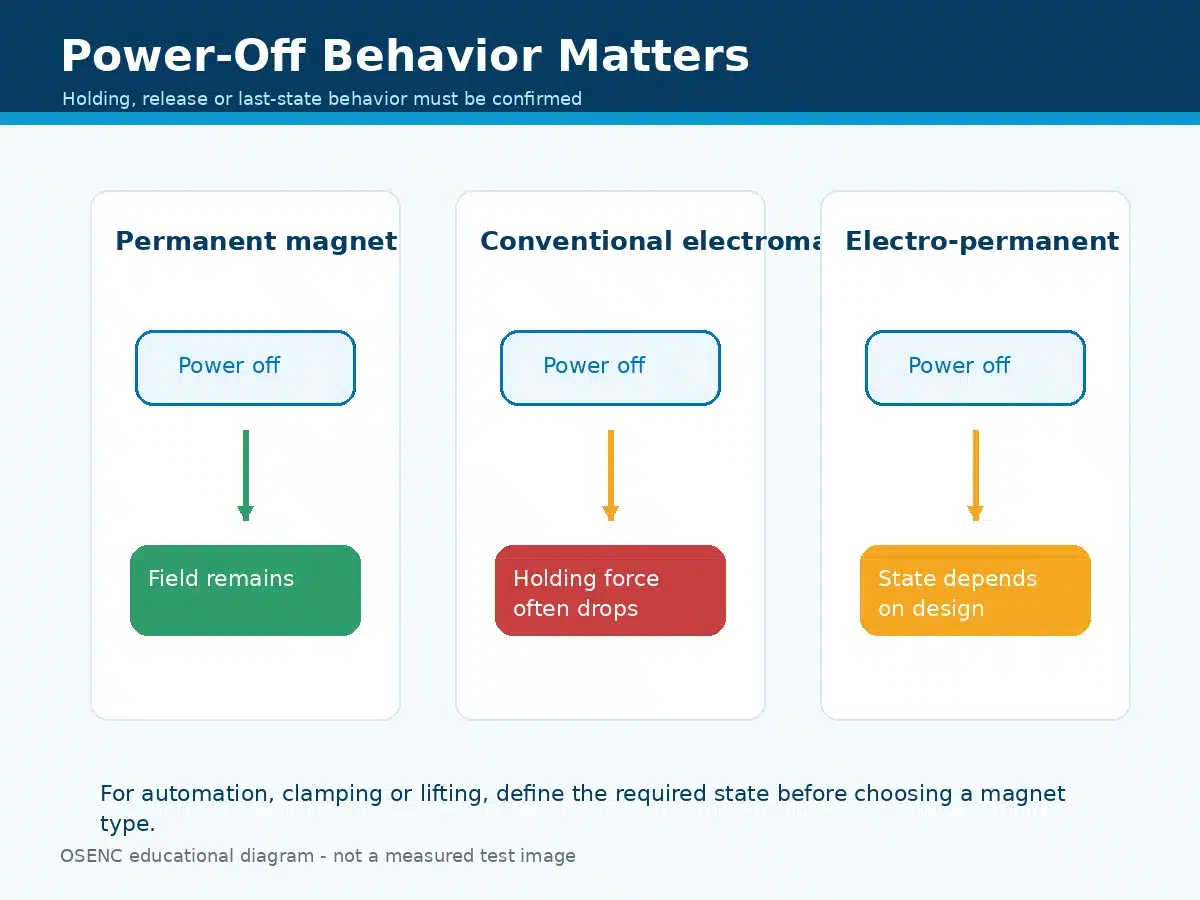
| Power-off behavior | Keeps magnetic field | Usually loses holding force when power stops | May keep holding force after switching, depending on design |
| Heat risk | No coil heating | Coil heating and duty cycle must be checked | Lower holding heat in many designs, but switching system still needs review |
| 최상의 대상 | Constant holding, sensing, compact assemblies, no-power applications | On/off gripping, release, sorting, automation control | Holding with lower continuous power demand or controlled release |
| Main risk | Wrong grade, shape, coating, air gap, or magnetization direction | Overheating, insufficient power, unsafe power-loss behavior | Misunderstanding switching logic or release state |
What Is a Permanent Magnet?
A permanent magnet is a magnetic material that can maintain a magnetic field without continuous electrical input. Common permanent magnet materials include neodymium, ferrite, SmCo, and Alnico.
For OSENC’s usual B2B projects, the most common focus is 맞춤형 네오디뮴 자석 and magnetic assemblies. These may include micro magnets, large magnets, high-grade magnets, irregular shapes, motor rotors, magnetic couplings, Halbach arrays, and other engineered assemblies.
A permanent magnet is usually a better starting point when the design needs stable magnetic force in a compact space and does not need electrical switching.
What Is an Electromagnet?
A conventional electromagnet uses electrical current through a coil to create a magnetic field. In many designs, the magnetic force can be switched on or off by controlling the current.
This makes an electromagnet useful when the application needs release, timing control, sorting, lifting, gripping, or automation logic.
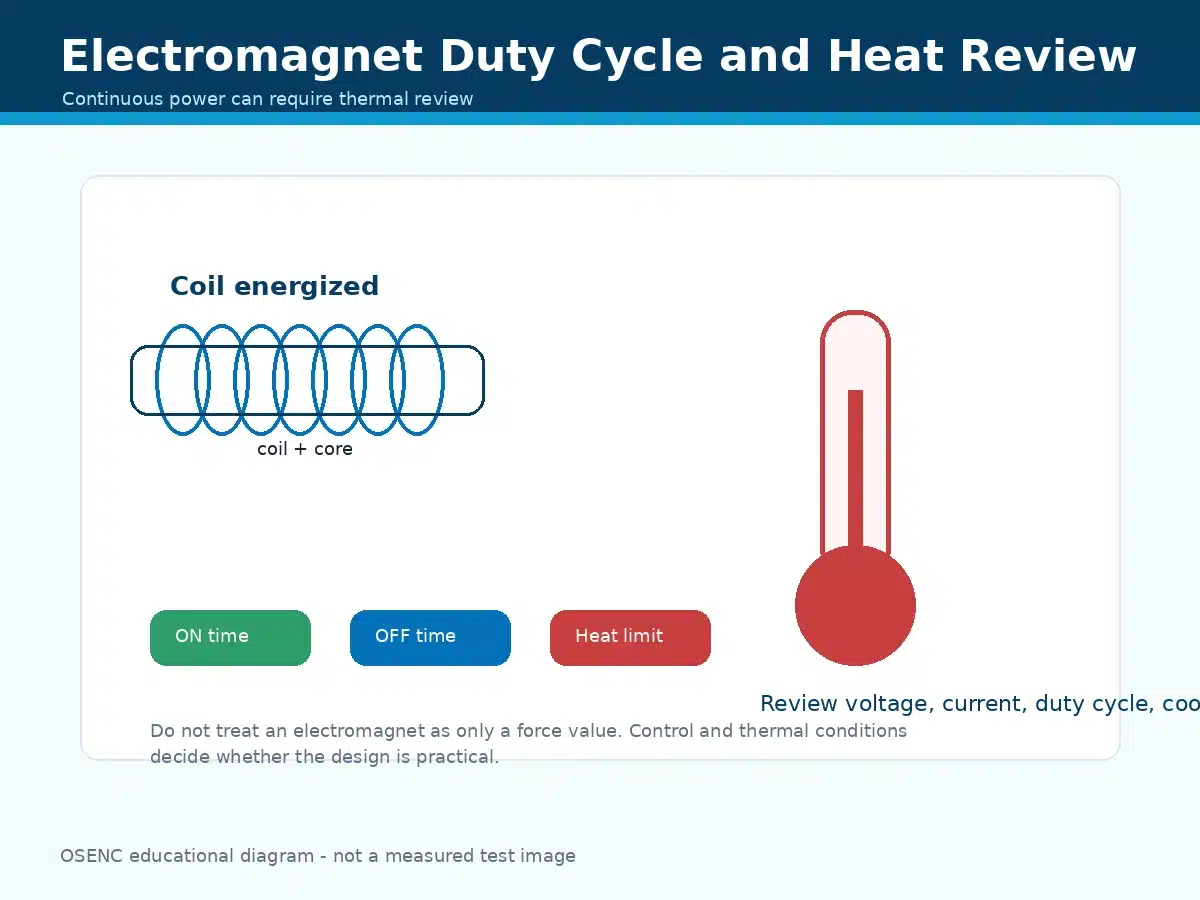
The trade-off is that the coil, power supply, and heat must be reviewed. Duty cycle matters because continuous energizing can generate heat and reduce performance if the design is not sized correctly.
What Is an Electro-Permanent Magnet?
An electro-permanent magnet is different from a conventional electromagnet. In many designs, it combines permanent magnet elements with an electrical switching system.
That means electrical power may be used mainly to switch the magnetic state or release the workpiece, instead of continuously powering the holding force. The exact behavior depends on the product design.
How Is the Magnetic Field Different?
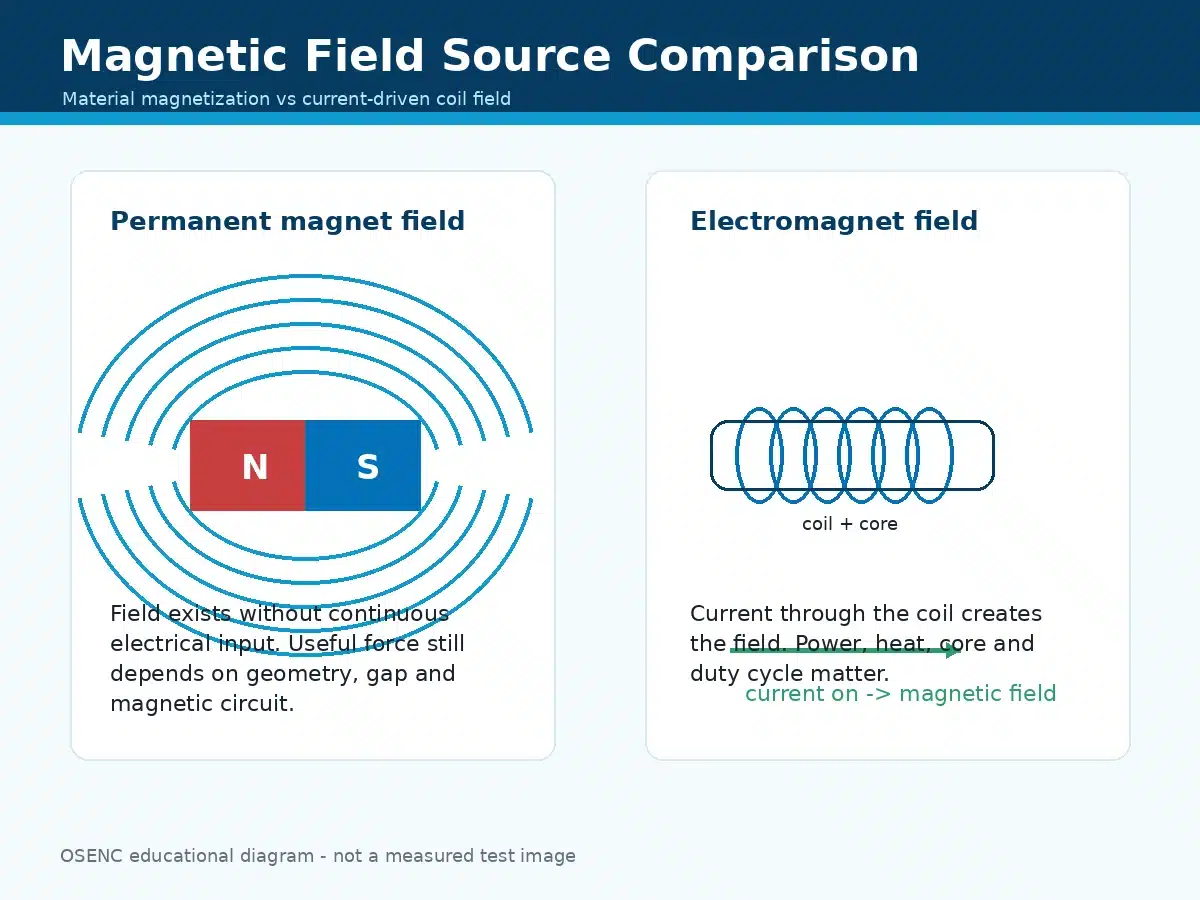
A permanent magnet has a magnetic field because of its material and magnetization. Its useful field depends on grade, size, shape, magnetization direction, pole layout, coating thickness, working gap, and surrounding magnetic circuit.
An electromagnet creates its magnetic field from current. Its field depends on coil design, current, turns, core material, pole area, heat, and the available power supply.
This is why a magnetic field comparison should not rely only on “magnet type.” A small permanent magnet in close contact may outperform a poorly matched electromagnet. A well-designed electromagnet may be better when the field must be switched, adjusted, or released.
When Should You Choose a Permanent Magnet?
Choose a permanent magnet when the magnetic field should be always available without power.
This is common in sensors, encoders, motors, magnetic couplings, holding fixtures, compact devices, rotor assemblies, and many custom magnetic assemblies.
| Requirement | Why Permanent Magnet May Fit |
|---|---|
| No continuous power available | The magnet works without electrical input. |
| 컴팩트한 디자인 | NdFeB can provide high magnetic performance in limited space. |
| Stable field needed | Useful for sensing, positioning, and holding. |
| Lower heat risk | No coil heat during normal holding. |
| Simple assembly | Fewer electrical parts may reduce system complexity. |
If the design needs frequent release, adjustable force, remote switching, or a controlled demagnetized state, another solution may be better.
When Is an Electromagnet the Better Choice?
An electromagnet is often better when the magnetic field must be controlled by a machine, circuit, or operator.
It can be useful for pick-and-place systems, separators, locks, automated holding, release mechanisms, test fixtures, and applications where the field needs to change during operation.
| Requirement | Why Electromagnet May Fit |
|---|---|
| On/off control is required | Current can control magnetic activation. |
| Adjustable force is useful | Current may be adjusted within the design limit. |
| Release is part of the process | The system can de-energize to release in many designs. |
| Automation timing matters | Magnetic action can be connected to sensors and controls. |
| Polarity control is required | Coil direction may affect field direction in suitable designs. |
Voltage, current, power supply stability, coil temperature, duty cycle, installation space, and failure state all matter.
When Does an Electro-Permanent Magnet Make Sense?
An electro-permanent magnet may make sense when the project needs magnetic holding but does not want continuous power during holding.
This can be useful in some workholding, clamping, automation, or handling applications. It may also be useful where power-loss behavior is important.
| 질문 | 중요한 이유 |
|---|---|
| Is it pulse-switched, energize-to-hold, or energize-to-release? | Determines control logic. |
| What happens when power is lost? | Critical for safety and process design. |
| How is release controlled? | Affects automation timing and backup planning. |
| What target material is required? | Magnetic force depends on the magnetic circuit. |
| What air gap is allowed? | Even small gaps can reduce useful holding force. |
Without these details, a buyer may choose the wrong magnetic system even if the nominal force looks attractive.
What Engineering Factors Decide the Choice?
The practical decision depends on the whole magnetic system, not only the magnet name.
| Engineering Factor | 중요한 이유 | 확인해야 할 사항 |
|---|---|---|
| Required function | Holding, sensing, torque, release, and gripping need different designs. | What should the magnet actually do? |
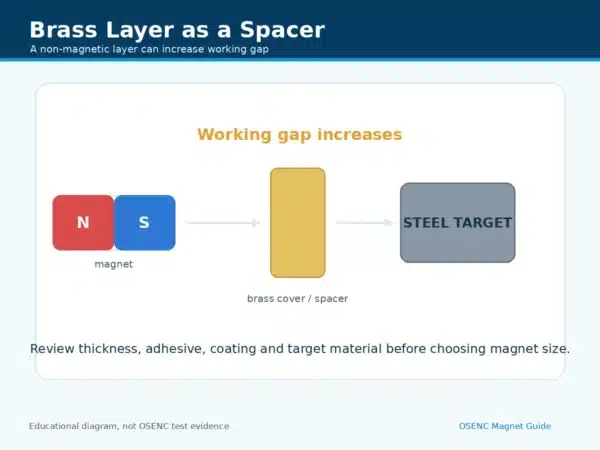
| 업무 공백 | Magnetic force changes strongly with distance and non-magnetic gaps. | Air gap, coating, adhesive, cover, paint, or spacer thickness. |
| 대상 물질 | Steel grade, thickness, and surface condition affect force. | Material, thickness, flatness, coating, rust, or paint. |
| Power condition | Electromagnets need suitable power and control. | Voltage, current, duty cycle, and heat limit. |
| Power-off state | This may decide safety and machine logic. | Hold, release, or remain switched after power loss. |
| Test method | Pull force and field readings depend on test conditions. | Test plate, air gap, direction, fixture, and acceptance target. |
Why “Magnet Strength” Alone Can Mislead You
Many buyers ask which is stronger: an electromagnet or permanent magnet. That question is incomplete.
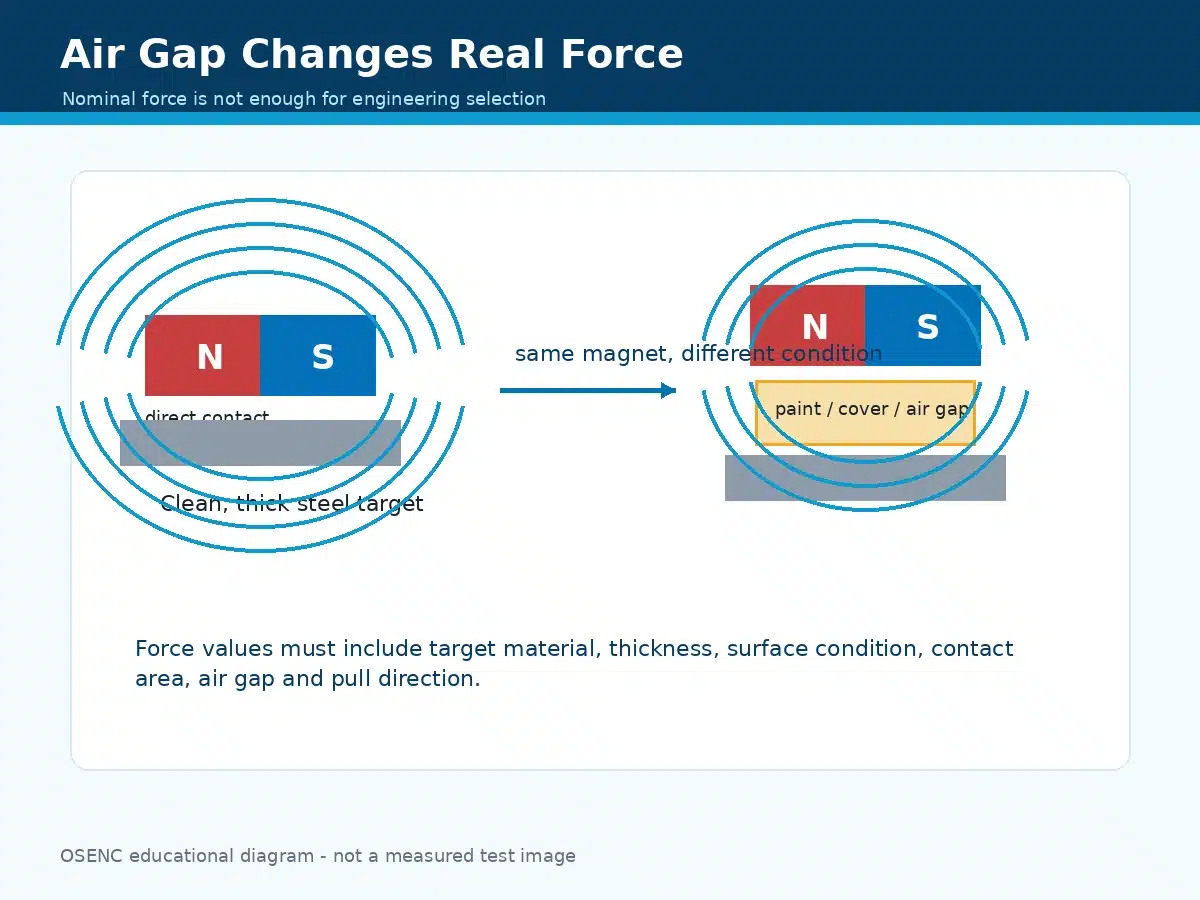
A useful magnetic design should define the required force at the real working distance. It should also define the direction of force, target material, contact area, duty cycle, and safety factor.
For example, a magnet that looks strong in direct contact with thick clean steel may perform very differently through a plastic cover, painted surface, adhesive layer, or curved part.
This is why OSENC usually asks for drawings, samples, or application conditions before recommending a magnet or magnetic assembly.
Could a Magnetic Assembly Be Better Than a Single Magnet?
Yes. In many B2B projects, the real solution is not a single magnet.
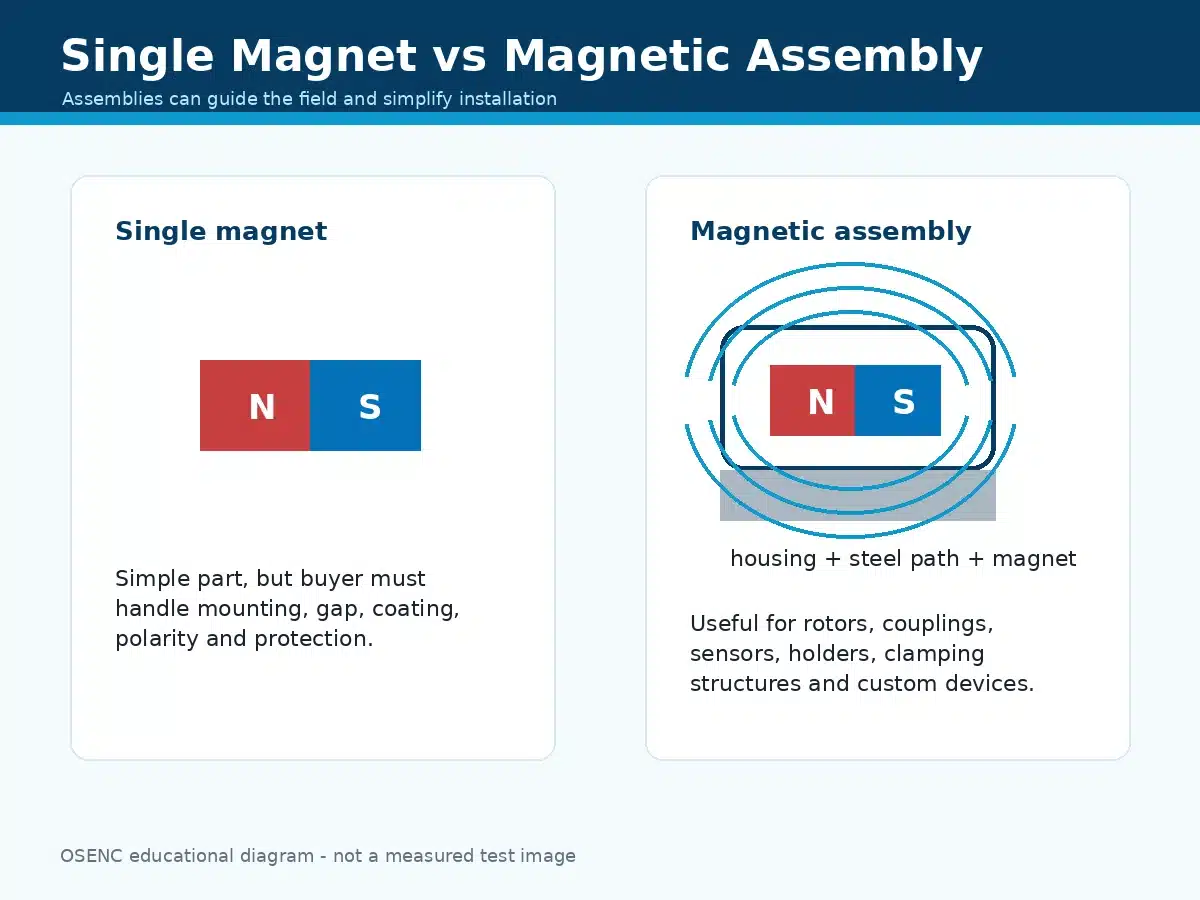
A magnetic assembly may include magnets, steel yokes, pole pieces, housings, shafts, adhesives, coatings, fasteners, or a control structure. These parts can guide the magnetic field and make the product easier to install.
OSENC can help review 네오디뮴 자석 requirements, 마이크로 자석 constraints, and assembly-level magnetic structures when a single catalog part is not enough.
RFQ Checklist: What Should You Send Before Choosing?
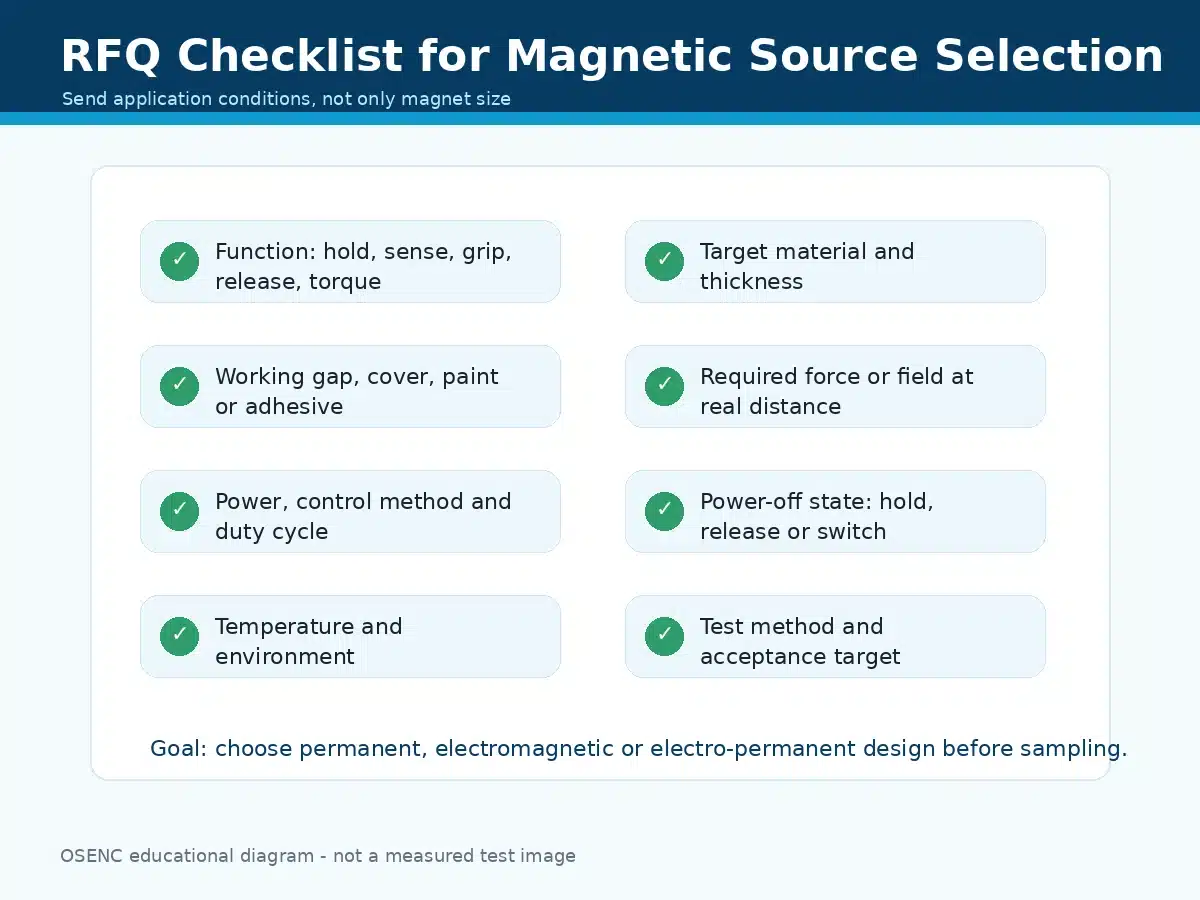
A good RFQ should describe the working condition, not only the magnet size.
| RFQ Information | 왜 도움이 되는가 |
|---|---|
| Application function | Holding, sensing, torque, gripping, clamping, release, or separation. |
| 대상 물질 | Steel type, thickness, surface condition, and coating. |
| 업무 공백 | Air gap, cover thickness, adhesive layer, or paint. |
| Required force or field | Pull force, holding force, torque, or magnetic field target. |
| Power condition | Available voltage, current, control method, and duty cycle. |
| Power-off state | Whether the system must hold, release, or stay locked. |
| 환경 | Moisture, corrosion, oil, dust, or outdoor exposure. |
| 테스트 요구 사항 | Pull test, Gauss check, assembly test, or simulation review. |
If exact force is unknown, send the application drawing and describe what must happen. OSENC can help evaluate whether the project is better suited to a permanent magnet, electromagnet, electro-permanent magnet, or custom magnetic assembly.
Common Mistakes When Comparing Permanent Magnets and Electromagnets
Force depends on target material, contact area, air gap, and pull direction.
A conventional electromagnet and an electro-permanent system may behave very differently when power is lost.
Higher magnetic performance may increase cost, brittleness, temperature sensitivity, or assembly risk.
How OSENC Supports Custom Magnet Selection
OSENC focuses on custom neodymium magnets and magnetic assemblies, including micro magnets, large magnets, high-grade magnets, irregular shapes, motor rotors, magnetic couplings, Halbach arrays, and other engineered magnetic products.
For projects involving electromagnets or electro-permanent magnets, OSENC can help evaluate the magnetic structure, application requirements, and whether a permanent-magnet, electromagnet, or hybrid solution is more suitable.
Depending on the project, OSENC may support magnetic circuit review, FEA, assembly discussion, and testing such as dimension inspection, Gauss check, pull force testing, coating inspection, or other agreed checks. Specific product values, electrical parameters, holding force, and test results should be confirmed from the actual drawing, test condition, and engineering review.
For environmental or dimensional concerns, buyers can also review 네오디뮴 자석 코팅 options and OSENC’s 품질 관리 information before sending an RFQ.
Technical Sources and Limitations
This article uses external sources for basic electromagnetic principles, permanent magnet design boundaries, air-gap and surface-condition cautions, and electro-permanent magnet behavior. It does not publish OSENC-specific voltage, current, duty cycle, holding force, release time, or customer case data because those details were not provided for public use.
자주 묻는 질문
전자석이 영구자석보다 더 강력할까요?
항상 그런 것은 아닙니다. 기존의 전자석은 강력하고 제어 가능한 힘을 발휘하도록 설계될 수 있지만, 실제로 유용한 힘은 코일 설계, 전력, 발열, 극 면적, 공기 갭, 대상 물질의 재질 등에 따라 달라집니다. 영구자석은 형상과 자기 회로가 적절하다면, 전원이 필요 없는 소형 설계에서도 더 강력한 힘을 낼 수 있습니다.
영구 자석에는 전기가 필요한가요?
아닙니다. 영구 자석은 자기장을 유지하기 위해 지속적인 전류가 필요하지 않습니다.
전자석은 전원이 없어도 작동하나요?
일반적인 전자석은 자기장을 생성하기 위해 전류가 필요합니다. 전원이 차단되면 유지력은 대개 떨어집니다. 전기 영구 자석은 이와 다르며, 각 자석의 구체적인 스위칭 설계에 따라 평가해야 합니다.
영구 자석의 가장 큰 장점은 무엇인가요?
가장 큰 장점은 지속적인 전원이 없어도 안정적인 자력을 유지할 수 있다는 점입니다. 이를 통해 배선, 발열 및 전력 시스템의 복잡성을 줄일 수 있습니다.
전자석의 가장 큰 장점은 무엇인가요?
가장 큰 장점은 제어성입니다. 자기장은 대개 전기적 제어를 통해 켜고 끄거나, 시간을 조절하거나, 강도를 조절할 수 있습니다.
전기 영구 자석의 가장 큰 장점은 무엇인가요?
주요 장점은 많은 설계가 스위칭 후에도 지속적인 유지력이 없어도 자력을 유지할 수 있다는 점입니다. 하지만 스위칭 방식, 해제 상태 및 전력 손실 특성을 반드시 확인해야 합니다.
자동화에 가장 적합한 옵션은 무엇일까요?
이는 자동화 시스템에 지속적인 유지, 제어된 해제, 힘 조절, 저발열, 또는 정의된 전원 차단 상태 중 어떤 기능이 필요한지에 따라 달라집니다. 영구 자석, 전자석, 전기 영구 자석은 각각 다른 시스템에서 모두 적합한 선택이 될 수 있습니다.
검토를 위해 OSENC에 무엇을 보내야 하나요?
Send drawings, target material, working gap, required force, temperature, available space, power condition, power-off behavior, production quantity, and any test requirements. If you are not sure which magnet type fits, OSENC can help compare the options before sampling.
Need Help Choosing a Magnetic Field Source?
Send OSENC your drawing, target material, working gap, force target, power condition, and required power-off behavior. We can help review whether a permanent magnet, electromagnet, electro-permanent magnet, or custom magnetic assembly is the better starting point.
엔지니어링 검토 요청하기