






Quick Answer: What Is a Permanent Magnet?
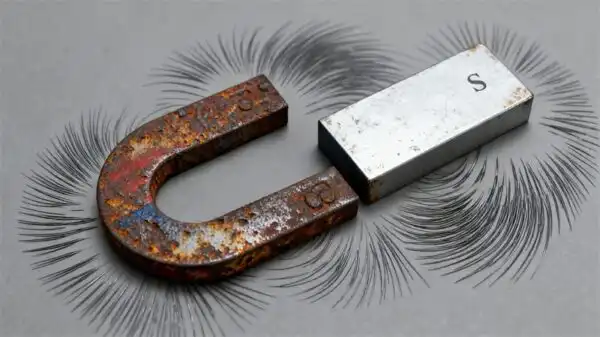
A permanent magnet is a magnetically hard material that retains a useful magnetic field after the external magnetizing field is removed. It does not need continuous electrical power to maintain that field.
“Permanent” does not mean the magnet can never weaken. Excessive temperature, a strong opposing magnetic field, corrosion or physical damage can reduce performance. In a real product, the result also depends on material, geometry, magnetization direction, magnetic circuit, air gap and operating conditions.
For engineers and buyers, the useful question is not simply “Which magnet is strongest?” It is which material and finished design can deliver the required field, force, torque or sensor signal at the actual working point?
What Makes a Magnet Permanent?
Permanent magnets retain magnetization because their magnetic domains remain preferentially aligned after the magnetizing field is removed. Materials designed for this job are often called magnetically hard materials.
Two properties are especially important. Remanence (Br) describes the residual magnetic flux density remaining after magnetization. Coercivity describes resistance to demagnetization by an opposing field.
A useful permanent magnet needs enough remanence to supply magnetic flux and enough coercivity to remain stable in its operating environment. The balance matters. A material with high remanence but inadequate resistance to demagnetization can be a poor choice in a short, open magnetic circuit or at elevated temperature.

What Are Permanent Magnets Made Of?
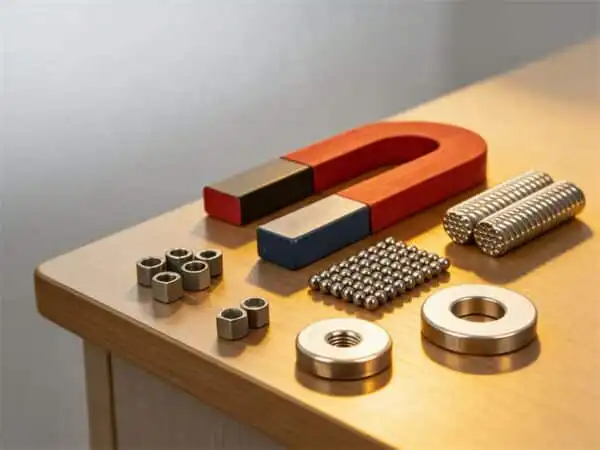
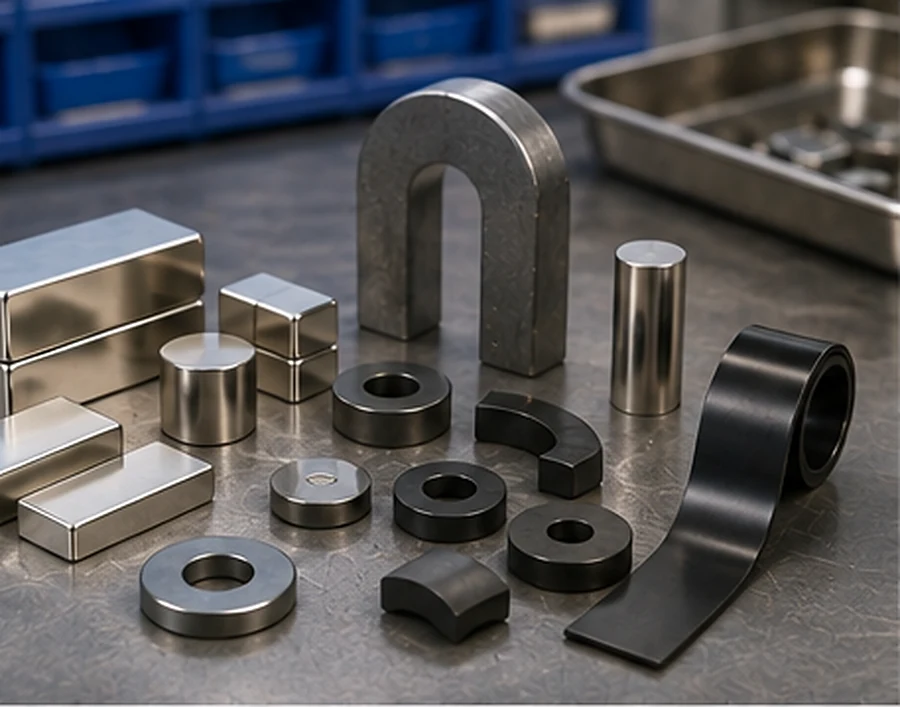
Most modern engineering applications use four principal permanent-magnet material families: neodymium iron boron, samarium cobalt, ferrite and Alnico.
| Material family | Main engineering advantage | Main limitation to check | Typical selection direction |
|---|---|---|---|
| Neodymium iron boron (NdFeB) | Very high magnetic performance for compact designs | Temperature margin, corrosion protection and brittleness | High field or force in limited space |
| Samarium cobalt (SmCo) | Strong thermal stability and good corrosion resistance | Higher material cost and brittle mechanical behavior | High-temperature or demanding environments |
| Ferrite / ceramic | Low cost and strong corrosion resistance | Lower magnetic performance usually requires more volume | Cost-sensitive, larger-volume designs |
| Alnico | High remanence and strong temperature stability | Relatively low coercivity makes geometry and demagnetizing fields important | Stable-field applications with suitable magnetic-circuit geometry |
Bonded and flexible magnets are better treated as manufacturing routes rather than a universal fifth base material family. Magnetic powders such as ferrite or NdFeB can be combined with polymer binders to create flexible products, complex shapes or multipole features. The trade-off is usually lower magnetic loading than a comparable dense material.
For a broader taxonomy, see OSENC’s guide to types of magnets.
Neodymium Magnets
NdFeB is the most relevant permanent-magnet family for compact, high-performance products. It is widely used when designers need more magnetic output from a limited envelope.
That does not make the highest NdFeB grade the automatic best choice. Grade selection changes material properties such as remanence, coercivity and maximum energy product, while the finished result still depends on dimensions, pole direction, air gap, surrounding steel, temperature and assembly.
OSENC focuses on custom neodymium magnets and magnetic assemblies, so the supplier guidance on this page is intentionally limited to NdFeB projects rather than implying that OSENC supplies every permanent-magnet family.
Why Two Magnets Described as the Same Material Can Perform Differently
Material family is only the first layer of a permanent-magnet specification. Two parts described simply as “NdFeB magnets” are not automatically interchangeable, because the family name does not define grade, dimensions, magnetization, temperature margin or the magnetic circuit around the part.
Even within a nominal material class, magnetic properties are linked to composition, microstructure and processing. Materials research on high-performance permanent magnets shows that relatively small structural differences can change coercivity and demagnetization behavior. For background on these microstructure-property relationships, see research from the Max Planck Institute for Sustainable Materials.
The finished component adds another layer: geometry changes the self-demagnetizing field, magnetization direction changes the field pattern, surrounding steel changes the magnetic circuit, and the working gap changes what the application actually receives.
Which Permanent-Magnet Properties Matter for Which Decision?
| Property | What it describes | Main engineering use | What it does not tell you by itself |
|---|---|---|---|
| Br | Remanent flux density after magnetization | Compare a material’s ability to provide magnetic flux | Finished surface Gauss or field at the actual working distance |
| HcB / Hcb | Reverse field required to reduce magnetic flux density B to zero | Understand the B-H demagnetization behavior of the material | Full resistance to irreversible demagnetization |
| HcJ / Hcj | Reverse field required to reduce magnetic polarization J to zero | Assess intrinsic resistance to irreversible demagnetization | Finished force, torque or sensor output |
| (BH)max | Maximum energy product of the material | Compare magnetic energy capability per unit volume | Exact magnet dimensions or application performance |
| Surface field / Gauss | Field measured at a stated location on or near a finished magnet | Verify a defined local field measurement | Pull force or field at another distance without geometry and circuit context |
| Pull force | Force under a particular test setup | Verify holding performance under a defined fixture and contact condition | Performance with a different steel target, gap, coating or alignment |
The distinction is not academic paperwork. The IEC standard for magnetically hard materials defines measurement of magnetic flux density, magnetic polarization, field strength and demagnetization curves. See IEC 60404-5:2015. ASTM also publishes a hysteresigraph test method for high-coercivity permanent-magnet materials in ASTM A977/A977M.
Why Grade or Surface Gauss Alone Cannot Select a Permanent Magnet
A common RFQ arrives as something like “I need N52” or “I need 5,000 gauss.” Neither statement is enough to define the finished magnet.
A surface-field reading changes with magnet shape, magnetization direction, measurement position and probe distance. The useful field in a sensor or motor is often measured at a working distance, not directly on the magnet surface.
Pull force is equally dependent on the test circuit. Air gap, target steel thickness, contact area, surface finish and alignment can change the measured force even when the magnet itself is unchanged.
Engineering chain
- Condition: the application requires a target field, force, torque or sensor signal.
- Variable change: dimensions, pole direction, material grade, air gap or surrounding steel changes.
- Physical mechanism: the magnetic circuit and operating point change.
- Limiting factor: available space, demagnetizing field, temperature or saturation in nearby steel may constrain the design.
- Engineering consequence: the same grade can produce different finished performance.
- Observable result: field or force at the actual working point changes.
- Verification: check the specified distance, target material and test configuration.
- Buyer action: send the functional target and test condition with the drawing instead of requesting a grade or Gauss number alone.

Material Data Is the Starting Point, Not the Acceptance Criterion
A material datasheet describes what the magnetic material is capable of under defined test conditions. The application, however, uses a finished component inside a magnetic circuit. That means the acceptance criterion should normally be tied to what the assembly needs: a field at a defined position, a force under a defined fixture, torque across a specified gap or another measurable functional result.
For a deeper explanation of measurement position, see Magnet Gauss.
Temperature: Working Temperature Is Not Curie Temperature
The working temperature is the temperature range the finished magnet must survive while still meeting the application requirement. The Curie temperature is a material transition temperature at which ferromagnetic ordering is lost. These are not interchangeable.
A magnet can suffer unacceptable reversible or irreversible magnetic loss before reaching its Curie temperature. The risk depends on material family, grade, geometry, the magnet’s operating point and the external magnetic circuit.
For NdFeB, intrinsic coercivity is particularly important when the design faces elevated temperature or an opposing field. A higher-temperature grade may improve demagnetization margin, but it can also change other material properties and cost. Temperature alone therefore does not determine the final grade.
Define continuous temperature, peak or fault temperature, exposure duration, nearby opposing fields, magnet geometry, air gap and required performance after thermal exposure. OSENC has a separate explanation of how temperature affects magnet strength.
Permanent Magnet vs Electromagnet
A permanent magnet supplies a persistent magnetic field without continuous electrical excitation. An electromagnet produces its field from electric current flowing through a coil.

| Decision factor | Permanent magnet | Electromagnet |
|---|---|---|
| Continuous electrical power for field | Not required | Required |
| Easy on/off control | No | Yes |
| Field adjustment during operation | Limited without mechanical or magnetic-circuit changes | Can be controlled through current and circuit design |
| Heat from excitation current | None in the magnet itself | Coil losses can create heat |
| Main design risks | Demagnetization, temperature, geometry, corrosion, assembly | Coil heating, power supply, insulation, control and magnetic circuit |
Neither is universally better. Use a permanent magnet when an always-available field and compact passive source are valuable. Use an electromagnet when switching or active field control is essential.
Permanent Magnet Applications: What Changes the Selection?
Permanent magnets appear in motors, generators, sensors, loudspeakers, magnetic couplings, holding systems, consumer electronics and industrial assemblies. The application name identifies the function, but it does not define the exact magnet.
| Application condition | Main magnetic requirement | Engineering priorities to check |
|---|---|---|
| Electric motors and generators | Flux and torque contribution in a rotating magnetic circuit | Temperature, demagnetization margin, geometry, pole layout and surrounding steel |
| Sensors and encoders | Stable field or field pattern at a defined sensing position | Working distance, tolerance stack, magnetization direction and position repeatability |
| Speakers and actuators | Stable bias field interacting with a moving or current-carrying element | Gap geometry, field uniformity, temperature and assembly tolerances |
| Holding and latching assemblies | Attraction force through a steel target or magnetic circuit | Air gap, target steel, contact area, coating, alignment and release requirement |
| Magnetic couplings | Torque transfer across a physical barrier or controlled gap | Gap, pole count, geometry, temperature and demagnetization margin |
This is why “magnet for a motor” or “magnet for a sensor” is not an exact specification. Two products with the same application name can require different material families, grades, dimensions and pole patterns because their magnetic circuits and operating conditions are different. See Motor and Permanent Magnet for that dedicated topic.

How to Choose a Permanent Magnet for an Engineering Project
1. Define the useful magnetic result
Specify what the magnet must do: field at a sensor, pull force, torque, holding force, flux in a gap or another measurable function.
2. Define the geometry and working distance
Provide the available envelope, air gap, surrounding steel, target material and moving interfaces. Field decays with distance, so a surface measurement is not a substitute for the working point.
3. Define the temperature condition
Record normal, peak and abnormal temperatures. Do not use Curie temperature as the design limit.
4. Define the environment
Moisture, salt, chemicals, abrasion and assembly processes can affect coating or material choice. NdFeB projects often require deliberate corrosion protection. OSENC’s neodymium magnet coating guide covers the main coating decision factors.
5. Define magnetization direction and pole layout
Axial, diametrical, radial and multipole magnetization can create very different field patterns from the same external shape. The drawing should state the required pole direction or functional field pattern. See Direction of the Magnetic Field.
6. Define how performance will be verified
A useful specification states the test condition. Depending on the project, that may be dimensional inspection, a field reading at a defined position, pull force under a defined setup, or assembly-level validation.

Five Magnet Selection Shortcuts to Avoid
Many failed specifications begin with a shortcut that removes the application condition from the decision. These five are especially risky:
| Shortcut | Why it fails | Better buyer action |
|---|---|---|
| Choose by grade alone | A higher grade changes material capability but does not fix geometry, air gap or magnetic-circuit limitations. | Define the functional target and available envelope first. |
| Choose by surface Gauss alone | A surface reading does not equal the field at a sensor or other working distance. | Specify the measurement position and required field there. |
| Choose by pull force alone | Pull force changes with steel target, contact area, coating, alignment and air gap. | Define the test fixture and contact condition. |
| Choose by temperature rating alone | Demagnetization risk also depends on grade, geometry, reverse fields and operating point. | Provide continuous, peak and fault temperature with the magnetic condition. |
| Copy a magnet from a similar application | The same application name can hide a different gap, pole pattern, housing or magnetic circuit. | Compare the actual drawing and acceptance condition, not only the application label. |
What to Send OSENC for a Custom NdFeB Magnet RFQ
For a custom neodymium magnet or magnetic assembly, send the information that changes the design, manufacturing route, verification method or price:
- drawing, shape and dimensions;
- dimensional tolerances that matter to assembly;
- target field, force, torque or sensor requirement with the measurement condition;
- working distance or air gap;
- continuous, peak and fault operating temperature where relevant;
- environment and corrosion exposure;
- magnetization direction or pole layout;
- mating steel, adhesive, housing or assembly constraints;
- prototype and expected production quantity;
- required inspection or acceptance test.
Those inputs create a practical basis for discussing material grade, coating, tolerance, magnetization and validation direction with OSENC. If the design is still incomplete, start with the functional target and drawing rather than guessing the “strongest” magnet.

Send the geometry, working gap, temperature, environment and verification condition so the discussion starts from the real design constraint.
Request an Engineering ReviewFAQ
Are permanent magnets really permanent?
They can retain useful magnetization for long periods when operated within appropriate thermal, magnetic, environmental and mechanical limits, but they are not immune to demagnetization. Excessive heat, strong reverse fields, corrosion or damage can reduce performance.
What material is used to make a permanent magnet?
The main engineering families are NdFeB, SmCo, ferrite and Alnico. Bonded and flexible magnets are manufacturing routes that can use magnetic powders such as ferrite or NdFeB with polymer binders.
What is the strongest type of permanent magnet?
NdFeB generally provides the highest energy product among widely used commercial permanent-magnet materials at room temperature, which makes it valuable for compact high-performance designs. That does not mean the highest NdFeB grade is automatically the best choice for every temperature, geometry or magnetic circuit.
Can a permanent magnet lose its strength?
Yes. Temperature, opposing magnetic fields, corrosion, mechanical damage and an unfavorable operating point can all reduce useful performance. The correct verification method depends on the application.
Does a higher magnet grade always make the finished magnet stronger?
No. Grade describes material capability, while finished performance also depends on dimensions, magnetization, air gap, surrounding steel, temperature and the test position. A higher grade can be wasted if another part of the magnetic circuit is the limiting factor.
What is the difference between a permanent magnet and an electromagnet?
A permanent magnet retains a magnetic field without continuous electrical power. An electromagnet creates a field when current flows through a coil, so its field can be switched or adjusted more easily.