Material Check | Aluminum and Magnets
Quick Answer: Is Aluminum Magnetic?
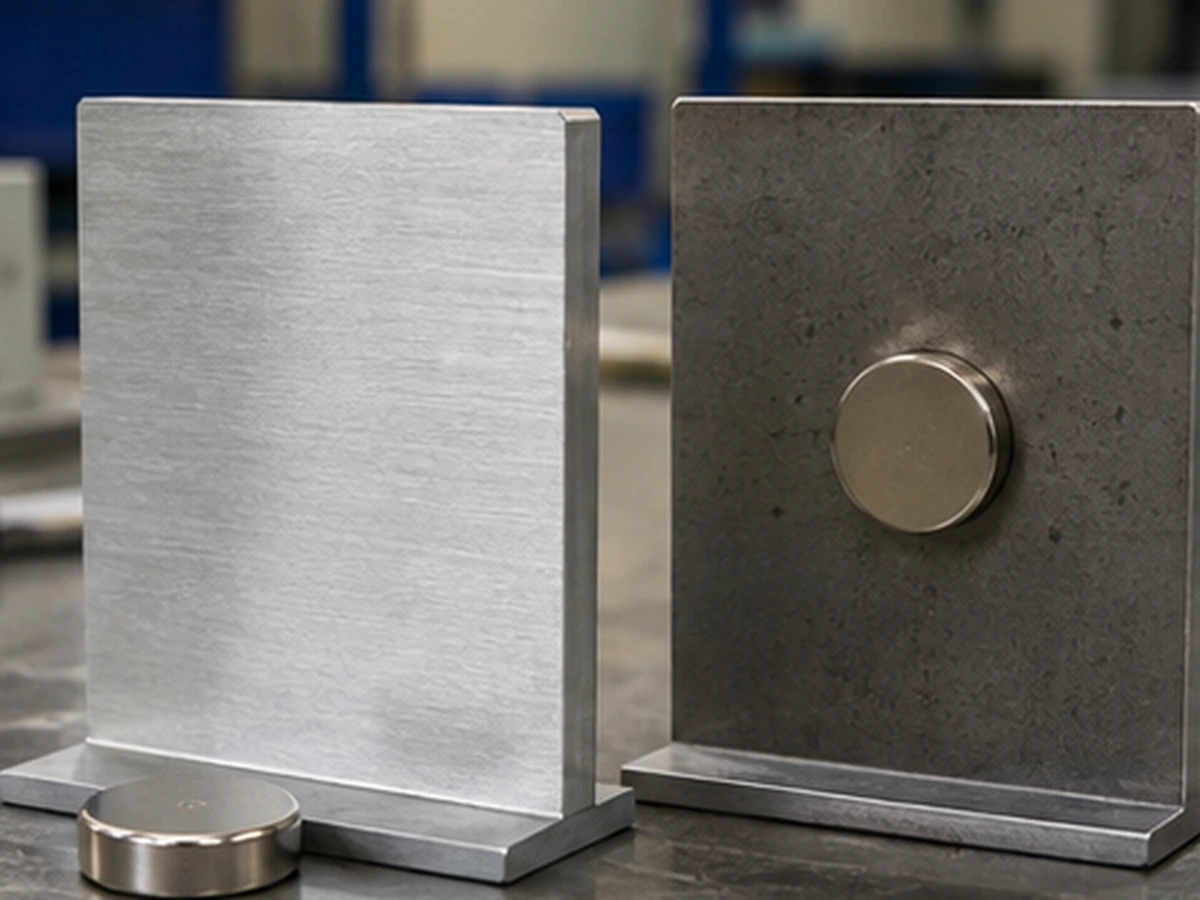
No, aluminum is not magnetic in the way iron, nickel or ordinary carbon steel is magnetic. A permanent magnet will not normally stick to a piece of aluminum.
Technically, aluminum is weakly paramagnetic. It responds slightly to an applied magnetic field, but the effect is far too weak to make a normal magnet stick to it.
Aluminum can still interact with magnets in two important situations:
- A magnet or magnetic field moves relative to the aluminum.
- A magnet attracts a steel component located behind an aluminum panel.
These effects come from electromagnetic induction or from another ferromagnetic material in the assembly. They do not mean the aluminum has become a permanent magnet.
Aluminum and Magnets: Quick Comparison
| Situation | Expected result | Main reason |
|---|---|---|
| A stationary magnet touches bulk aluminum | Normally no noticeable attraction | Aluminum is not ferromagnetic |
| A stronger neodymium magnet touches aluminum | Still does not attach like it does to steel | A stronger field does not change aluminum’s material class |
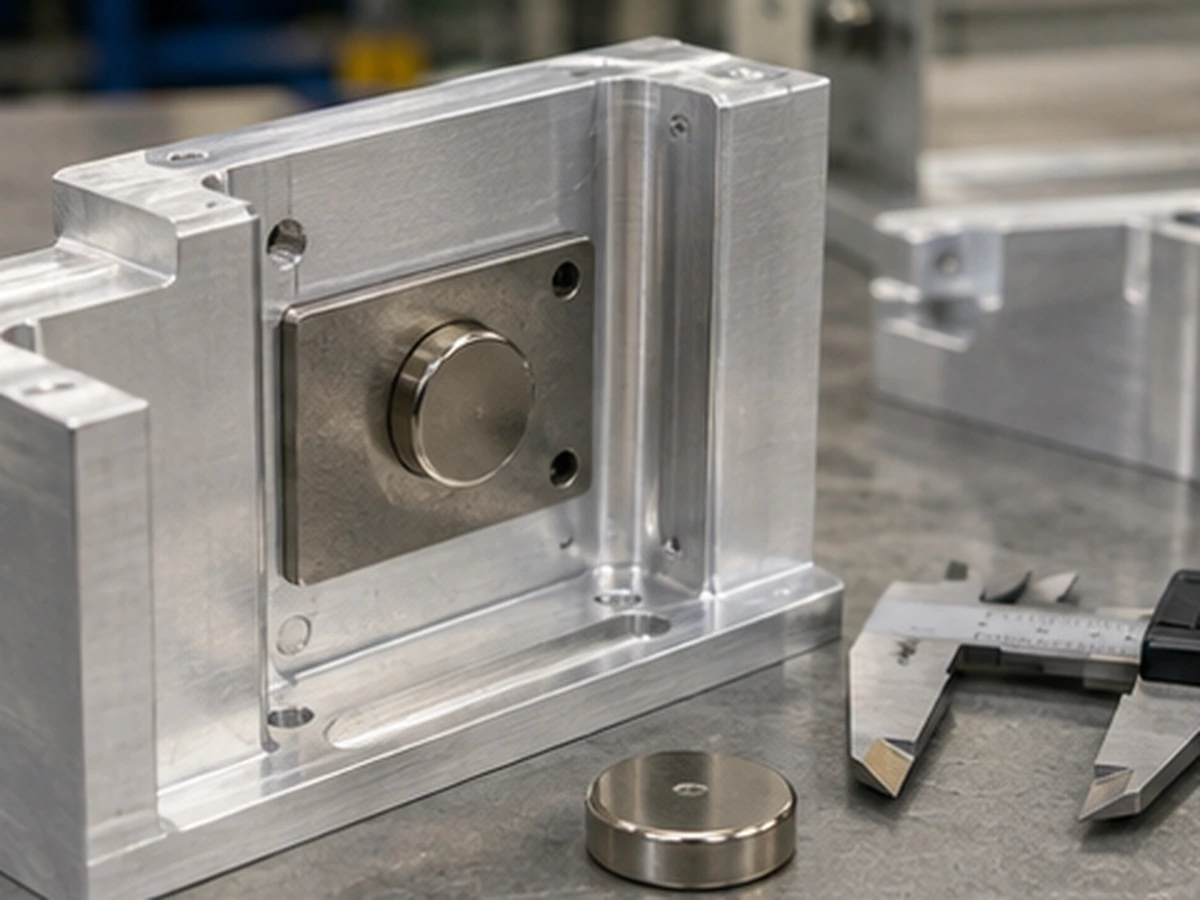
| Aluminum separates a magnet from steel | The magnet may attract the steel through the aluminum | The aluminum becomes part of the total working gap |
| A magnet moves near aluminum | Drag, resistance or braking may occur | Changing magnetic flux induces eddy currents |
| Aluminum is exposed to an alternating field | Eddy currents and possible heating may occur | The field continues changing even without mechanical motion |
| A magnet sticks to an “aluminum” assembly | Inspect the complete assembly | Steel fasteners, inserts, shafts or backing may be responsible |
Is Aluminum Really Non-Magnetic?
For everyday use, calling aluminum “non-magnetic” is reasonable because a permanent magnet does not normally stick to it.
In materials science, the more accurate term is paramagnetic. Paramagnetic materials develop a very small response in the direction of an applied magnetic field, but they do not retain the strong permanent magnetization associated with ferromagnetic materials.
OpenStax classifies aluminum as paramagnetic and explains that the response of paramagnetic materials is weak and does not produce permanent magnetization after the applied field is removed.
The practical distinction is:
| Material behavior | Response to a permanent magnet | Retains useful permanent magnetization? |
|---|---|---|
| Ferromagnetic | Strong attraction may occur | Often possible |
| Paramagnetic | Very weak attraction under an applied field | No ordinary permanent magnetization |
| Diamagnetic | Very weak opposing response | No |
Therefore, aluminum is not completely unaffected by magnetic fields, but its static response is too small for ordinary magnetic attachment.
Why Doesn’t Aluminum Stick to Magnets?
Permanent magnets stick strongly to ferromagnetic materials because those materials can develop a substantial magnetization in response to the applied field.
Bulk aluminum does not provide the same strong magnetic return path. Even a high-strength neodymium magnet will not make it behave like carbon steel.
This distinction matters when specifying a magnetic closure, mounting system or holding fixture. If the target surface is aluminum, increasing the magnet grade alone will not create normal steel-like attachment.
Common alternatives include:
- Adding a suitable steel target plate.
- Installing the magnet inside a mechanical holder.
- Capturing the magnet in a pocket or bracket.
- Using a project-specific adhesive system.
- Redesigning the assembly so the magnet acts on another magnet or ferromagnetic component.
The retention method should be selected from the actual load, environment and service conditions rather than from the magnet grade alone.
Why Can a Moving Magnet Affect Aluminum?
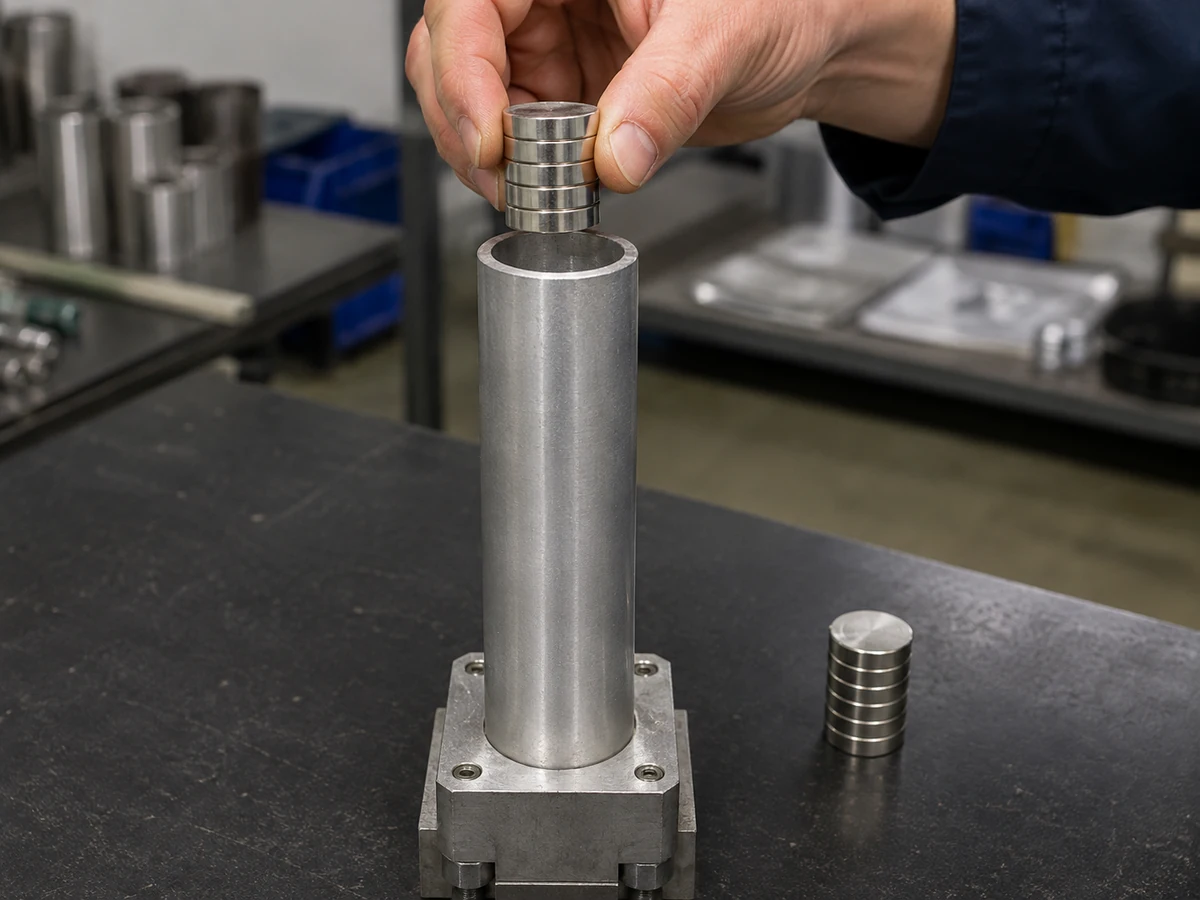
Aluminum is a good electrical conductor. When a magnet moves relative to aluminum, the magnetic flux through the conductor changes and can induce circulating electrical currents called eddy currents.

Those currents create their own magnetic field. Under Lenz’s law, the induced effect opposes the change that produced it, which can create drag or braking.
The University of Maryland demonstrates this by dropping a strong magnet arrangement through an aluminum tube. The changing flux induces currents in the tube that oppose the falling motion.
This does not mean the aluminum has become ferromagnetic. The interaction depends on changing magnetic flux.
Factors that can affect the result include:
- Relative speed.
- Field strength and field gradient.
- Magnet-to-aluminum distance.
- Aluminum thickness and geometry.
- Electrical conductivity.
- Available paths for circulating current.
- Field frequency.
- Dynamic duty cycle.
Slots or breaks in a conductive plate can restrict the current paths and reduce magnetic damping. This is why two aluminum parts with different shapes may behave differently near the same moving magnet. See the UCF/OpenStax explanation of eddy currents.
If relative motion stops and the applied field is not otherwise changing, the induced currents decay and the damping force falls to zero. However, an alternating or otherwise time-varying field can continue to induce eddy currents without mechanical motion.
Continuous or high-frequency operation may also produce electrical losses and temperature rise. The actual drag force and heating cannot be determined from the word “aluminum” alone; they require the magnet layout, conductor geometry, speed or frequency and duty cycle.
Does Aluminum Block a Magnetic Field?
An ordinary aluminum sheet does not shield a static magnetic field through the same mechanism that it can oppose a changing field.
In a stationary permanent-magnet application, the magnetic flux is not changing, so the aluminum does not create continuous eddy-current shielding. A magnet may therefore attract a ferromagnetic target behind the sheet.
However, the aluminum thickness becomes part of the total distance between the magnet and the target. This added gap can substantially reduce usable force.
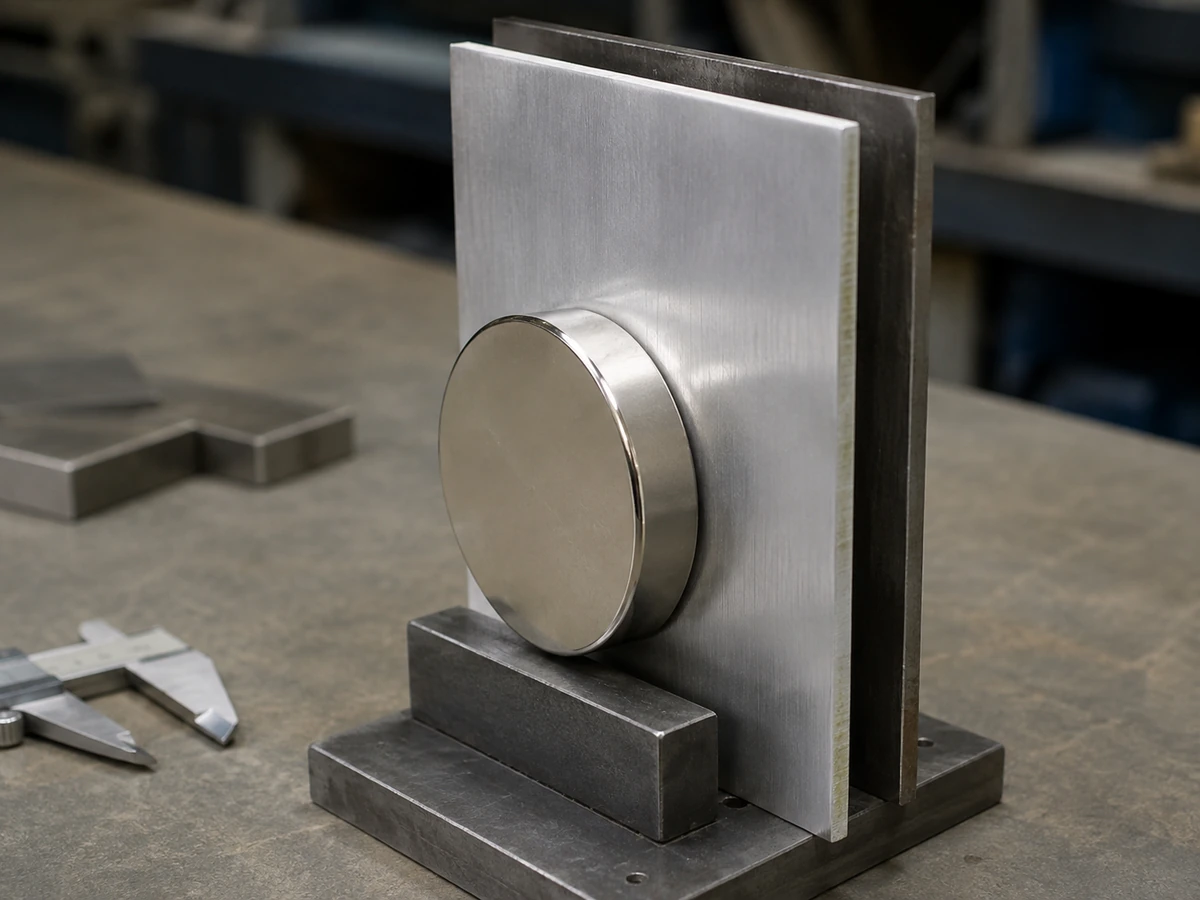
For a static attachment design, evaluate:
- Aluminum thickness.
- Coatings and adhesive layers.
- Additional air gaps.
- Magnet dimensions and magnetization direction.
- Target-steel material.
- Target size and thickness.
- Alignment and contact area.
- Required load direction.
A direct-contact pull-force value should not be treated as the final force through an aluminum panel. Published pull-force values are commonly measured under controlled conditions using a large, flat and sufficiently thick steel target. Different gaps, surfaces and steel dimensions can change the result. See K&J Magnetics’ pull-force test conditions.
Prototype testing in the real assembly is the safest basis for final design approval.
Changing fields are different. A conductive sheet can oppose a rapidly changing magnetic field by generating induced currents, and the result depends on frequency, resistivity, thickness and geometry. Aluminum should therefore not be described as either universally transparent to magnetic fields or a universal magnetic shield.
Why Does a Magnet Sometimes Stick to an Aluminum Part?
A magnet test examines the complete object, not just the visible surface.
If a stationary magnet shows clear attraction to a part identified as aluminum, inspect the assembly before concluding that the aluminum itself is strongly magnetic.
| Observation | Possible explanation | Recommended check |
|---|---|---|
| Attraction is concentrated near holes | Steel screws, threaded inserts or bushings | Remove or test the hardware separately |
| Attraction occurs near an edge | Hidden frame or backing plate | Review the cross-section or assembly drawing |
| Attraction appears near a shaft | Steel axle, bearing or internal mechanism | Test components separately |
| Attraction covers most of the surface | Steel core, laminated construction or incorrect material identification | Confirm the base material and BOM |
| No static attraction, but movement feels resisted | Eddy-current interaction | Compare stationary and moving tests |
| Results vary between supposedly identical parts | Different hardware, contamination or material mix | Check supplier records and material specifications |

A University of Maryland spinning-disc demonstration specifically warns that the steel axle produces a different magnetic response from the aluminum disc. This is a useful reminder that a component-level magnet test can be misleading when several materials are present.
A magnet test can help locate ferromagnetic components, but it cannot prove that a material is aluminum or identify its alloy.
How Should You Design a Magnet Around Aluminum?
Start by identifying what the magnet must do. Static holding, sensing and dynamic damping are different engineering tasks.
| Design objective | Practical approach | Main validation requirement |
|---|---|---|
| Attach directly to an aluminum surface | Add steel, use another magnet, or use mechanical/adhesive retention | Surface, load and environmental validation |
| Attract steel through an aluminum panel | Treat the panel and coatings as the working gap | Force test using the complete stack-up |
| Create drag near moving aluminum | Evaluate an eddy-current arrangement | Speed, geometry, gap, duty cycle and temperature |
| Operate a sensor through an aluminum housing | Review the complete sensor-field-housing system | Sensor type, frequency, wall thickness and working distance |
| Install a magnet inside an aluminum bracket | Use a pocket, holder, overmolding, mechanical capture or suitable adhesive | Shock, vibration, temperature and assembly testing |

Do Not Treat Pull, Shear and Peel as the Same Load
A magnet may perform well in a straight pull test but slide under a much smaller shear load. Adhesive joints can also respond very differently to shear and peel.
The engineering review should therefore define:
- Load direction.
- Required holding force.
- Safety margin or acceptance criterion.
- Contact area.
- Surface condition.
- Shock and vibration.
- Number of operating cycles.
- Expected temperature and environment.
Be Careful With Adhesive-Backed Magnets
An adhesive-backed magnet may be one retention option for suitable surfaces and light-duty conditions. It should not be treated as a universal solution for every aluminum finish.
The adhesive system must be selected for the surface treatment, load direction, temperature, humidity, contamination risk and required service life. Mechanical capture may be more appropriate where failure could release the magnet or interrupt equipment operation.
What Information Should Be Included in an RFQ?
For a magnetic design involving aluminum, provide more than the magnet dimensions.
A useful RFQ package should include:
- Aluminum alloy or material specification, if known.
- Aluminum-part dimensions and wall thickness.
- Assembly drawing or cross-section.
- Magnet dimensions and available installation space.
- Magnetization direction, if already defined.
- Total gap between the magnet and its target.
- Target material, size and thickness.
- Coatings, paint, adhesive and intermediate layers.
- Required force or sensing distance.
- Load direction: pull, shear or peel.
- Contact area and alignment tolerance.
- Relative motion and travel path.
- Speed or operating frequency.
- Duty cycle.
- Acceptable drag and temperature rise for dynamic systems.
- Operating temperature and environment.
- Shock, vibration and impact conditions.
- Preferred retention method.
- Prototype and production quantities.

Osenc can review the drawing and working conditions for a custom neodymium magnet or magnetic assembly. Static force, field distribution, working distance and assembly structure can then be evaluated against the actual application rather than assuming aluminum behaves like steel.
For dynamic eddy-current systems, final performance should be validated from the actual magnet layout, aluminum geometry, working gap, speed or frequency, duty cycle and temperature conditions.
Frequently Asked Questions
Does aluminum stick to neodymium magnets?
No, bulk aluminum does not normally stick to a stationary neodymium magnet. A stronger neodymium magnet does not turn aluminum into a ferromagnetic material.
Can aluminum become permanently magnetized?
Aluminum can show a weak response while an external field is applied, but it does not retain ordinary ferromagnetic-style permanent magnetization.
Can a magnet work through aluminum?
Yes, a static magnetic field can pass through an ordinary aluminum panel and act on steel or another magnet behind it. The panel thickness and other layers increase the working gap and can sharply reduce usable force.
Why does a magnet fall slowly through an aluminum tube?
The moving magnet changes the magnetic flux through the conducting tube. This induces eddy currents whose magnetic effect opposes the falling motion.
Does aluminum shield magnets?
Not as a simple universal rule. Ordinary aluminum does not provide normal static magnetic shielding, but it can oppose changing magnetic fields through eddy currents. Frequency, conductivity, thickness and geometry determine the result.
Can a magnet test prove that a part is aluminum?
No. It can indicate the presence or absence of noticeable ferromagnetic attraction, but it cannot identify an alloy or rule out hidden steel components.
What is the best way to attach a magnet to aluminum?
The correct method depends on the load and environment. Options include a steel target, another magnet, mechanical capture, a holder or a suitable adhesive system.
Need Help With a Magnet-and-Aluminum Assembly?
Send Osenc the assembly drawing, aluminum thickness, target material, working gap, load direction and required force or sensing distance.
The team can review the magnet size, magnetization direction, steel target, retention method and static magnetic performance before sample validation.
Contact Osenc to Discuss the Application