Quick Answer: How Do You Measure Magnet Strength?
Magnet strength is not measured with one universal number. The correct method depends on what you need to know.
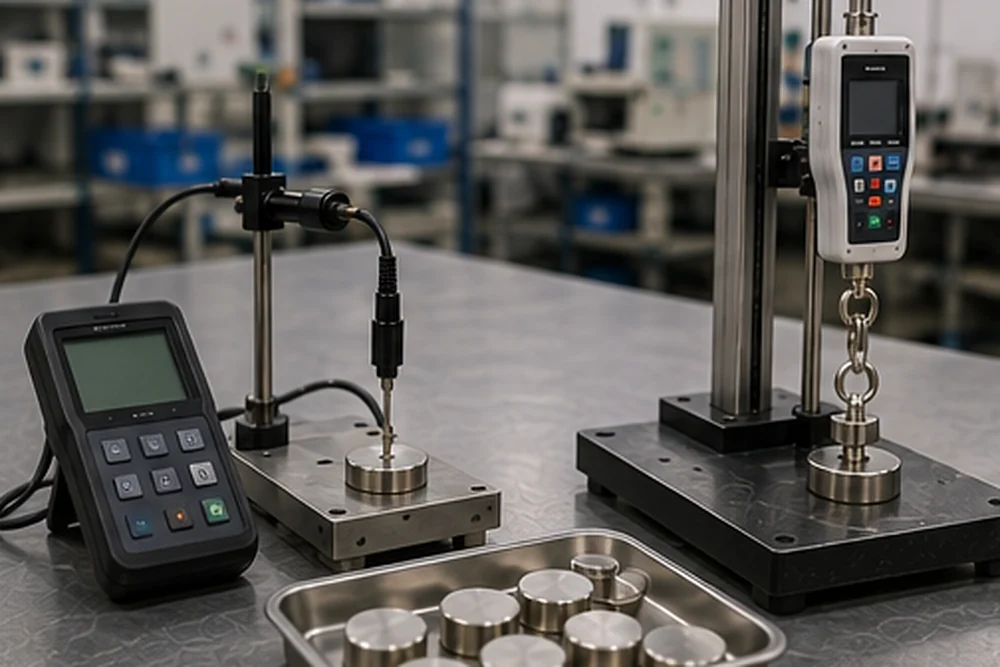
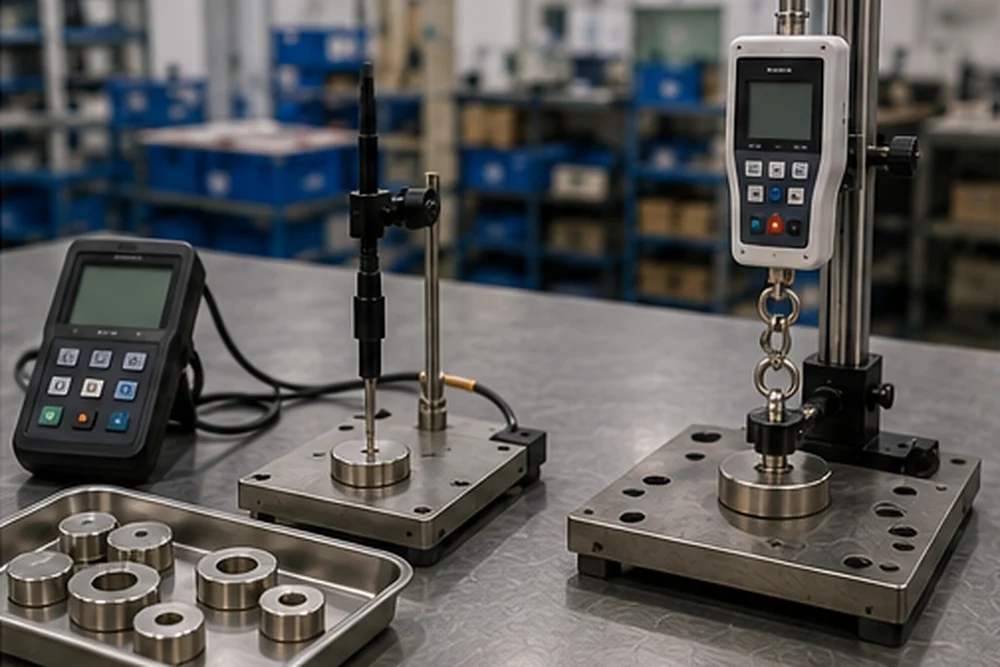
A gauss meter measures magnetic flux density at a defined location. A pull force test measures the force required to separate a magnet or magnetic assembly from a defined mating surface under controlled conditions.
If you need to verify intrinsic material properties such as remanence, coercivity, or maximum energy product, a material-test system is more appropriate. For a motor, sensor, coupling, or magnetic holder, the more useful result may instead be field strength, holding force, torque, or performance at the actual working gap.
What Does “Magnet Strength” Mean?
Before selecting a magnet strength tester, define the result that matters to the application.
| What you need to know | Measurement | Typical equipment | Main limitation |
|---|---|---|---|
| Magnetic field at a specific point | Magnetic flux density | Gauss meter or teslameter | Depends strongly on probe position and direction |
| Magnetic moment or integrated flux change | Magnetic moment, open-circuit magnetization, or linked flux change | Fluxmeter with a suitable measuring coil | Depends on coil geometry, calibration, and test method |
| Intrinsic material performance | Br, HcB, HcJ, BHmax, demagnetization curve | Hysteresigraph or another applicable material-test system | Tests material properties, not complete assembly performance |
| Separation force from a mating surface | Breakaway or pull force | Force gauge and controlled fixture | Depends on the complete test setup |
| Performance in the product | Field, force, torque, sensing distance, or coupling output | Application-specific test fixture | Requires actual operating conditions |
A higher value in one category does not automatically mean a better result in another.
For example, a high surface Gauss reading does not guarantee a specific pull force. Likewise, a strong bench pull-force result does not prove that a magnet will provide the required sensor field through an air gap.
Which Magnet Strength Test Should You Use?
Start with the engineering question, not the instrument.
| Application question | Recommended measurement | Information needed |
|---|---|---|
| Will a Hall sensor detect the magnet at a defined position? | Magnetic flux density at the sensor location | Sensor position, working gap, magnet orientation, target field |
| Does a magnet have consistent surface-field distribution? | Gauss measurements at defined coordinates | Probe type, measurement grid, fixture, magnet orientation |
| Will a magnetic holder resist direct separation? | Normal pull force | Mating material, contact area, surface condition, pull direction |
| Will an assembly resist sideways movement? | Application-specific shear or sliding test | Friction, load direction, vibration, surface condition |
| Does the material meet a specified magnetic grade? | Controlled material-property measurement | Required properties, specimen conditions, applicable test method |
| Will a coupling or rotor provide the required output? | Torque or application-performance test | Working gap, pole layout, speed, temperature, alignment |
| Is one production batch consistent with another? | Agreed incoming or production test | Acceptance limits, sampling plan, test fixture, reporting method |
When the real requirement is performance at a working distance, a surface measurement alone is usually insufficient. The measurement point should match the location that matters in the product.
How Do You Measure a Magnet with a Gauss Meter?
A gauss meter uses a Hall probe to measure magnetic flux density at the probe’s sensing area. Results are normally shown in gauss or tesla.
The NIST conversion is:
1 gauss = 0.0001 tesla, and 10,000 gauss = 1 tesla.
Source: NIST Guide to SI Conversion Factors
Why Does Probe Position Matter?
The magnetic field around a permanent magnet is not uniform. The reading may change when the probe is moved away from the surface, shifted toward an edge, tilted, or turned toward another field component.
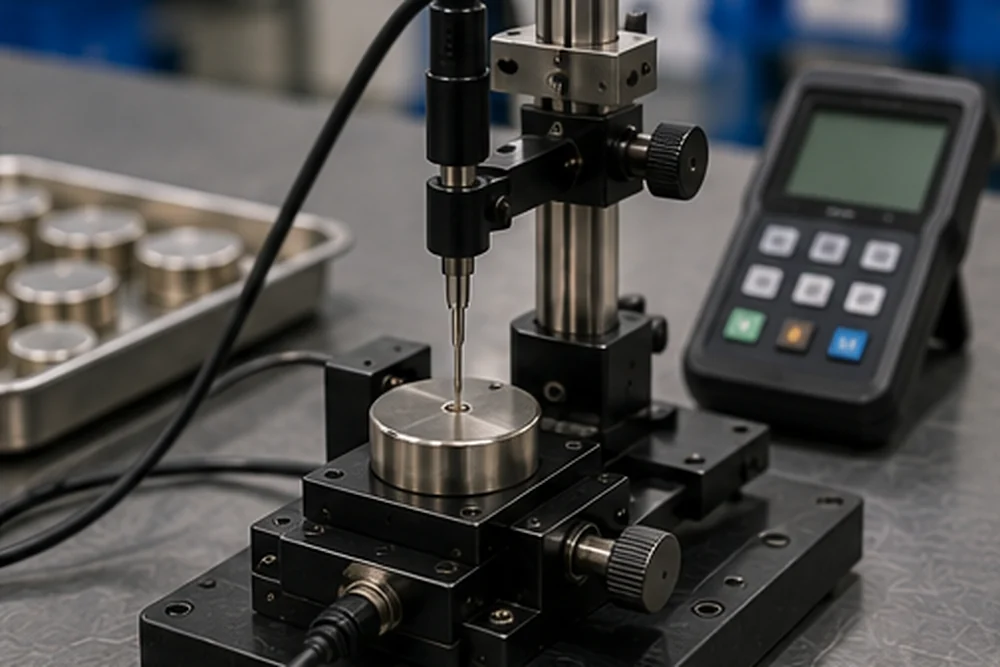
The Hall sensor is also located inside the probe body. The physical outside surface of the probe is not always the exact sensing plane.
Lake Shore’s gaussmeter documentation identifies probe alignment, temperature, zeroing, instrument accuracy, and repeatable positioning as important measurement variables. It also explains that the maximum response occurs when the field vector has the correct orientation relative to the Hall sensor.
Source: Lake Shore Model 475 Gaussmeter Manual
A Controlled Gauss Measurement Workflow
This is a general comparison workflow. The instrument manufacturer’s procedure and the project inspection plan take priority.
- Define the field component and measurement location.
- Confirm the correct probe type and sensing direction.
- Allow the instrument and probe to stabilize as required by the manufacturer.
- Zero the probe using the specified method.
- Place the magnet in a repeatable orientation.
- Use a fixture when small position changes could affect the result.
- Position the probe at the defined coordinate and spacing.
- Record the reading without changing the probe angle.
- Repeat the measurement according to the inspection plan.
- Report individual readings, ranges, averages, or pass/fail results as required.
Do not simply move the probe around until the highest number appears unless the stated purpose is specifically to locate the maximum field.
What Should a Gauss Test Record Include?
Record at least:
- Magnet drawing or part identification.
- Magnetization direction.
- Pole being measured.
- Probe type and sensing direction.
- Measurement coordinate.
- Probe-to-part spacing.
- Part and probe orientation.
- Instrument range and unit.
- Zeroing method.
- Test temperature when relevant.
- Number of measurements.
- Individual values and acceptance range.
Without this information, two suppliers may report different Gauss values even when testing similar magnets.
How Do You Perform a Pull Force Test?
A pull force test measures the force required to separate a magnet or magnetic assembly from a mating surface.
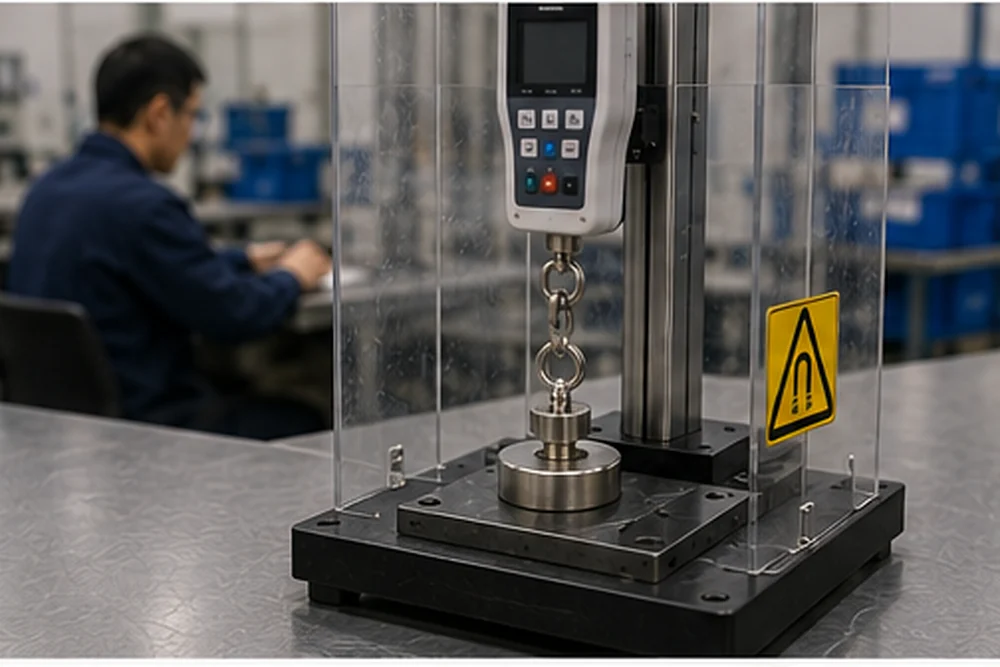
The result is meaningful only when the test conditions are defined. Steel material, steel thickness, surface finish, contact area, fixture alignment, air gap, loading direction, and test speed can all affect the result.
ASTM work item WK70439 is developing a proposed method for pull testing permanent magnet assemblies. It remains a proposed work item rather than a published ASTM standard. ASTM notes that proprietary testing methods can produce widely different values.
Source: ASTM Magnet Pull Force Measurement
A Controlled Pull Force Comparison Workflow
The following workflow supports repeatable comparison. It is not a universal standard procedure.
- Identify whether the test applies to a bare magnet or complete assembly.
- Define the mating plate material, thickness, dimensions, and surface condition.
- Clean and inspect the contact surfaces.
- Control any coating, spacer, adhesive layer, or intentional air gap.
- Align the magnet and force gauge with the specified pull direction.
- Apply the load through a controlled fixture.
- Separate the magnet using the agreed test motion.
- Record the maximum force using the agreed reporting method.
- Repeat the test as required.
- Report the fixture and test conditions with the result.
A result that states only “50 kg pull force” is incomplete. It should identify whether the value means kilogram-force, how the assembly was tested, and which mating surface was used.
Force should preferably be stated in newtons. If kilogram-force is also used, the unit should be written clearly rather than shortened to kilograms, which is a unit of mass.
Is Pull Force the Same as Shear Force?
No. A normal pull test separates the magnet perpendicular to the mating surface. A shear or sliding load acts parallel to the surface.
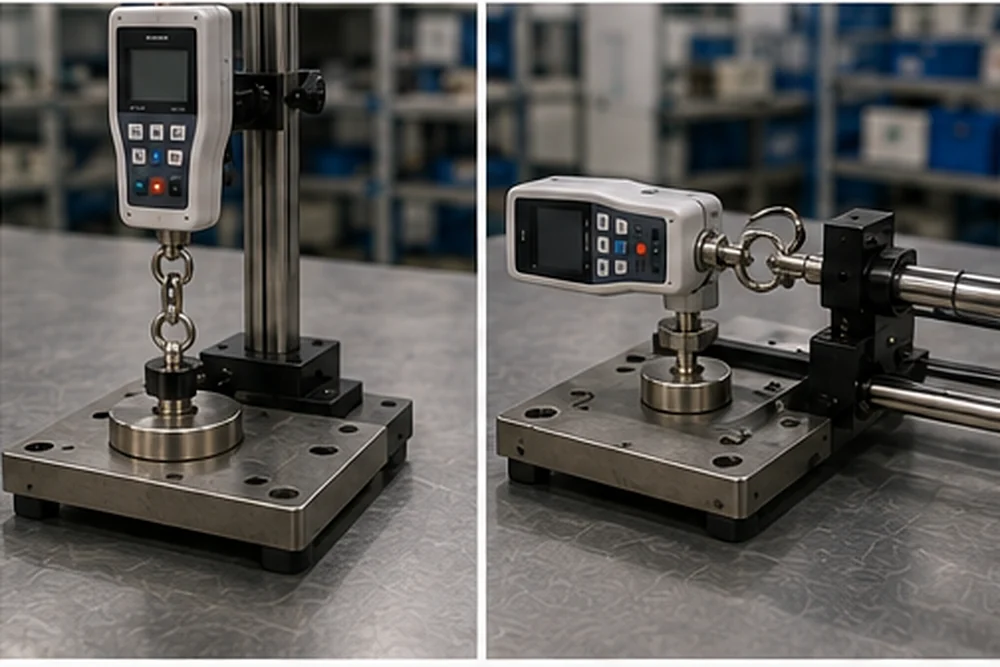
Sliding resistance is affected by friction, surface texture, rubber coatings, mechanical stops, vibration, and load direction. A normal pull-force result should not be used as a shear rating without an application-specific evaluation.
Is Rated Pull Force the Same as Safe Working Load?
No. A bench pull-force result should not automatically be treated as the safe working load of the final product.
Real applications may introduce:
- Air gaps.
- Thin or low-permeability mating materials.
- Curved or uneven surfaces.
- Shear loading.
- Shock or vibration.
- Temperature changes.
- Misalignment.
- Adhesive or housing failure.
- Magnet chipping or breakage.
The responsible product engineer should establish the required design margin for the actual application. This article does not provide a universal safety factor.
Pull-Test Safety
Strong magnets can move suddenly, trap fingers, or chip when they strike a fixture or mating plate.
Use a guarded test setup, keep hands outside the attraction path, and follow the workplace risk assessment and PPE requirements. This article is not a complete laboratory safety procedure.
An NdFeB safety data sheet should also be consulted for the specific magnet material and handling conditions.
Can a Gauss Meter Confirm a Magnet Grade?
A surface Gauss reading cannot by itself confirm that a finished magnet is N42, N52, or another grade.
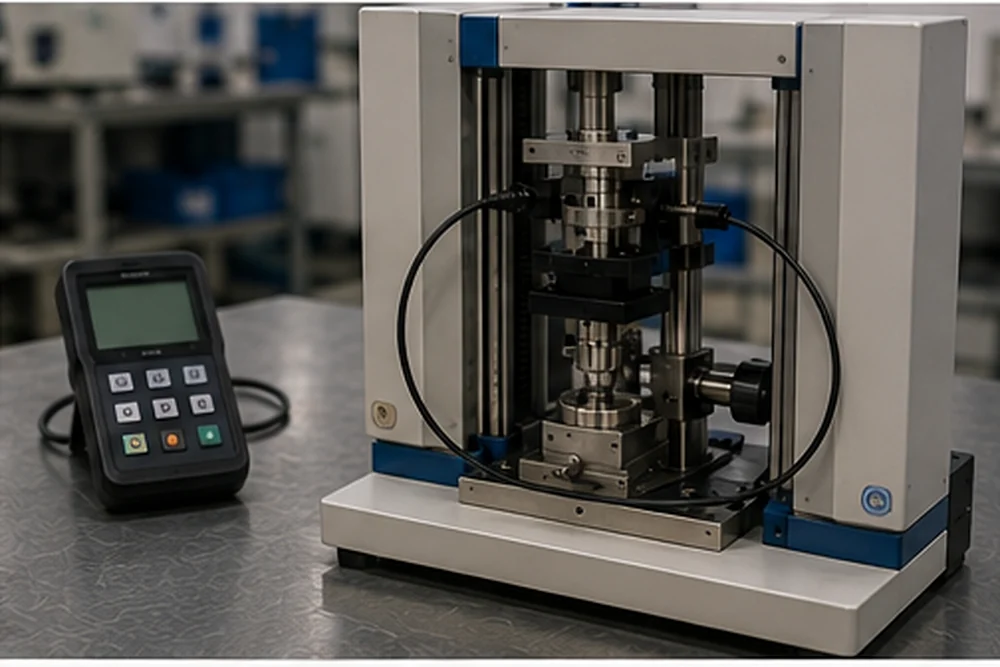
A grade relates to controlled material properties obtained from a magnetization or demagnetization curve. Important properties may include:
- Br: Remanent magnetic flux density after the magnetizing field is removed.
- HcB: Coercive field strength associated with magnetic flux density.
- HcJ: Intrinsic coercive field strength associated with magnetic polarization.
- BHmax: Maximum energy product derived from the demagnetization curve.
IEC 60404-5:2015 defines measurement methods for magnetic flux density, magnetic polarization, magnetic field strength, demagnetization curves, and recoil lines of permanent magnet materials.
Source: IEC 60404-5:2015
ASTM A977/A977M addresses the measurement of high-coercivity permanent magnet materials using hysteresigraphs. It applies to material-property measurement, not simple finished-part surface-field inspection.
Source: ASTM Committee A06.01 Standards
A finished magnet’s Gauss reading is also affected by:
- Magnet dimensions.
- Shape and length-to-diameter ratio.
- Magnetization state.
- Magnetization direction.
- Probe position.
- Edge effects.
- Nearby steel or magnetic components.
- Air gap.
Surface-field testing can be useful for comparing finished parts under the same controlled conditions. It should not replace applicable grade documentation or controlled material-property testing.
Readers evaluating a specific high-grade requirement can also review Osenc’s confirmed N52 neodymium magnet page, while keeping in mind that final grade selection still depends on the application.
Can You Convert Gauss Directly to Pull Force?
No universal formula converts a single Gauss reading directly into pull force.
The two quantities can be related within a fully defined magnetic system, but a valid force prediction also needs information about:
- Magnet dimensions and shape.
- Grade and magnetization state.
- Pole area and pole layout.
- Mating material.
- Steel thickness.
- Working air gap.
- Coatings or spacers.
- Contact geometry.
- Pull direction.
- Nearby magnetic components.
For example, two magnets may show similar field readings at one probe location but produce different pull-force results because their pole areas, thicknesses, or magnetic circuits are different.
The reverse is also possible. Two assemblies may produce similar direct-contact pull force but very different field levels at a sensor positioned several millimeters away.
Use Gauss testing when the field at a location matters. Use pull-force testing when controlled separation force matters.
Should You Test the Magnet Alone or in the Final Assembly?
Test the object that best represents the engineering requirement.
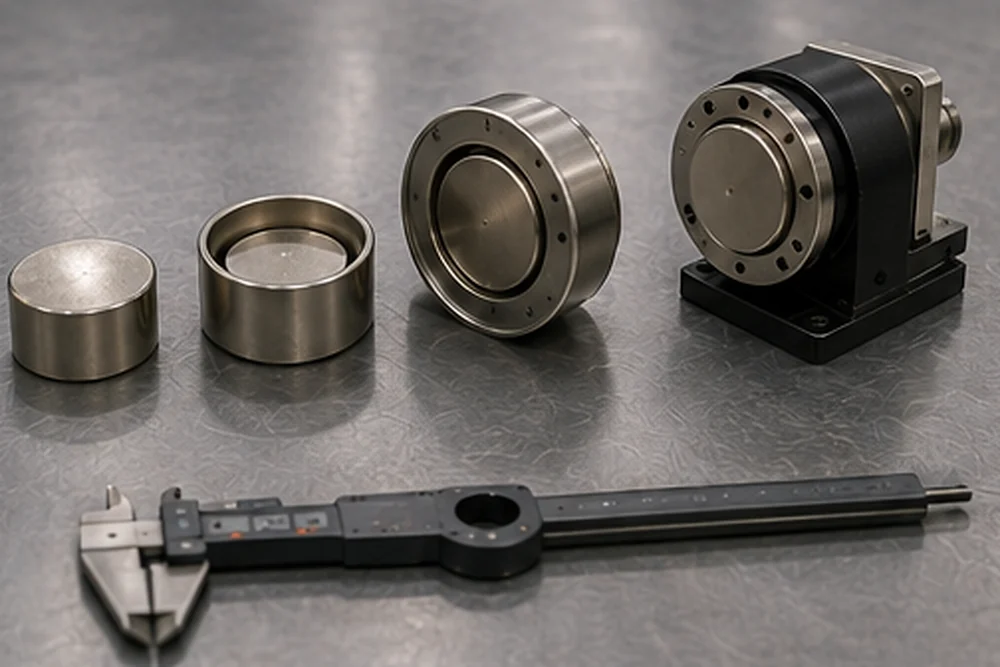
| Test object | Suitable when | Main limitation |
|---|---|---|
| Bare magnet | Checking polarity, surface-field consistency, or incoming part variation | Does not include housing, steel, adhesive, or working gap |
| Partially assembled component | Checking how a cup, back iron, housing, or carrier changes performance | May not represent the final mounting condition |
| Final magnetic assembly | Verifying actual holding, sensing, torque, or coupling performance | Requires a controlled application-specific fixture |
| Final product | Validating real system operation | Harder to isolate the cause of a failed result |
Nearby steel can redirect magnetic flux. A housing can change the working gap. Adhesive thickness, coating, and assembly tolerance can also change the distance between the magnet and the mating component.
For a sensor or encoder, measure the field at the sensor’s installed position. For a magnetic holder, test against the intended mating material and surface condition. For a coupling or rotor, use the actual working gap and alignment conditions where practical.
Magnetic simulation can help predict field, force, torque, or pole-layout behavior before samples are produced. However, a simulation is a design prediction, not a measured result.
A practical development path is:
- Define the operating condition.
- Model or estimate performance where useful.
- Build a representative sample.
- Validate the magnet or assembly under controlled conditions.
Osenc can support custom magnet and magnetic assembly discussions from drawings, samples, sketches, and application requirements. Available project support may include magnetic-field evaluation, simulation, assembly review, and testing, subject to the project requirements and manufacturing review.
How Do You Compare Magnet Test Reports from Different Suppliers?
Do not compare headline numbers until you confirm that both suppliers used equivalent test conditions.
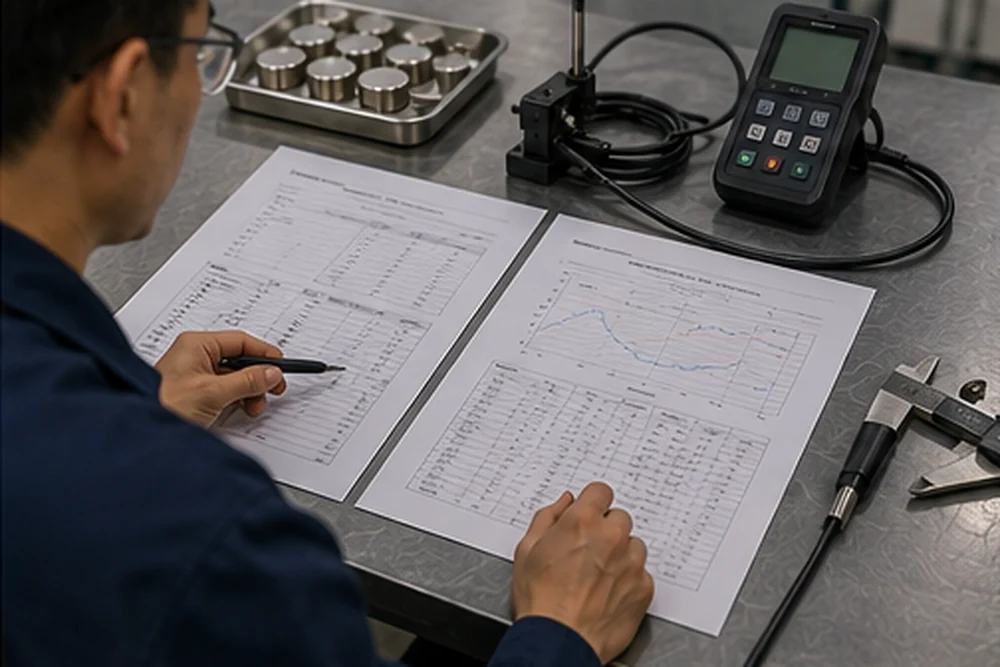
| Report item | What to check |
|---|---|
| Test object | Bare magnet, subassembly, or final assembly |
| Measurement | Surface field, field at distance, magnetic moment, pull force, torque, or material property |
| Instrument | Equipment type, probe or sensor, range, and unit |
| Test position | Exact coordinate, distance, and orientation |
| Fixture | Mating plate, pull fixture, coil, holder, or assembly condition |
| Environment | Temperature and other relevant conditions |
| Repetition | Number of tests and whether individual results are shown |
| Result format | Individual values, average, minimum, maximum, or range |
| Acceptance criteria | Nominal value, tolerance, minimum value, or pass/fail limit |
| Calibration | Calibration status or traceability required by the purchasing agreement |
A report should allow another qualified person to understand what was measured and, where practical, reproduce the comparison.
A company quality-management page can show the supplier’s general inspection approach, but it does not replace a project-specific test method or acceptance record. See Osenc’s quality management information for the currently confirmed general scope.
What Should You Include in a Magnet Strength RFQ?
A useful RFQ should describe the required function before specifying a measurement value.

Magnet or Assembly Information
Provide:
- Drawing and revision.
- Dimensions and tolerances.
- Magnet material or proposed grade.
- Magnetization direction and pole layout.
- Coating.
- Housing, steel parts, adhesive, and other assembly components.
- Intended operating temperature.
- Environmental conditions where relevant.
Application Requirement
State whether the magnet must provide:
- Holding force.
- Field at a sensor.
- Detection distance.
- Torque.
- Coupling output.
- Positioning force.
- Separation performance.
- Batch-to-batch consistency.
Test Conditions
Define:
- Bare magnet or final assembly.
- Measurement location.
- Working gap.
- Probe direction.
- Mating material and thickness.
- Pull or load direction.
- Fixture requirements.
- Test temperature.
- Required number of measurements.
Acceptance Criteria
Specify:
- Target value.
- Minimum or allowable range.
- Unit.
- Sampling requirement.
- Whether individual readings are required.
- Whether the requirement applies to samples, production parts, or both.
A well-defined RFQ reduces the risk of receiving a technically correct test report that does not answer the actual application question.
Frequently Asked Questions
Is a Gauss Meter the Same as a Magnet Strength Tester?
A gauss meter is one type of magnet strength tester, but the phrase “magnet strength tester” is not specific.
It may refer to a gauss meter, teslameter, pull-force tester, fluxmeter, hysteresigraph, torque fixture, or an application-specific test system. Confirm which magnetic quantity the equipment measures.
Can a Smartphone Measure Magnet Strength?
A smartphone may show changes in ambient magnetic field if it contains a magnetometer. Android documents that compatible sensors report magnetic-field components on the X, Y, and Z axes in microtesla.
However, the sensor range, calibration, location, device interference, and repeatability may be unsuitable for magnet acceptance testing.
Source: Android SensorEvent Documentation
Use a phone only for rough indication. Do not treat it as a calibrated gauss meter or supplier acceptance tool.
How Often Should Magnet Strength Be Tested?
There is no universal testing frequency for every magnet project.
The inspection plan should reflect:
- Application risk.
- Production stability.
- Customer requirements.
- Sample size.
- Process changes.
- Supplier changes.
- The agreed acceptance method.
Critical projects may require different controls from non-critical commercial applications.
Need Help Defining a Magnet Test Requirement?
Send Osenc your drawing, working gap, target field or pull force, mating material, temperature range, and proposed acceptance method.
The purpose of the review is to identify what should be measured before sample validation, helping reduce unclear specifications and unnecessary sample revisions.
Discuss a project through the Osenc custom neodymium magnet service or contact Osenc.