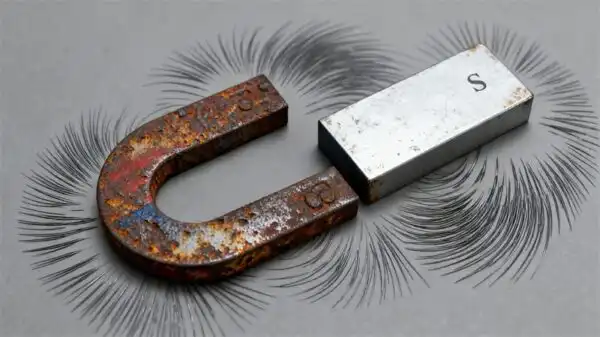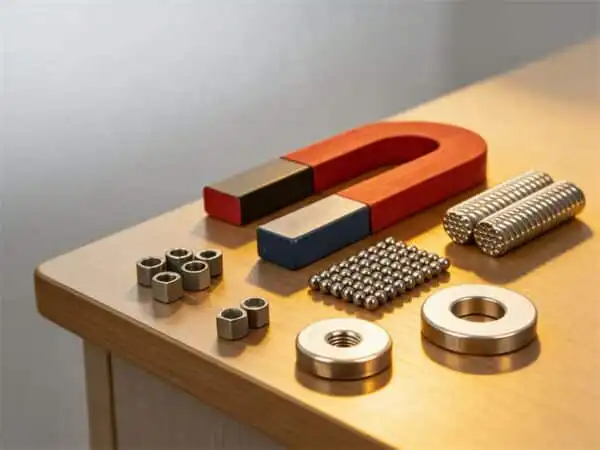
Yes. Neodymium (NdFeB) magnets can rust and corrode when moisture reaches the magnet material. Most sintered NdFeB magnets therefore use a protective coating or another barrier between the magnet and its environment.
For a buyer, the important question is not simply whether the magnet is “coated.” The real questions are how much moisture, salt, condensation, chemical exposure, abrasion, impact, and temperature cycling the magnet will see, and whether the coating can remain intact in the finished assembly.
Quick Answer: What Causes Neodymium Magnets to Rust?
Sintered NdFeB is a multiphase magnetic material. It contains the main Nd2Fe14B magnetic phase plus grain-boundary phases that include neodymium-rich material. Research on NdFeB corrosion in humid environments shows that these grain-boundary regions can be preferentially attacked in humid or electrochemical environments. Water vapor is an important corrosion driver, and the resulting attack can progress through pitting, intergranular corrosion, cracking, flaking, or material loss.
That is why an unprotected NdFeB surface is a poor choice for persistent moisture exposure. A coating helps by separating the magnet body from the environment, but the protection lasts only while the barrier remains suitable for the actual exposure and mechanical conditions.
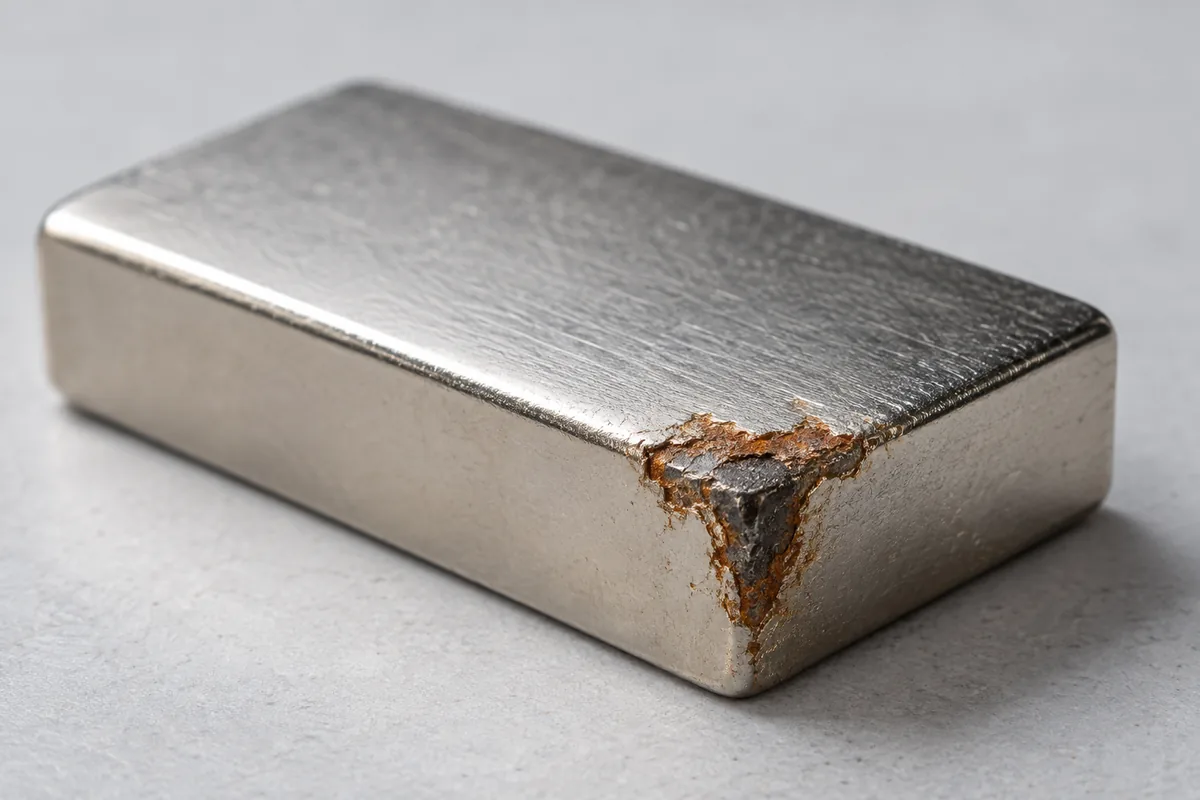
Does Rust Make a Neodymium Magnet Weaker?
It can, but the mechanism is often explained badly.
Rust does not simply “break magnetic field lines.” Corrosion damages the magnet material itself. As corrosion progresses, magnetic material can be consumed, pits can form, the surface can deteriorate, and pieces can crack or flake away. Those changes alter the effective magnetic volume and geometry of the part and can reduce remanence or practical assembly performance.
A long-term corrosion study on sintered NdFeB attributed most of the measured remanence loss in its test conditions to loss of the magnetic matrix phase, with the remainder associated with surface-structure deterioration. In other words, corrosion-related performance loss is a material and microstructure problem, not a mysterious interruption of flux.
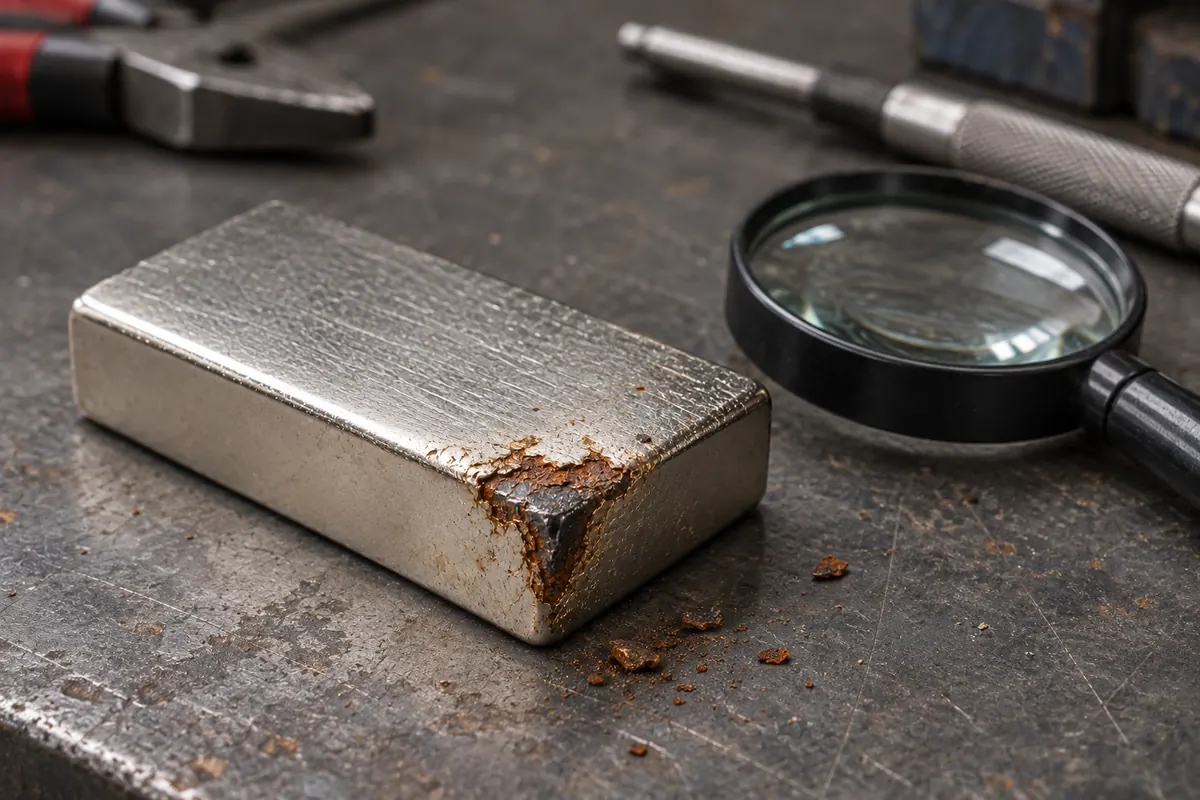
This also matters when diagnosing a failed part. Corrosion and demagnetization are not the same failure mechanism. Excessive temperature or a sufficiently strong opposing magnetic field can cause irreversible magnetic loss even when the surface looks intact. Corrosion can reduce magnetic performance by physically and chemically degrading the magnet. A useful failure analysis should separate these causes rather than calling every weak magnet “demagnetized.”
Where Does Corrosion Usually Start?
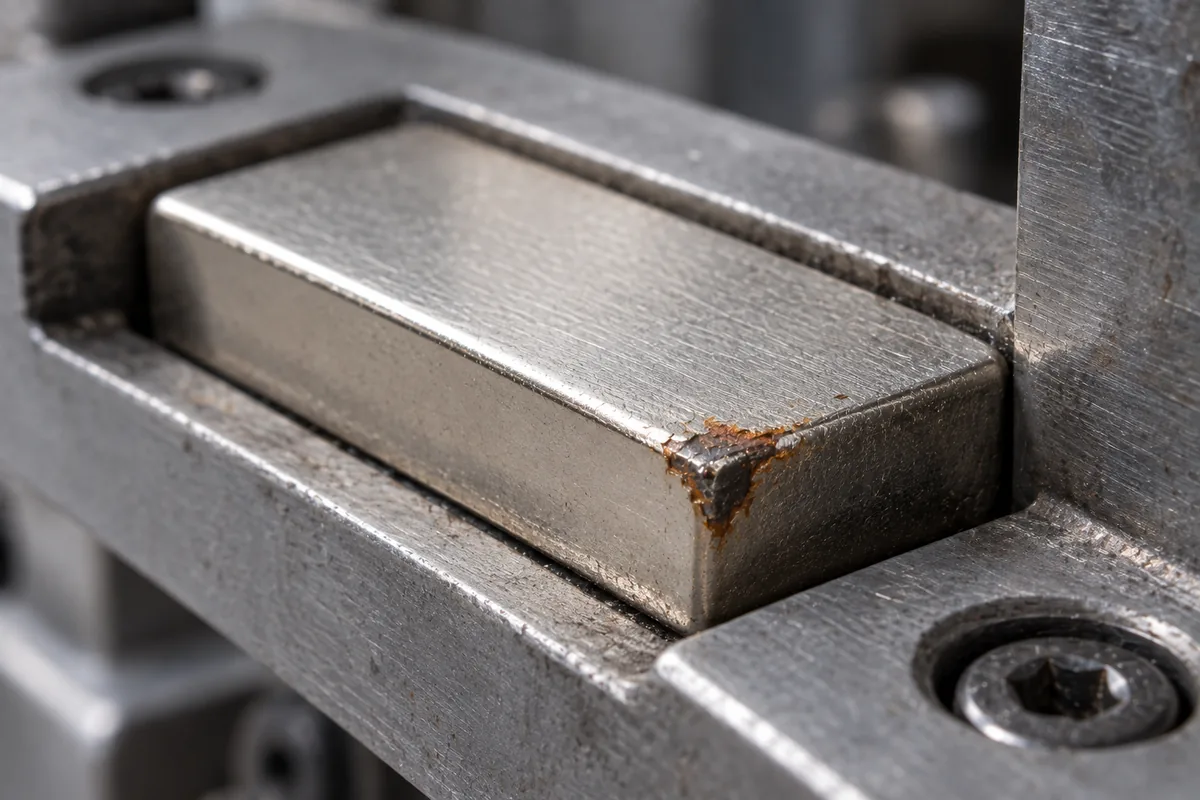
1. Coating chips, scratches, and damaged edges
NdFeB magnets are hard and brittle. If magnets snap together, strike steel, rub against an abrasive surface, or are stressed during assembly, the coating may be damaged at edges or contact points. A small breach can expose the underlying magnet material to moisture.
Buyer action: specify the assembly method and any impact, abrasion, clamping, or repeated-contact risk. A coating that looks adequate on an untouched sample may be a poor choice if the production assembly routinely damages it.
2. Condensation and high humidity
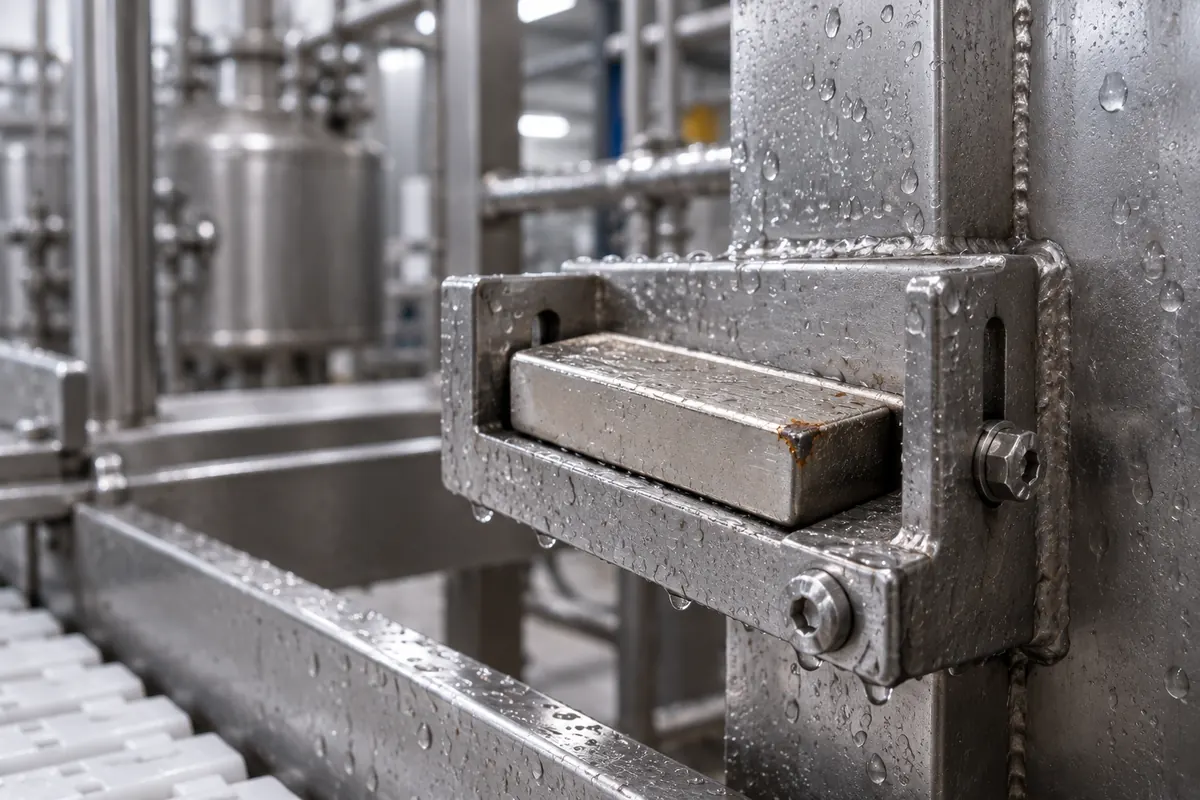
A magnet does not need to be submerged to corrode. Humid-environment studies show that water vapor can drive intergranular attack in sintered NdFeB. Condensation is especially important because it creates repeated wet/dry exposure on the part or inside an enclosure.
Buyer action: define the real environment, including humidity, condensation cycles, storage, washdown, and whether moisture can be trapped around the magnet.
3. Fresh water, salt water, and chloride exposure
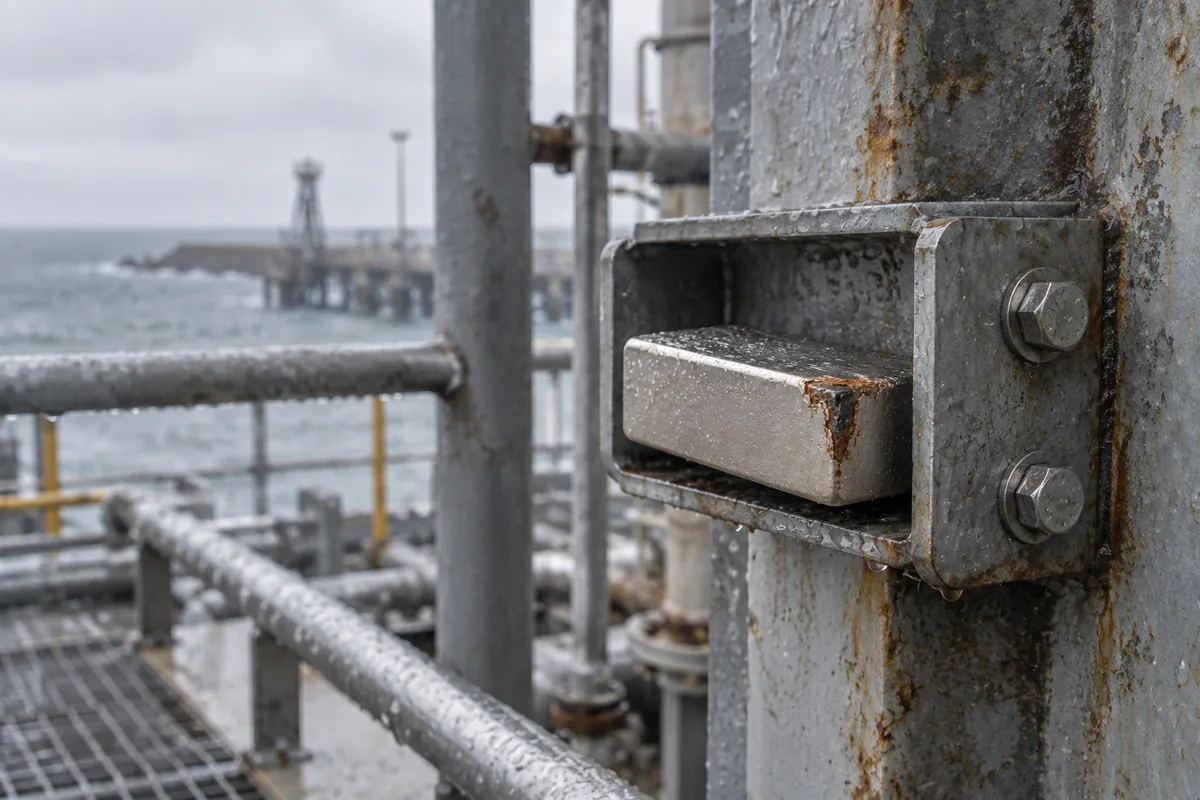
Both fresh water and salt-containing environments can be problematic when water reaches the NdFeB material. Chloride exposure is particularly aggressive in many corrosion systems and is relevant to marine, coastal, road-salt, sweat, and salt-fog conditions.
Buyer action: do not describe the application only as “outdoor.” State whether the magnet sees rain, standing water, immersion, coastal air, salt spray, sweat, cleaning solution, or another defined medium.
4. Temperature combined with moisture
Temperature affects corrosion kinetics, coating behavior, adhesives, seals, and the magnet’s magnetic stability. It should not be collapsed into one simplistic rule such as “hotter always means faster rusting.” The engineering decision is the combination of temperature range, humidity or liquid exposure, dwell time, cycling, and the complete assembly.
Buyer action: provide both the operating temperature range and the environmental exposure. Working temperature alone is not enough to select the final NdFeB grade or corrosion-protection route.
Are Coated Neodymium Magnets Waterproof?
Not automatically.
A coating is a protective barrier. “Waterproof” is a system-level claim that depends on coating continuity, edges, pinholes, wear, geometry, assembly damage, seals, interfaces, and the exposure duration and pressure. A coated magnet may tolerate one environment and fail in another.
For persistent wet or submerged service, the question should therefore change from “Which coating is waterproof?” to “What barrier or encapsulation system keeps the NdFeB body isolated for this exposure, and how will we verify it?”
Which Coating Should You Choose for NdFeB Corrosion Protection?
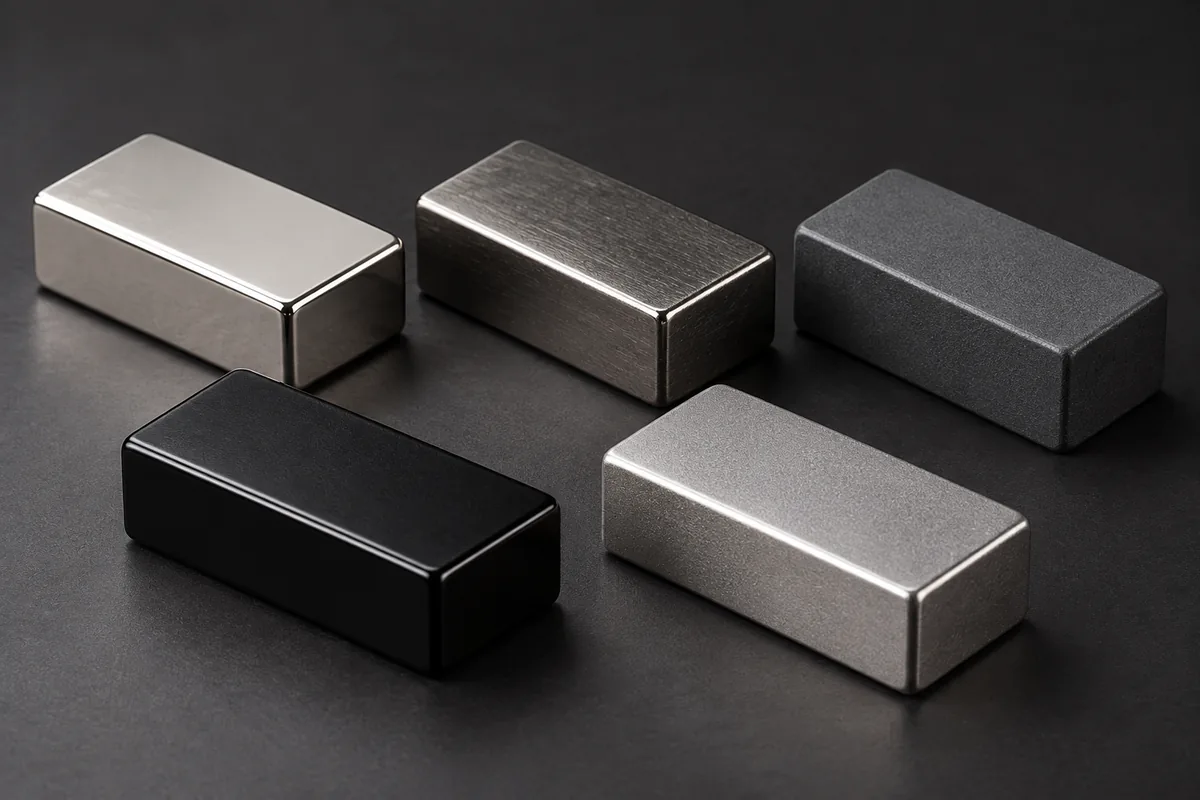
There is no responsible universal ranking such as “epoxy is always better than nickel” or “PTFE is the best coating.” Coating selection is a trade-off between environmental resistance, coating integrity, dimensions, abrasion, assembly process, temperature, and verification requirements.
| Protection route | Why buyers consider it | Main decision boundary | What to verify |
|---|---|---|---|
| Ni-Cu-Ni / nickel | Common metallic barrier with a durable finished surface for many general applications | A damaged edge, pinhole, chip, or worn area can expose NdFeB | Environment, edge condition, handling damage, coating inspection |
| Zinc | A metallic protection option for projects where its surface and process characteristics fit the requirement | Do not assume it matches another coating in corrosion behavior | Exposure, surface requirement, assembly conditions, acceptance test |
| Epoxy | Polymer coating direction often considered when added environmental isolation is useful | Polymer layers can still be scratched, chipped, or damaged during assembly | Abrasion, edges, coating continuity, chemical and temperature exposure |
| Parylene | Thin conformal polymer barrier that may be evaluated where coverage and dimensional impact matter | Suitability depends on the actual environment, geometry, process, and acceptance criteria | Coverage, thickness requirement, interfaces, environment, inspection |
| PTFE | Polymer option that may be evaluated when the application needs properties beyond a standard metallic finish | Do not infer universal chemical, food, medical, or marine suitability from the coating name alone | Media compatibility, temperature, geometry, assembly, acceptance method |
| Encapsulation / sealed assembly | Moves protection from the magnet surface toward the complete assembly | A sealed concept is only as reliable as joints, interfaces, materials, and manufacturing controls | Seal design, ingress path, mechanical loads, test method, acceptance criteria |
OSENC can discuss Ni-Cu-Ni, zinc, epoxy, Parylene, PTFE and other project-specific coating directions when evaluating custom neodymium magnets. The final route should be matched to the working environment and the finished assembly, not selected from a coating name alone.
For a deeper comparison of available surface-protection routes, see the OSENC Neodymium Magnet Coating guide.
How to Specify a Rust-Resistant Neodymium Magnet
A useful coating RFQ should include more than “need anti-rust coating.” The following inputs can materially change the recommendation:
- Magnet drawing, dimensions, and critical tolerances.
- Operating temperature range and thermal cycling.
- Indoor, outdoor, condensation, washdown, immersion, coastal, salt-fog, sweat, or chemical exposure.
- Expected exposure duration and whether liquid can remain trapped around the magnet.
- Abrasion, impact, vibration, sliding contact, and edge-chipping risk.
- Assembly method, including adhesive bonding, press fit, overmolding, potting, or mechanical retention.
- Any coating-thickness or dimensional constraint.
- Required surface, cleanliness, electrical, or bonding characteristics.
- Validation method and pass/fail criteria.
These inputs can narrow the coating direction, but a final coating and assembly decision should be confirmed against the real drawing, exposure, and validation requirements.
How Should Corrosion Protection Be Tested?
Testing should reproduce a defined engineering question, not generate an impressive hour count for a brochure.
Depending on project scope, corrosion-related validation may include coating inspection, controlled humidity exposure, immersion or cyclic testing, or salt-spray testing. If ASTM B117 is used, its scope matters: ASTM B117-26 describes a controlled salt-fog environment for producing relative corrosion-resistance information, and it explicitly warns that stand-alone salt-spray results do not reliably predict performance in natural service environments.
That means “500 hours of salt spray equals X years outdoors” is not a sound general conversion.
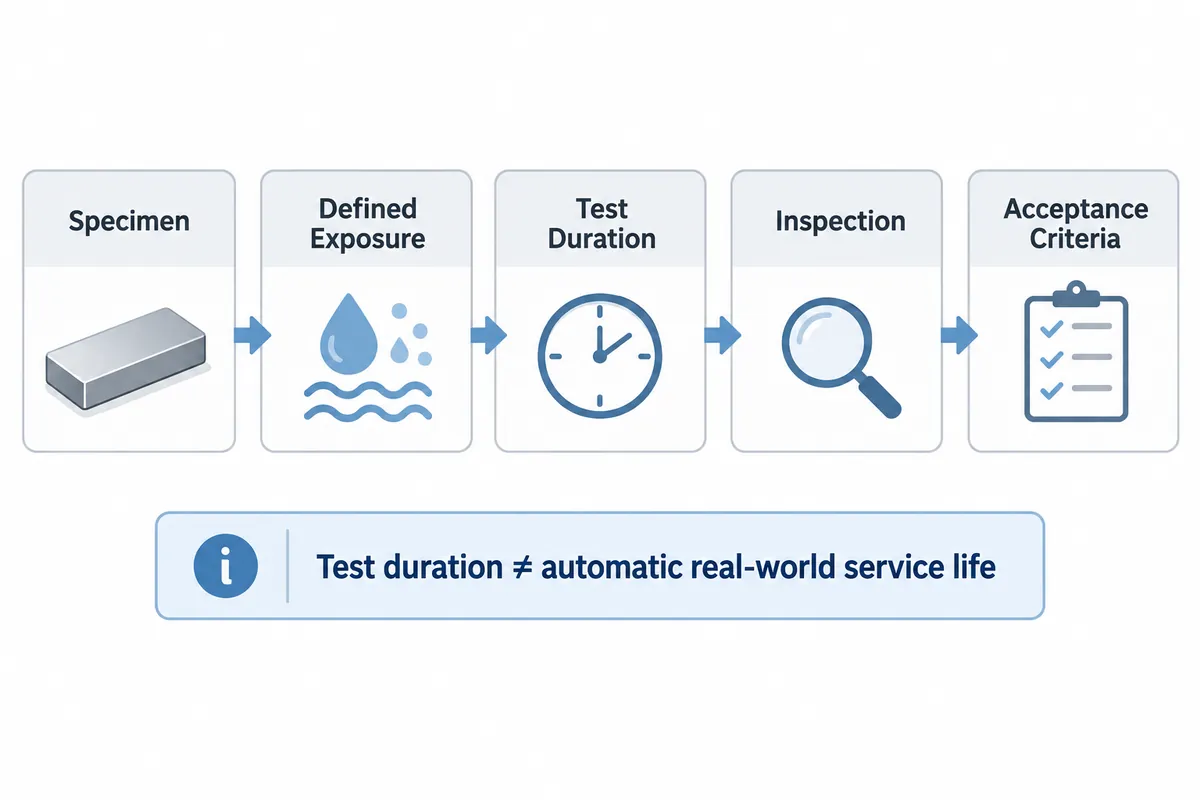
A useful test plan defines:
- the specimen and coating condition;
- the exposure method and duration;
- whether edges or defects are included;
- the inspection interval;
- the failure criteria, such as visible corrosion, blistering, coating damage, mass change, dimensional change, or another project-specific requirement;
- whether the tested specimen represents the finished assembly.
OSENC may support salt-spray testing and coating inspection for suitable projects, but a test name alone is not a result. The required method, condition, duration, specimen, and acceptance criteria should be agreed for the project.
Can a Rusted Neodymium Magnet Be Repaired?
Surface staining is not the same as deep NdFeB corrosion. If corrosion has already produced pitting, flaking, cracking, powdering, or material loss, cleaning the surface cannot restore the material that has disappeared.
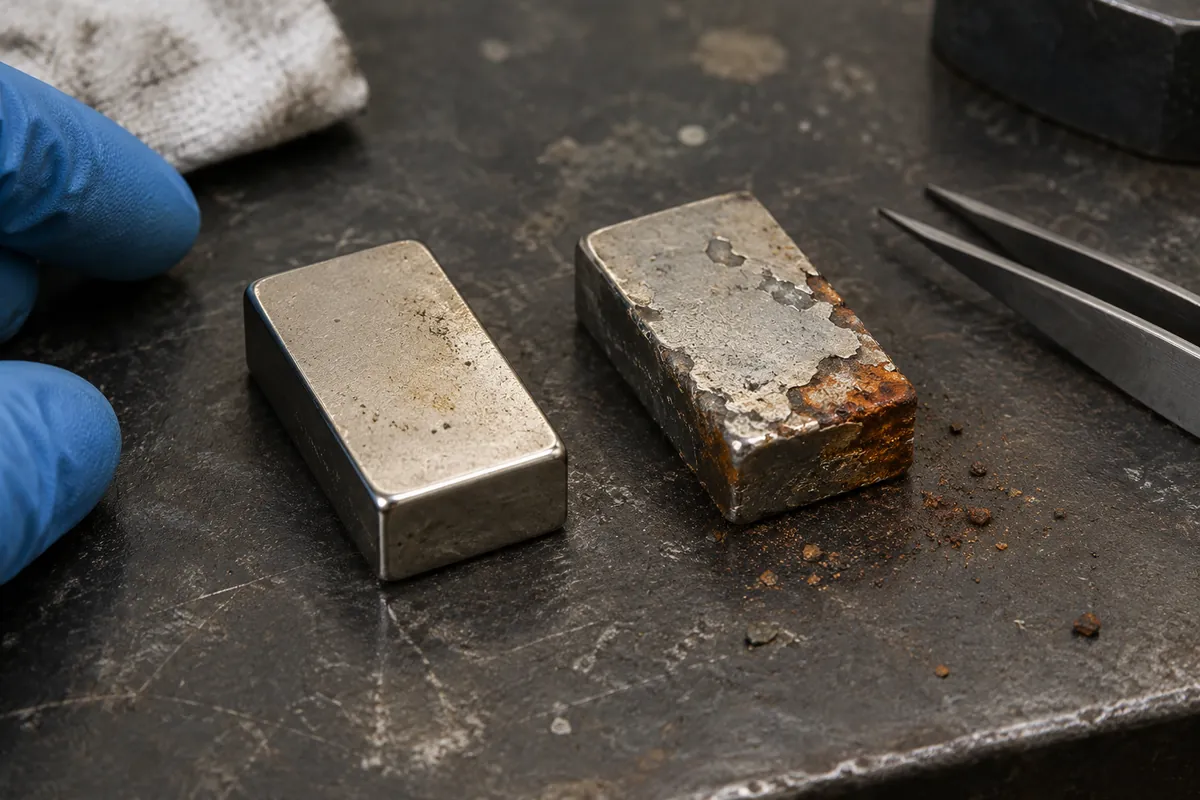
For a non-critical part with light surface contamination, the practical response may be inspection, cleaning, drying, and prevention of further exposure. For a motor, sensor, holding assembly, or other performance-critical component, visible coating failure or corrosion should trigger a dimensional, visual, and magnetic-performance check against the original acceptance criteria. Replacement is usually the safer engineering route when material loss or structural damage is present.
Do not try to rescue a corroded part by assuming it only needs “re-magnetizing.” First determine whether the failure is corrosion, mechanical damage, thermal demagnetization, an external demagnetizing field, or some combination of them.
How to Prevent Neodymium Magnet Rust in an Assembly
The most reliable corrosion control happens before production:
- Match the surface protection to the actual environment rather than the application name.
- Protect coated edges from impact and chipping during handling and assembly.
- Avoid designs that trap water against the magnet.
- Consider whether the magnet needs assembly-level sealing or encapsulation rather than a coating alone.
- Check compatibility between coating, adhesive, potting compound, overmold, and cleaning process.
- Define corrosion validation before mass production, especially when the magnet will see humidity, salt, washdown, or immersion.
- Inspect coating condition after assembly steps that can scratch, clamp, press, or strike the magnet.
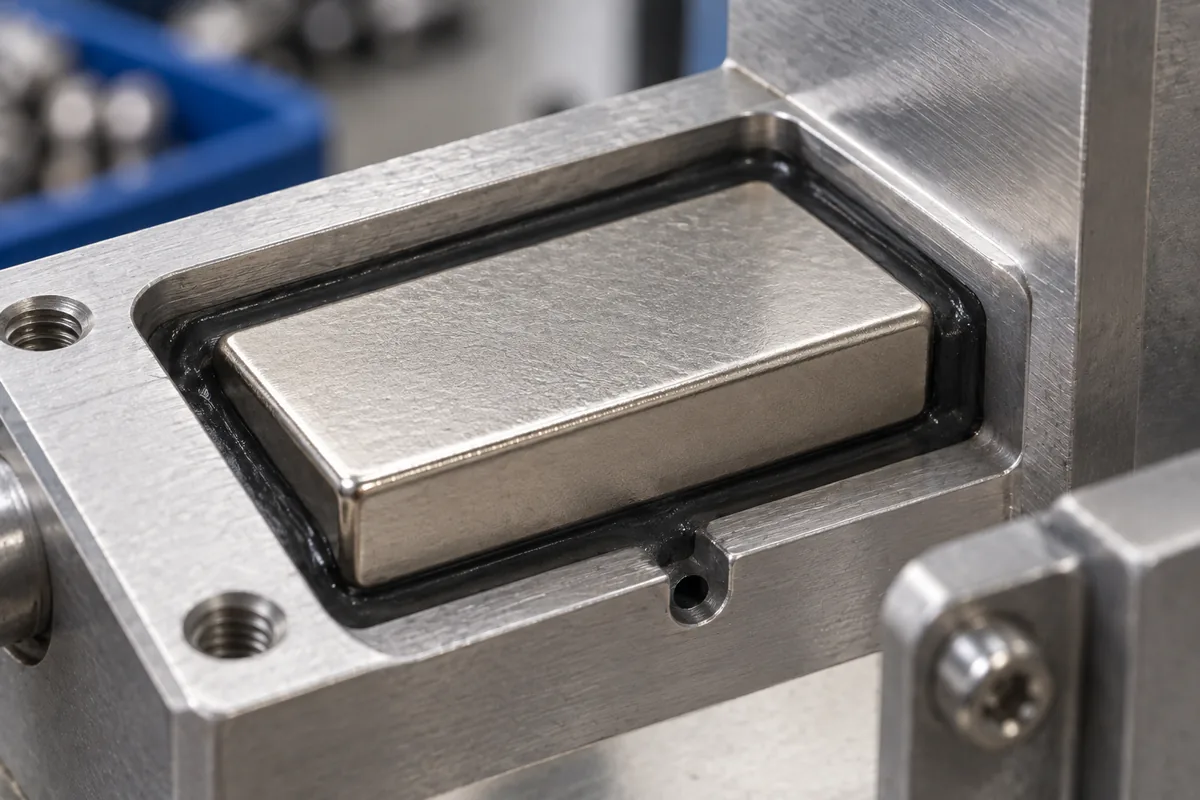
If the magnet’s field or pull force is performance-critical, validate the finished assembly under the intended working distance, air gap, target material, temperature, and mechanical condition. Corrosion protection and magnetic design are connected through the finished geometry, not through the coating name alone.
Neodymium vs. Ferrite and Samarium-Cobalt in Corrosive Environments
Ferrite magnets are ceramic oxide materials and are generally far more resistant to ordinary water corrosion than sintered NdFeB. Samarium-cobalt magnets also generally offer better corrosion resistance than NdFeB, although material choice still involves magnetic performance, temperature, geometry, cost, and mechanical constraints.
Do not change magnet material solely because the application is “wet.” First establish the required field or force, available volume, temperature, environment, assembly method, and validation target. A corrosion-resistant material that cannot meet the magnetic or mechanical requirement is not a successful substitution.
FAQ
Do neodymium magnets rust?
Yes. Sintered NdFeB magnets are vulnerable to corrosion when moisture reaches the magnet material. Protective coatings or assembly-level barriers are commonly used to reduce that exposure.
Does rust reduce neodymium magnet strength?
It can. Corrosion can consume magnetic material, damage grain boundaries, create pits and cracks, and change the effective magnetic volume and geometry. That can reduce remanence and working performance. Corrosion is not the same mechanism as heat- or field-induced demagnetization.
Are nickel-coated neodymium magnets waterproof?
No coating name by itself guarantees waterproof performance. Nickel can provide a useful barrier, but scratches, chips, pinholes, edges, interfaces, and prolonged exposure can allow moisture to reach the NdFeB body.
Can neodymium magnets be used outdoors?
Yes, but the design should account for rain, condensation, standing water, coastal or salt exposure, temperature cycling, drainage, coating damage, and the complete assembly. “Outdoor” alone is not enough information to select the protection system.
Do neodymium magnets rust in water?
They can corrode when water reaches the NdFeB material. Fresh water and salt-containing water both create risk; salt or chloride exposure can make the environment more aggressive. Persistent immersion usually requires stronger system-level isolation than simply choosing a standard coating.
Can a rusty neodymium magnet be restored?
Cleaning may remove loose surface contamination, but it cannot replace NdFeB material that has pitted, flaked, cracked, or corroded away. Performance-critical magnets should be inspected and checked against their original acceptance criteria, and damaged parts should be replaced when reliability is uncertain.
What information should I send for a corrosion-resistant custom magnet?
Send the magnet drawing, temperature range, moisture or chemical exposure, immersion or salt conditions, abrasion and impact risk, assembly method, dimensional constraints, and required corrosion or coating acceptance test. Those inputs are more useful than requesting a coating by name without the operating conditions.
Specify the Environment Before You Specify the Coating
Neodymium magnets can deliver high magnetic performance, but sintered NdFeB needs deliberate corrosion protection. The correct engineering sequence is straightforward: define the environment, identify how the coating or assembly could fail, choose a suitable protection route, and verify the finished part with agreed acceptance criteria.
For a custom project, send OSENC the drawing together with the operating temperature, moisture or chemical exposure, assembly method, and corrosion-validation requirement. You can also review custom neodymium magnet options or contact OSENC with the project inputs. That gives the engineering review enough information to discuss a coating and verification route without pretending that one finish is universally “rust proof.”