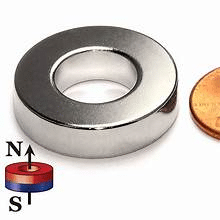
The direction of magnetic field is the direction (Magnetization Direction) to which a compass needle points when placed inside a magnetic field. Magnetic field is a vector quantity and its direction decides several other things like direction of induced current, direction of magnetic force, torque on magnetic dipole, etc. So it’s direction can be explained in relation to any of the directions of the above quantities.
The magnetism of a permanent magnet mainly comes from its crystal structure that is easily magnetized. It can obtain extremely high magnetism under the action of an external strong magnetic field, and its magnetism will not disappear after the external magnetic field disappears. Therefore, “magnetization” is NdFeB. It is a key step for permanent magnetic materials to obtain magnetic properties.
Isotropic Magnets vs Anisotropic Magnets
Magnetic materials are divided into two categories: isotropic magnets and anisotropic magnets.
Isotropic magnets have the same magnetic properties in any direction and can be attracted together at will
Anisotropic magnets have different magnetic properties in different directions, and the direction in which the best magnetic properties can be obtained is called the orientation direction of the magnet.
Magnetic materials are anisotropic magnets if they have an orientation process in the production process. Sintered NdFeB is generally formed and pressed by magnetic field orientation. Therefore, it is necessary to determine the orientation direction before production, that is, the future magnetization direction. Powder magnetic field orientation is one of the key technologies to manufacture high-performance NdFeB. The magnetization direction applies a magnetic field to the permanent magnet along the direction of the magnetic field orientation, and gradually increases the magnetic field strength to reach a technical saturation state. This process is called magnetization. Sintered NdFeB generally has several shapes such as square, cylinder, ring, tile, etc. Next, we will talk about their common magnetization directions.
In addition to the above ordinary single-pole magnetization, the sintered NdFeB magnetic ring can also be multi-pole magnetized according to actual needs, that is, after magnetization, multiple N and S poles can be present on a plane. Due to the special designed size and magnetization fixture of the pole head, there will be additional charges for the magnetization fixture.
Magnetization method:
A magnetizer is a tool for magnetizing magnetic materials or magnetic device magnets, through which a magnetic field is applied to the permanent magnet products that need to be magnetized. If the magnetized magnetic field cannot reach the technical saturation magnetic field, the remanence Bj and the coercive force Hcj of the permanent magnet cannot reach their due values. So how to determine the energy of the magnetizer? First, according to the size of the magnet of the magnetized product and the direction of magnetization, determine the size of the magnetizing tool, then calculate the size of the center magnetic field of the tool, the size of the tool magnetic field should be 3-5 times the coercive force of the magnet, and finally calculate the magnetizing current, According to the current and the voltage of the magnetizer, the energy storage capacity of the magnetizer is finally determined, and the energy of the magnetizer is finally determined. The basic principle of magnetization is to place the magnetic object to be magnetized in the magnetic field formed by the coil through which the DC current passes. There are two main methods: DC magnetization and pulse magnetization.

I’m Ben, with over 10 years in the permanent magnet industry. Since 2019, I’ve been with Osenc, specializing in custom NdFeB magnet shapes, magnetic accessories, and assemblies. Leveraging deep magnetic expertise and trusted factory resources, we offer one-stop solutions—from material selection and design to testing and production—streamlining communication, accelerating development, and ensuring quality while reducing costs through flexible resource integration.