Material Check | Copper and Magnets
Quick Answer: Is Copper Magnetic?
Copper is not magnetic in the everyday attraction sense. A normal permanent magnet will not usually stick to pure copper.
More accurately, copper is diamagnetic. It has a very weak magnetic response opposite to an applied magnetic field, but that effect is far too weak for the strong attraction people expect from iron or steel.
Short answer: pure copper does not normally stick to magnets.
Does Copper Stick to Magnets?
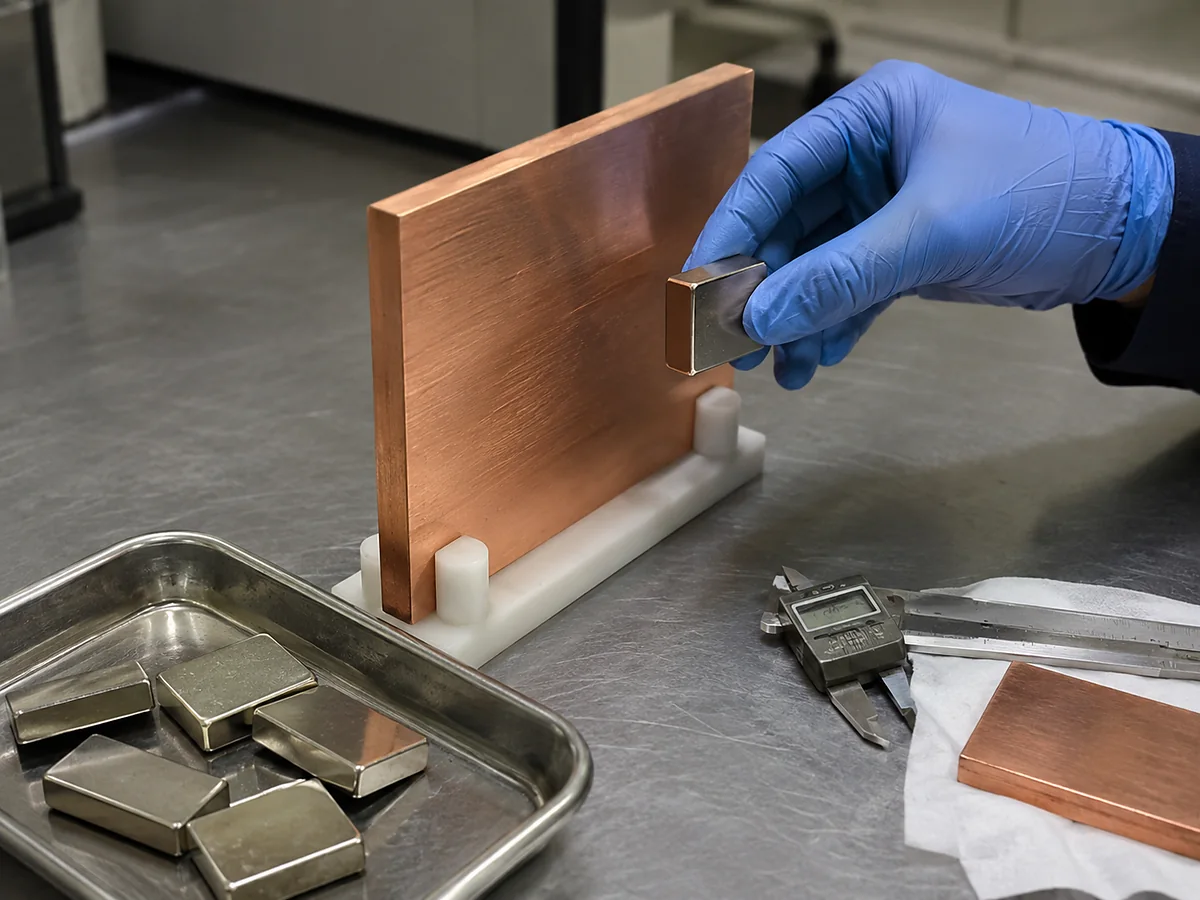
No. Pure copper does not normally stick to magnets.
If a magnet appears to stick to a copper-colored object, the object may not be pure copper. It may have steel behind it, a magnetic fastener, a plated layer over another metal, contamination, or another magnetic material hidden inside the structure.
A magnet test is useful as a quick field check, but it should not be treated as a material certificate. If copper purity, alloy grade, or hidden backing material matters, use proper material identification, supplier documentation, or testing such as PMI, XRF, or OES instead of relying only on magnet response.
This is especially important for engineers and buyers. A magnet can tell you whether there is obvious ferromagnetic attraction at the tested area, but it cannot confirm the exact copper alloy, grade, composition, heat treatment, or internal structure.
Why Does Copper Not Attract Magnets Like Iron or Steel?
The main reason is that copper is not ferromagnetic.
Iron, nickel, cobalt, and many steels can show strong magnetic attraction because their internal magnetic domains can align strongly with an external magnetic field. That is why a magnet can pull on many steel parts.
Copper behaves differently. It is diamagnetic, so its magnetic response is extremely weak and opposite to the applied field. In ordinary use, this weak response is not strong enough to make a magnet stick to copper.
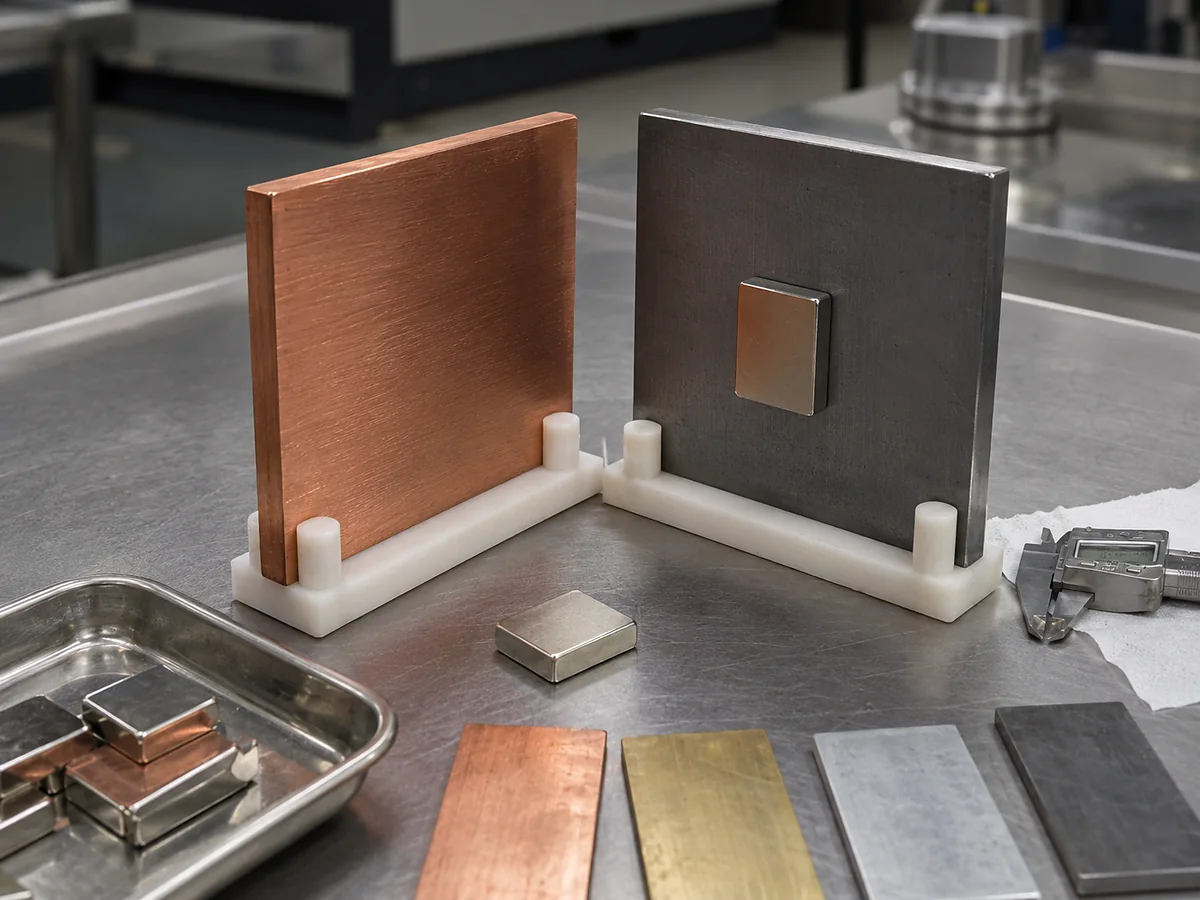
| Material | Ordinary Magnet Stick? | Practical Meaning |
|---|---|---|
| Copper | No | Not a useful magnetic target for holding force. |
| Aluminum | No | Usually no static attraction, but can show eddy-current effects with motion. |
| Brass | Usually no | Most common brass parts do not stick unless another magnetic material is present. |
| Iron | Yes | Strong magnetic response. |
| Carbon steel | Usually yes | Often useful as a magnetic target or magnetic return path. |
| Stainless steel | Depends | Ferritic and martensitic grades may attract; many annealed austenitic grades respond weakly. |
For a holding magnet, the difference is very practical. If the target surface is copper, the magnet will not grip it the way it grips steel. A stronger magnet does not change copper into a strong magnetic target.
Why Can Copper Still React Near Moving Magnets?
Copper can still matter near magnets because copper is a good electrical conductor.
When a magnet moves near copper, or when copper moves through a magnetic field, the changing magnetic field can induce circulating electrical currents in the copper. These are called eddy currents.
Those eddy currents create their own magnetic field that opposes the change that produced them. This is why a strong magnet can fall more slowly through a copper or aluminum tube than through a plastic tube. The magnet is not sticking to the copper. Instead, the motion creates a changing magnetic field, and the induced currents oppose that motion.
| Situation | What Usually Happens |
|---|---|
| Static magnet sitting near copper | Usually no noticeable attraction. |
| Magnet sliding past copper | Eddy currents may create drag or damping. |
| Magnet falling through a copper tube | The fall may slow because induced currents oppose motion. |
| Copper plate moving through a magnetic field | Eddy-current braking or damping may occur. |
| Copper wire carrying current | The current creates a magnetic field around the wire. |
| Static copper part used as a holding target | Copper is not a useful magnetic target like steel. |
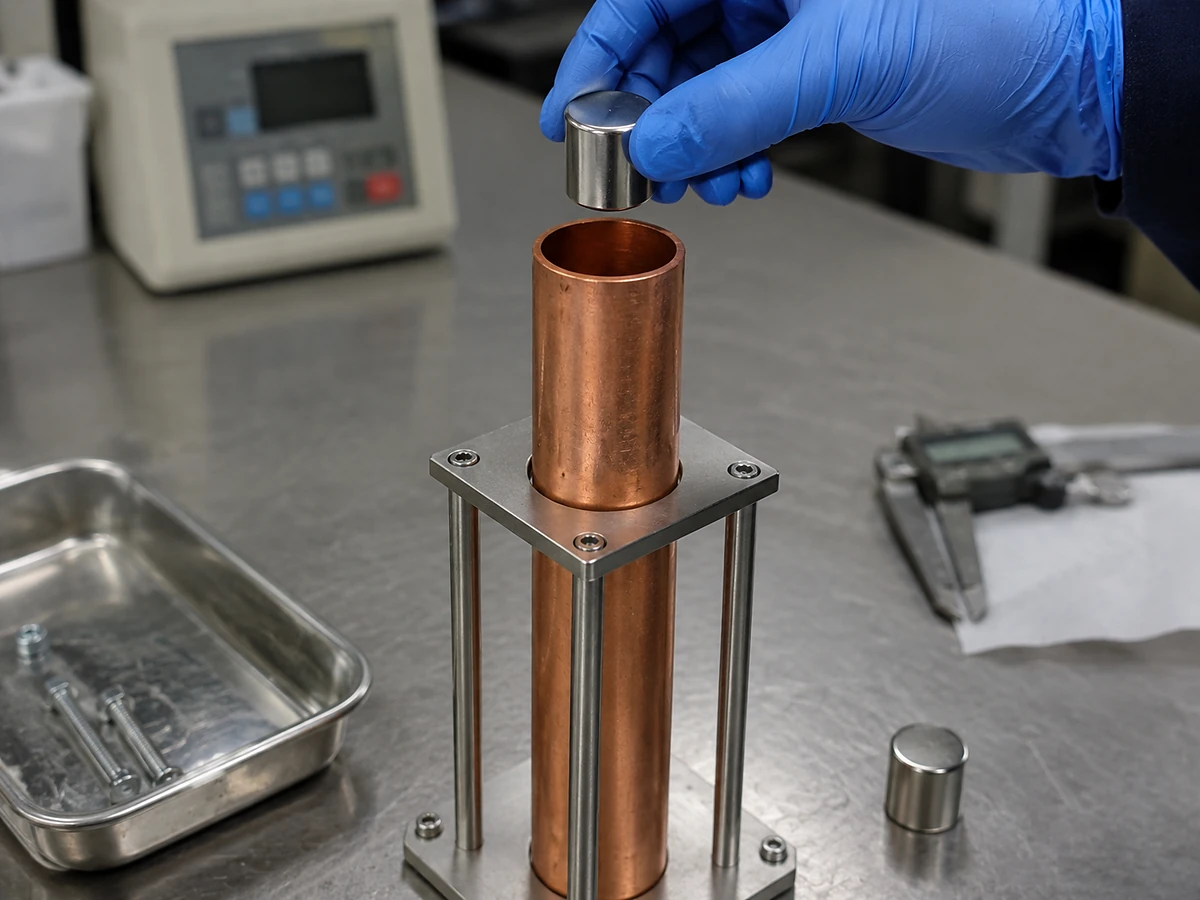
For product design, this means copper should not be ignored only because it does not stick to a magnet. The important question is whether the magnetic field is changing relative to the copper.
When Does Copper Matter in a Magnetic Assembly?
Copper can matter when there is motion, changing magnetic field, current flow, or a continuous conductive path near the magnet.
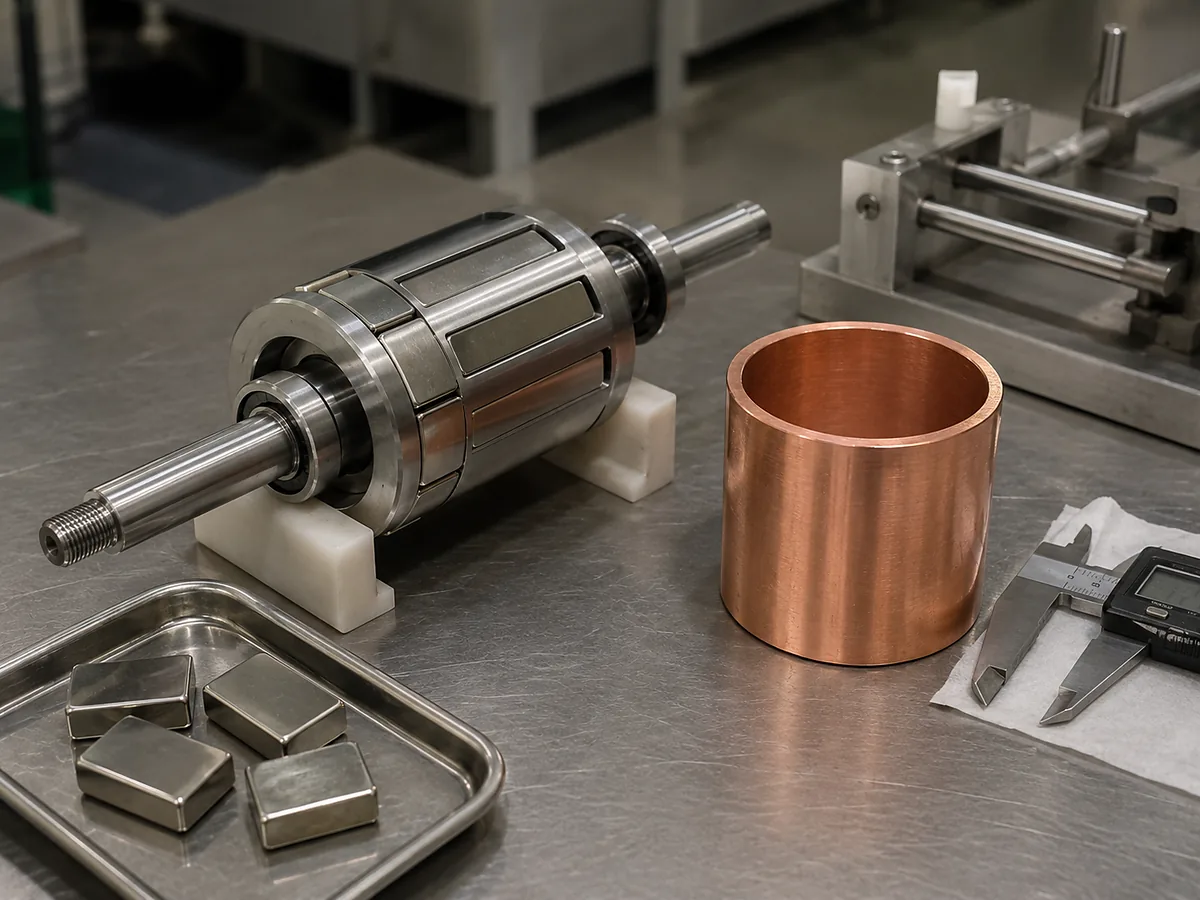
Common examples include copper sleeves near rotating magnets, copper tubes near moving magnets, copper windings in motors or actuators, PCB traces near sensors or magnetic encoders, and conductive parts close to magnetic couplings, rotors, or Halbach-style assemblies.
In these cases, the design concern is not that copper becomes a normal magnet target. The concern is that copper may influence damping, electrical behavior, unwanted heating, sensor behavior, or system efficiency depending on geometry and working conditions.
| Design Question | Why It Matters |
|---|---|
| Is the magnet moving relative to copper? | Motion can induce eddy currents. |
| Is the magnetic field changing over time? | Changing fields can induce currents in conductors. |
| Is the copper part a closed loop, sleeve, tube, or large plate? | Continuous conductive paths can support stronger eddy currents. |
| How close is the copper to the magnet? | Smaller gaps can increase field interaction. |
| What is the speed or frequency? | Faster changes can increase eddy-current effects. |
| Is there nearby steel or iron? | Ferromagnetic parts can dominate the magnetic circuit. |
| What is the function? | Holding, sensing, damping, torque, or positioning require different review paths. |
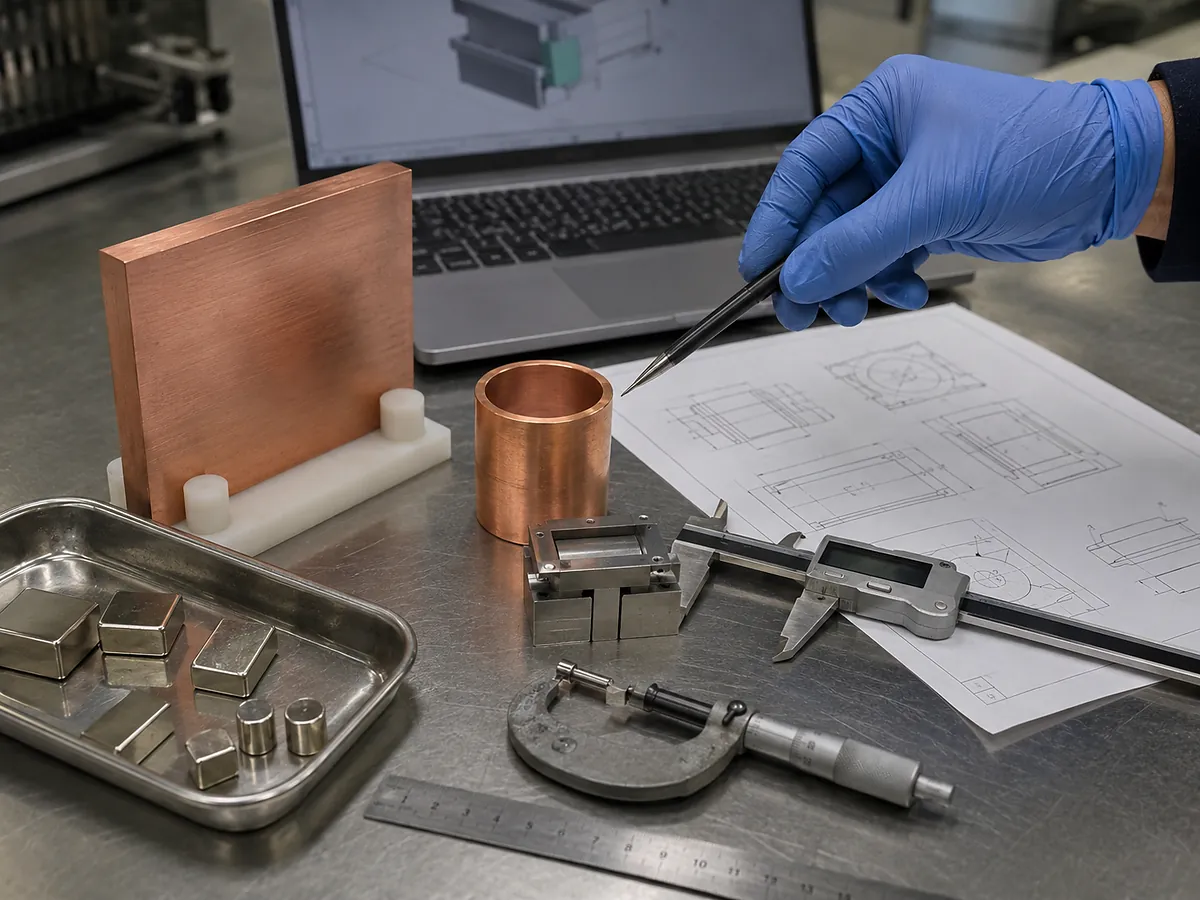
This is where an application drawing becomes more useful than a simple material name. “Copper near a magnet” is not enough information. The relative motion, distance, geometry, current path, and target function decide whether copper is important.
When Usually Does Copper Not Matter Much?
In many ordinary static holding applications, copper is not a useful magnetic target because it does not provide the strong attraction that steel or iron can provide.
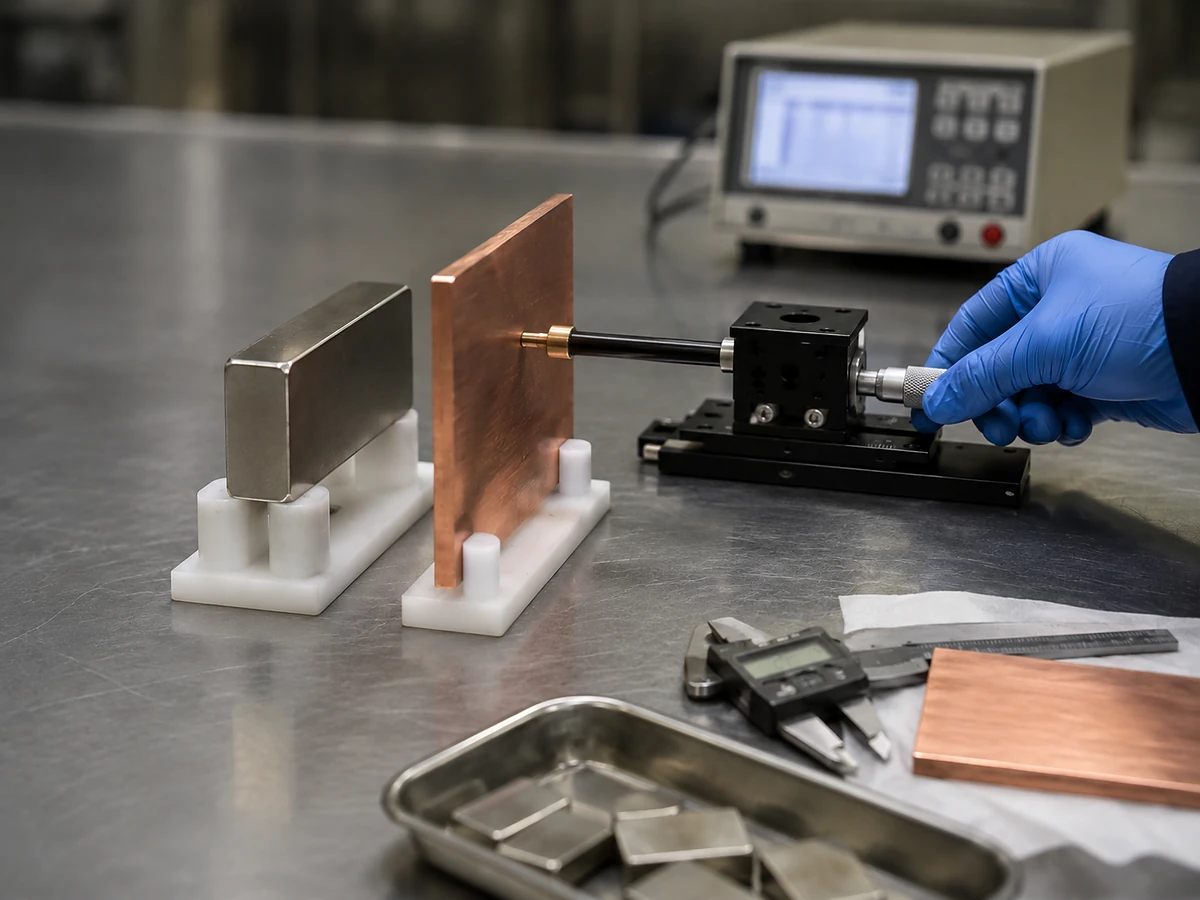
For example, if a customer wants a neodymium magnet to hold onto a copper sheet, the magnetic holding force will normally be poor unless there is steel or another ferromagnetic material behind or inside the structure.
Copper also should not be treated as a magnetic return path. If a design needs a strong magnetic circuit, steel or another suitable ferromagnetic material is usually the material that provides the return path, not copper.
Copper may be less important when the magnet and copper are both static, the air gap is large, copper is not part of a loop or sleeve, nearby ferromagnetic materials dominate the magnetic circuit, or copper is only a decorative nearby component.
What Should Engineers Check Before Choosing a Magnet Near Copper?
If your magnetic design includes copper, the RFQ should include more than magnet size and grade.
For Osenc or any magnet engineering review, the most useful information is:
| RFQ Input | What to Provide |
|---|---|
| Application goal | Holding, sensing, damping, torque transfer, positioning, braking, or another function. |
| Copper part type | Sheet, tube, sleeve, wire, coil, busbar, PCB trace, ring, or machined part. |
| Copper dimensions | Thickness, width, diameter, length, and relevant tolerances. |
| Magnet position | Distance from copper, air gap, and orientation. |
| Motion condition | Static, sliding, rotating, falling, vibrating, or reciprocating. |
| Speed or frequency | Relative speed, RPM, pulse frequency, or operating cycle if applicable. |
| Conductive path | Whether copper forms a closed loop, sleeve, tube, or large continuous surface. |
| Magnet details | Size, shape, grade if known, magnetization direction, and coating requirement. |
| Nearby materials | Steel, stainless steel, aluminum, plastic, brass, or other parts near the magnet. |
| Temperature condition | Ambient and working temperature near the magnet and copper. |
| Acceptance method | Pull force, surface field, motion feel, sensor output, temperature rise, fit, or assembly test. |
This information helps avoid a common mistake: selecting a magnet only by grade. Grade matters, but real performance also depends on working distance, magnet shape, magnetization direction, target material, assembly structure, and operating conditions.
For a custom neodymium magnet or magnetic assembly, Osenc can review drawings, sketches, samples, or application requirements to help evaluate magnet size, grade, coating, magnetization direction, air gap, and assembly structure. For complex magnetic assemblies, simulation, sample validation, and testing may be considered where suitable.
Common Mistakes About Copper and Magnets
| Mistake | More Accurate View |
|---|---|
| “Copper is not magnetic, so magnets never interact with it.” | Static attraction is weak, but moving or changing magnetic fields can induce eddy currents. |
| “If a magnet does not stick, the part must be pure copper.” | A magnet test cannot prove purity or alloy grade. |
| “Copper-colored means copper.” | Copper color may come from plating, coating, alloy color, or surface finish. |
| “A stronger magnet will stick to copper.” | A stronger magnet does not make copper act like steel. |
| “Copper can replace steel in a magnetic circuit.” | Copper is not a high-permeability magnetic return path. |
| “Copper blocks all magnetic fields.” | Copper is not a simple static magnetic shield. Shielding depends on field type, frequency, geometry, thickness, and gaps. |
These details are important because many design mistakes begin with a simple material assumption. In magnetic products, the surrounding parts can affect real performance as much as the magnet itself.
How Osenc Can Help With Magnet Designs Near Copper
Osenc’s main role is not to sell copper. Osenc helps customers evaluate neodymium magnets and magnetic assemblies when surrounding materials, geometry, air gap, motion, coating, magnetization direction, or assembly conditions affect the result.
If your design includes copper parts near a magnet, Osenc can review the drawing or sketch, magnet size, copper part location, air gap, movement direction, required force or sensor behavior, temperature condition, and coating requirement. If the magnet needs environmental protection, the neodymium magnet coating choice should also be reviewed with the final assembly conditions.
This is especially useful for motors, magnetic couplings, rotors, sensors, encoders, small mechanisms, and custom magnetic assemblies where copper may be nearby but not acting as the magnetic target. Quality checks such as dimension inspection, surface field checks, pull-force tests, coating inspection, or other validation steps can be discussed through Osenc’s quality management process when they are relevant to the project.
FAQ
Is copper magnetic?
Copper is not magnetic in the everyday attraction sense. More accurately, copper is diamagnetic, so its magnetic response is very weak and not like iron or steel.
Does copper stick to magnets?
No. Pure copper does not normally stick to a magnet. If a magnet sticks to a copper-colored part, check for steel, plating, contamination, hidden backing material, or another magnetic component.
Why does a magnet fall slowly through a copper pipe?
A moving magnet creates a changing magnetic field in the copper pipe. This induces eddy currents, and those currents create a magnetic field that opposes the motion. The magnet slows down, but it is not sticking to the copper.
Can copper block a magnetic field?
Copper is not a simple shield for static magnetic fields. It can affect changing magnetic fields through induced currents, but shielding behavior depends on frequency, thickness, geometry, distance, and gaps.
Is brass magnetic like copper?
Most common brass is not magnetic in the everyday attraction sense because it is mainly copper and zinc. However, a magnet test cannot prove the exact alloy or rule out hidden magnetic parts.
Can a magnet test prove that a part is pure copper?
No. A magnet test is only a rough screening step. If alloy identity matters, use supplier documentation or proper material identification methods such as PMI, XRF, or OES.
Does copper plating make a magnet stick?
Copper plating itself does not make a surface a strong magnetic target. If a plated part sticks to a magnet, the attraction usually comes from the material under the plating or another magnetic component.
Should I worry about copper near a neodymium magnet?
For a simple static layout, often not much. But if there is motion, rotation, current flow, a changing magnetic field, or a copper sleeve, tube, coil, or plate near the magnet, the design should be reviewed more carefully.
Technical References
For deeper review of copper magnetism, eddy currents, conductive shielding and material identification, see the technical references below.
Custom magnet engineering review
Need Help With a Magnet Design Near Copper?
If your design includes copper parts near a neodymium magnet, send Osenc the drawing, copper part position, air gap, movement condition, target function, and acceptance method.
Osenc can help review whether the issue is magnet size, grade, coating, magnetization direction, working distance, nearby steel, assembly structure, or validation method.
Contact Osenc for a Magnet Review