
Recently, many Amazon sellers have run into confusion during the “magnetic product” review process. Amazon often asks for a magnetic testing report that complies with IATA standards, and some review notes specifically mention measuring the magnetic field strength (in gauss) at 2.1 meters from any surface of the package, using PI 953.
In practice, this wording is easy to misunderstand. Below is a clear, seller-friendly explanation of the correct IATA air-transport standard for magnetized goods—and why most compliant test reports typically provide a “Pass/Fail” conclusion rather than a single numeric gauss value.

1) The Relationship Between IATA DGR and PI 953
First, it helps to clarify the terminology:
- IATA DGR (Dangerous Goods Regulations) is the full technical rulebook published by the International Air Transport Association and updated annually.
- PI 953 (Packing Instruction 953) is a specific section within IATA DGR that addresses magnetized material, including packaging, marking, and testing requirements.
So when referencing compliance, it’s more accurate to cite the full standard (for example, IATA DGR 66th Edition (2025)) and then note that testing follows PI 953, rather than referencing “PI 953” alone as if it were the complete standard.
2) Is Amazon’s “Gauss Value at 2.1 Meters” Requirement Reasonable?
Some sellers receive review feedback requesting a report that includes:
- The magnetic field strength measured at 2.1 meters (7 feet) from the package surface, and
- The test method and numeric results (gauss value).
This is often based on a misunderstanding of what IATA requires.
Under IATA DGR (66th Edition), Section 2.3.2 (Magnetized Material), the key criterion is:
At 2.1 m (7 ft) from any surface of the package, the magnetic field must not exceed 0.418 A/m, which is equivalent to 0.00525 gauss (i.e., 5.25 milligauss).
Importantly, this threshold is used to determine whether a shipment is regulated/restricted as dangerous goods. It does not mean the test report must always list a specific numeric reading.
In real-world compliance testing, a proper PI 953-style report typically provides:
- The test method, environment, and equipment details, and
- A final determination: “Complies / Does not comply with IATA DGR requirements for magnetized material.”
Many qualified testing agencies issue a clear Pass/Fail conclusion without publishing a single “gauss at 2.1 m” number—because the compliance question is simply whether the package is above or below the limit.
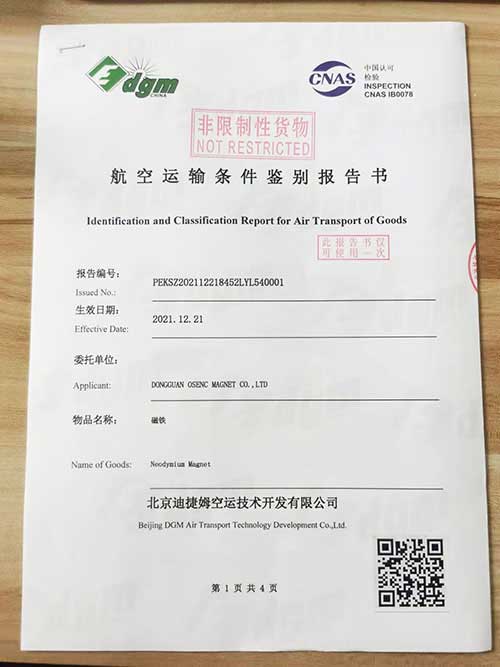
3) Why Many Reports Don’t Provide a Specific Gauss Number
Some sellers try to request an exact gauss value, but testing agencies or suppliers often can’t (or won’t) provide it. Common reasons include:
A) The purpose of the test
IATA testing is designed to determine whether the shipment is regulated under dangerous goods rules—not to produce a lab-grade magnetic field profile. If the field strength at 2.1 m is below the threshold, the shipment is generally considered non-restricted in this context.
B) Report format and compliance practice
A compliant IATA report typically needs to document:
- The test method (PI 953 reference),
- Equipment and calibration status,
- Test conditions (setup, environment), and
- The final compliance outcome.
Publishing a numeric reading can create unnecessary disputes because magnetic measurements can vary slightly due to positioning, instrument sensitivity, and environmental factors. Many labs avoid this by issuing a clear compliance statement instead.
C) Standard version and interpretation
Some sellers may have seen older templates that included numeric values. However, under current compliance practice, the key requirement is demonstrating the shipment meets the threshold—not necessarily listing a single number in the final report.
4) What Sellers Should Do If Amazon Still Requests This
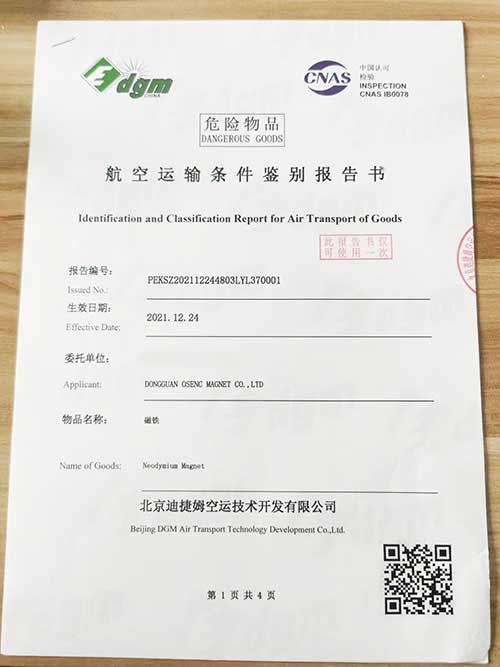
If you receive an Amazon request like this, here’s a practical approach:
Step 1: Submit a complete IATA DGR-compliant report
Make sure your report:
- References the latest applicable IATA DGR edition (e.g., IATA DGR 66th Edition, 2025), and
- Mentions PI 953 as the test basis, and
- Clearly states the final result: Pass / Compliant.
Step 2: Add a short clarification note with the submission
Include a brief statement explaining that:
- The IATA threshold is 0.418 A/m at 2.1 m, and
- Compliance is determined by whether the field is below this limit, and
- Many standard reports provide Pass/Fail confirmation rather than publishing numeric values.
Step 3: If needed, request a supplemental letter
If Amazon continues to insist on a numeric gauss value, ask the testing agency to issue a short supplemental statement confirming:
- The test setup followed PI 953 principles, and
- The package is below the IATA DGR limit at 2.1 m, therefore compliant.
This often resolves the issue without forcing the lab to provide a single “official” number.
5) Conclusion
Amazon’s magnetic product review exists to ensure air-transport safety, but in practice, reviewers may sometimes misinterpret how IATA compliance reports are commonly issued.
As a seller, understanding the correct IATA standard—and what a compliant report normally looks like—helps you respond confidently. Don’t get trapped chasing a “specific gauss value” if your report already provides a clear IATA DGR compliance conclusion. In most cases, a properly issued Pass/Fail IATA report is the strongest proof you can submit.
If you want, paste the exact wording Amazon gave you in the rejection/review note—I can rewrite a short “submission explanation” paragraph (native US English) that you can attach with your report.