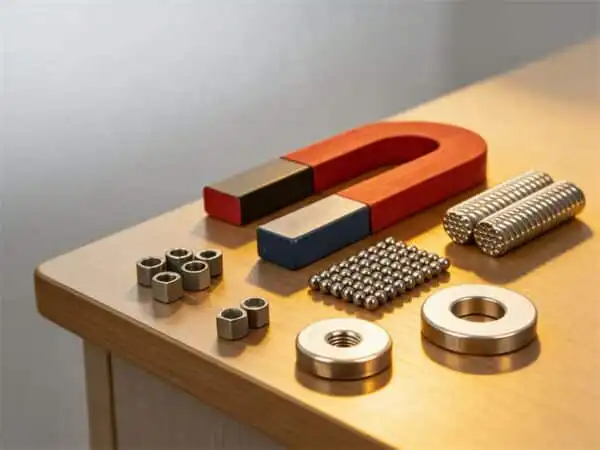
¿Afecta el calor a los imanes? Sí. Calentar un imán permanente suele reducir su respuesta magnética mientras está caliente. En los imanes de neodimio, una pérdida moderada puede ser reversible, pero una temperatura excesiva puede provocar una desmagnetización irreversible. La temperatura de Curie no es el límite seguro de temperatura de servicio.
Para NdFeB, la temperatura segura viene determinada por el punto de trabajo en caliente, no solo por el grado N o la temperatura de Curie. La coercitividad intrínseca (Hcj), la geometría, la dirección de magnetización, el entrehierro, el circuito de retorno de acero, la exposición a campos inversos y la respuesta requerida en caliente influyen en la decisión.
- Por qué el calor debilita los imanes
- Cómo cambian Br y Hcj con la temperatura
- Pérdida reversible frente a pérdida irreversible y temperatura de Curie
- ¿Qué temperatura es excesiva para los imanes de neodimio?
- Cómo elegir NdFeB para temperaturas más altas
- ¿El frío hace que los imanes sean más fuertes?
- Por qué la geometría y el circuito magnético modifican la temperatura admisible
- Por qué basarse únicamente en los gauss o en la fuerza de atracción puede resultar engañoso
- NdFeB frente a SmCo, ferrita y Alnico
- Cómo verificar el rendimiento térmico
- Cuándo utilizar simulación o validación térmica
- Qué debe enviar para un imán destinado a condiciones críticas de temperatura
- Preguntas frecuentes
¿Por qué el calor debilita los imanes?
El calor modifica las propiedades magnéticas de un material magnético permanente. De forma simplificada, el aumento de la temperatura incrementa la agitación térmica y dificulta que el material mantenga el mismo orden magnético. Como resultado, la respuesta magnética suele disminuir a medida que aumenta la temperatura.
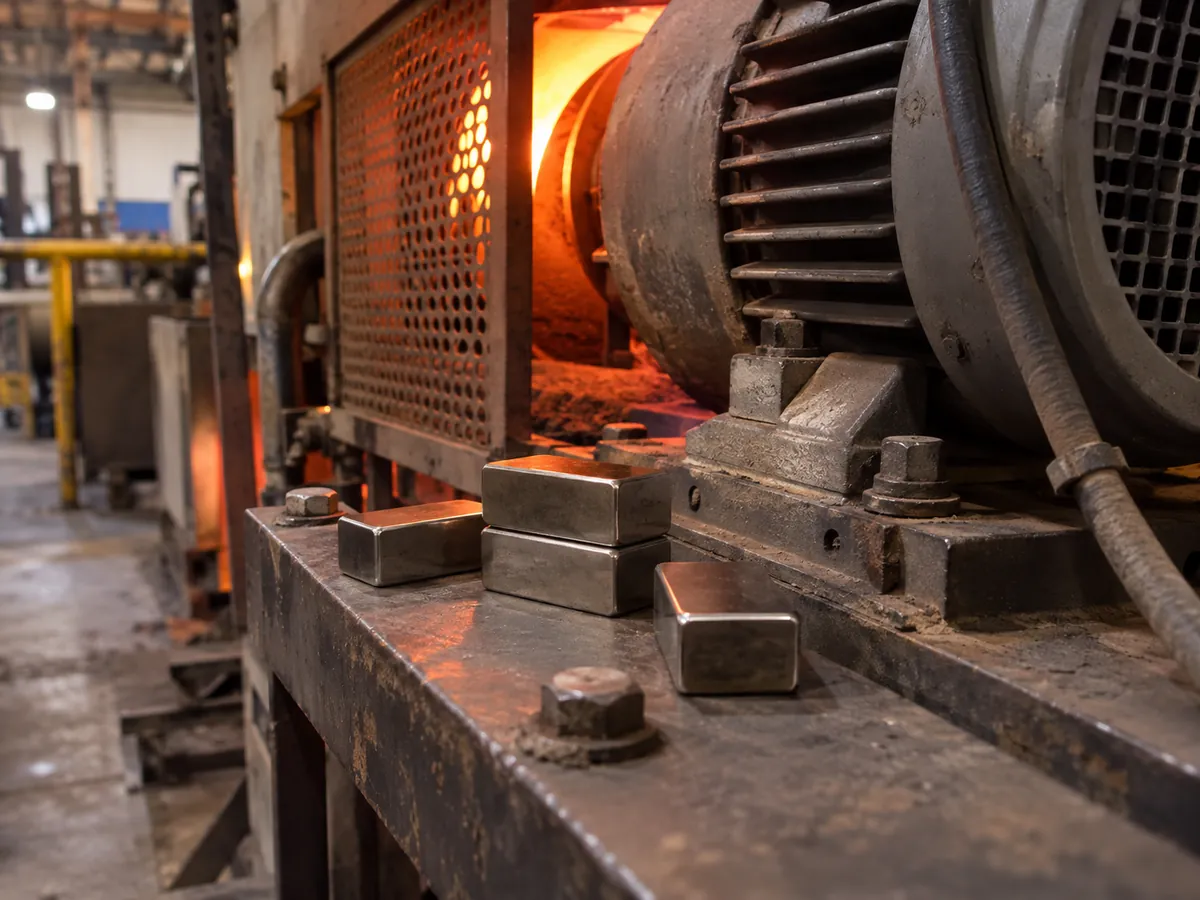
Esta respuesta es correcta, pero sigue siendo demasiado simplificada para seleccionar un imán de neodimio. Un imán puede debilitarse mientras está caliente y recuperarse tras enfriarse, o puede perder permanentemente parte de su magnetización. La diferencia depende del punto de trabajo del imán en su curva de desmagnetización a la temperatura máxima.
La cuestión es: “En la condición real de funcionamiento de mayor temperatura, ¿seguirá teniendo el imán suficiente flujo y un margen de coercitividad suficiente para evitar la desmagnetización irreversible?”
¿Cómo cambian Br y Hcj con la temperatura?
¿Qué ocurre con Br?
Cuando los compradores hablan de “fuerza magnética”, suelen mezclar varias propiedades diferentes. Para el diseño térmico, dos de las más importantes son remanencia (Br) y el coercitividad intrínseca (Hcj).
Por qué Hcj es importante para la desmagnetización irreversible
Br está estrechamente relacionado con el flujo magnético que puede proporcionar el material. Hcj mide la resistencia a la desmagnetización irreversible. Según datos representativos de NdFeB sinterizado publicados por Arnold Magnetic Technologies, ambos disminuyen a medida que aumenta la temperatura, pero el coeficiente de temperatura de Hcj presenta una magnitud mucho mayor que el coeficiente de Br. Por eso, un imán puede seguir proporcionando un rendimiento magnético útil aunque su margen de seguridad frente a pérdidas irreversibles ya se haya reducido considerablemente.
Fuente sobre el comportamiento representativo del coeficiente de temperatura de NdFeB: Nota técnica de Arnold Magnetic Technologies.
| Variable | Efecto típico del aumento de la temperatura en NdFeB | Por qué es importante | Acción de compras/diseño |
|---|---|---|---|
| Br | Disminuye | El flujo y el campo en caliente son inferiores a los valores a temperatura ambiente. | Defina el rendimiento mínimo aceptable a la temperatura real de servicio. |
| Hcj | Disminuye, a menudo más que Br | La resistencia a la desmagnetización irreversible se debilita. | Compruebe la curva de desmagnetización en caliente y el punto de trabajo, en lugar de basarse únicamente en el grado a temperatura ambiente. |
| BHmax | Varía según la curva del material | El producto energético a temperatura ambiente no describe el rendimiento del sistema en caliente. | No dé por hecho que un número N más alto proporciona automáticamente un mejor rendimiento térmico. |
| Punto de trabajo | Se desplaza a medida que cambia la curva | Un diseño con poco margen en el coeficiente de permeancia puede sobrepasar el codo a temperaturas elevadas. | Revise la geometría, el entrehierro, el circuito de retorno de acero y cualquier campo magnético opuesto. |
Un material representativo de NdFeB sinterizado puede tener un coeficiente de temperatura reversible de Br de aproximadamente -0.11% por °C. Esto resulta útil para una primera estimación, pero no para un cálculo de diseño definitivo. El coeficiente varía según el grado y el intervalo de temperatura, y una variación de Br no se traduce directamente en la misma variación porcentual de la fuerza de atracción o del rendimiento del conjunto.
Ejemplo práctico: estimación de la variación reversible de Br
Cálculo meramente ilustrativo: normalice Br a la temperatura de referencia hasta 100%. Suponga un coeficiente reversible representativo de Br de -0.11% por °C y un aumento de temperatura de 80 °C.
Br(T) ≈ Br(Tref) × [1 + αBr × (T − Tref)]Con αBr = -0,0011\/°C y ΔT = 80°C:
Br relativo ≈ 100% × [1 − (0.0011 × 80)] = 91.2%Este no es un resultado de ensayo de OSENC ni una garantía del grado. Es un ejemplo normalizado que muestra cómo se utiliza un coeficiente de temperatura. El coeficiente exacto debe obtenerse de los datos del material correspondientes al grado y al intervalo de temperatura seleccionados.
Por qué una disminución del 8,8% de Br no implica una disminución del 8,8% de la fuerza de atracción
La fuerza de atracción es el resultado de un sistema, no una reproducción directa de Br. También depende de la geometría del imán, el entrehierro de trabajo, el acero de contacto, el área de contacto, la saturación y el circuito magnético completo. Por tanto, una estimación reversible de Br puede ayudar a predecir una tendencia, pero no puede convertirse en una pérdida de fuerza de atracción del mismo porcentaje sin un cálculo del circuito o un ensayo controlado.
La pérdida reversible, la desmagnetización irreversible y la temperatura de Curie son conceptos diferentes
1. Pérdida reversible por temperatura
Cuando el imán se mantiene dentro de una zona de trabajo adecuada, su respuesta magnética disminuye al aumentar la temperatura y se recupera en gran medida cuando el imán se enfría. Este comportamiento se describe mediante un coeficiente reversible de temperatura.
2. Desmagnetización irreversible
Si el punto de trabajo a alta temperatura sobrepasa el codo de la curva de desmagnetización, parte de la pérdida magnética permanece después de que el imán se enfríe. El imán puede seguir funcionando, pero su flujo a temperatura ambiente puede ser inferior al que tenía antes de la exposición al calor.
Parte de la pérdida irreversible puede recuperarse mediante remagnetización si el material no ha sufrido daños estructurales permanentes. Esto no corrige un diseño deficiente. Si el mismo imán vuelve a someterse a las mismas condiciones térmicas y magnéticas, la pérdida puede repetirse.
3. Temperatura de Curie
La temperatura de Curie es la transición del material, a una temperatura mucho mayor, en la que desaparece el orden magnético normal de largo alcance. Un material sinterizado NdFeB representativo tiene una temperatura de Curie de aproximadamente 310°C. Eso no significa que un imán de neodimio estándar puede funcionar de forma continua a 310 °C.
Información general sobre temperatura/magnetización: NASA GSFC. Los valores representativos del material NdFeB varían según el grado; utilice los datos exactos del proveedor para el diseño final.
La temperatura máxima de servicio es un límite de la aplicación. Depende del material exacto, la geometría, el coeficiente de permeancia, el campo externo y la pérdida irreversible admisible.
¿Qué temperatura es demasiado alta para los imanes de neodimio?
No existe una única temperatura que sea “demasiado alta” para todos los imanes NdFeB. Los datos publicados para los grados N estándar habituales suelen indicar valores máximos de uso próximos al extremo inferior del rango de temperaturas del neodimio, mientras que los materiales con mayor coercitividad pueden estar especificados para temperaturas considerablemente superiores. Sin embargo, estas cifras publicadas no constituyen garantías universales.
Incluso dentro de una misma familia de grados nominales, la temperatura admisible puede variar según la forma del imán y el punto de trabajo. Un imán delgado que trabaje en un circuito magnético débil puede ser más vulnerable que otro más grueso fabricado con el mismo material.
Temperatura de funcionamiento continuo
La temperatura que alcanza realmente el imán durante el funcionamiento normal en régimen permanente.
Temperatura de pico
Exposiciones breves durante el curado, el arranque, una sobrecarga, la limpieza, la esterilización o debido a fuentes de calor cercanas.
Temperatura del imán, no temperatura ambiente
Un motor, una bobina, una carcasa metálica o el curado de un adhesivo pueden hacer que el imán alcance una temperatura superior a la del aire circundante.
¿Es N52 más resistente al calor?
N52 es una designación de grado basada en el producto energético, no una clasificación de temperatura. No indica el margen de Hcj en caliente ni la temperatura de servicio segura del imán acabado. Un grado de menor energía con mayor coercitividad intrínseca puede ser la opción más adecuada en un circuito magnético caliente.
La secuencia de selección debe ser la siguiente: rendimiento requerido en caliente → temperatura continua y máxima del imán → Hcj y curva de desmagnetización en caliente → geometría / coeficiente de permeancia → exposición a campos inversos → método de validación. Elegir primero el número N más alto invierte la lógica de ingeniería.
¿Cómo elegir un imán NdFeB para temperaturas más altas?
La clase de temperatura o el sufijo del grado son solo un punto de partida. La capacidad térmica final depende de cómo funcione el imán dentro del circuito magnético real. La tabla siguiente relaciona las condiciones habituales del comprador con el mecanismo físico, la consecuencia técnica, el paso de validación y la acción de compra.
| Condición del comprador | Mecanismo físico / factor limitante | Consecuencias técnicas | Cómo verificarlo | Acción del comprador |
|---|---|---|---|---|
| Mayor temperatura continua del imán | Br y Hcj disminuyen al aumentar la temperatura. | El rendimiento en caliente disminuye y el margen frente a la desmagnetización se reduce. | Revise los datos del material en caliente y el punto de trabajo en caliente. | Especifique la temperatura real del imán y el rendimiento requerido en caliente. |
| Pico breve de alta temperatura | La temperatura máxima y el tiempo de permanencia pueden exponer el imán a una curva de desmagnetización menos favorable. | Incluso un episodio breve puede provocar una pérdida irreversible si el punto de trabajo sobrepasa el codo de la curva. | Reproduzca la condición máxima y, a continuación, enfríe y vuelva a medir. | Indique la temperatura máxima, el tiempo de permanencia aproximado y la frecuencia del episodio. |
| Imán delgado o relación de aspecto desfavorable | La geometría puede reducir el coeficiente de permeancia. | El punto de trabajo puede acercarse al codo de la curva incluso si el grado del material no cambia. | Calcule la línea de carga / Pc utilizando la dirección de magnetización y el circuito reales. | No adopte el límite de temperatura indicado por un proveedor para una geometría diferente. |
| Entrehierro grande o camino de retorno deficiente | El circuito magnético se vuelve menos favorable. | El campo en la carga puede disminuir y el margen frente a pérdidas irreversibles puede reducirse. | Modele el entrehierro, el circuito de acero y la posición de trabajo reales. | Envíe la geometría del conjunto, no solo las dimensiones del imán sin montar. |
| Campo opuesto de una bobina o de un imán cercano | La solicitación magnética inversa aumenta, mientras que Hcj puede ser ya menor a esa temperatura. | El riesgo de desmagnetización puede aumentar considerablemente durante el funcionamiento en caliente o en condiciones de fallo. | Incluya la condición de campo inverso máximo en la revisión del punto de trabajo. | Especifique los campos opuestos en condiciones normales y en el peor caso. |
| Fuerza de atracción o campo requerido en caliente | El rendimiento final depende tanto de las propiedades del material como del circuito magnético. | Una prueba superada a temperatura ambiente puede convertirse en un fallo funcional en caliente. | Mida el campo / flujo / fuerza de atracción o el rendimiento del conjunto en condiciones definidas de alta temperatura. | Establezca el requisito de aceptación a la temperatura real de servicio. |
La especificación de compra debe definir el perfil térmico real, el circuito magnético y la condición de aceptación. Solo entonces debe concretarse la elección del grado del material.
¿El frío hace que los imanes sean más fuertes?
En los imanes de neodimio, la remanencia suele aumentar a medida que desciende la temperatura dentro de los intervalos industriales habituales. Por tanto, un imán puede medir una fuerza algo mayor en frío que en caliente.
Esto no significa que “cuanto más frío, mejor” sin límite alguno. NdFeB presenta un comportamiento adicional a bajas temperaturas en el rango criogénico, incluida la reorientación de espín cerca de 140 K en materiales representativos. La ferrita plantea un problema distinto: su coercitividad puede disminuir al bajar la temperatura, por lo que el frío extremo puede hacer que algunos diseños con ferrita sean más vulnerables a la desmagnetización.
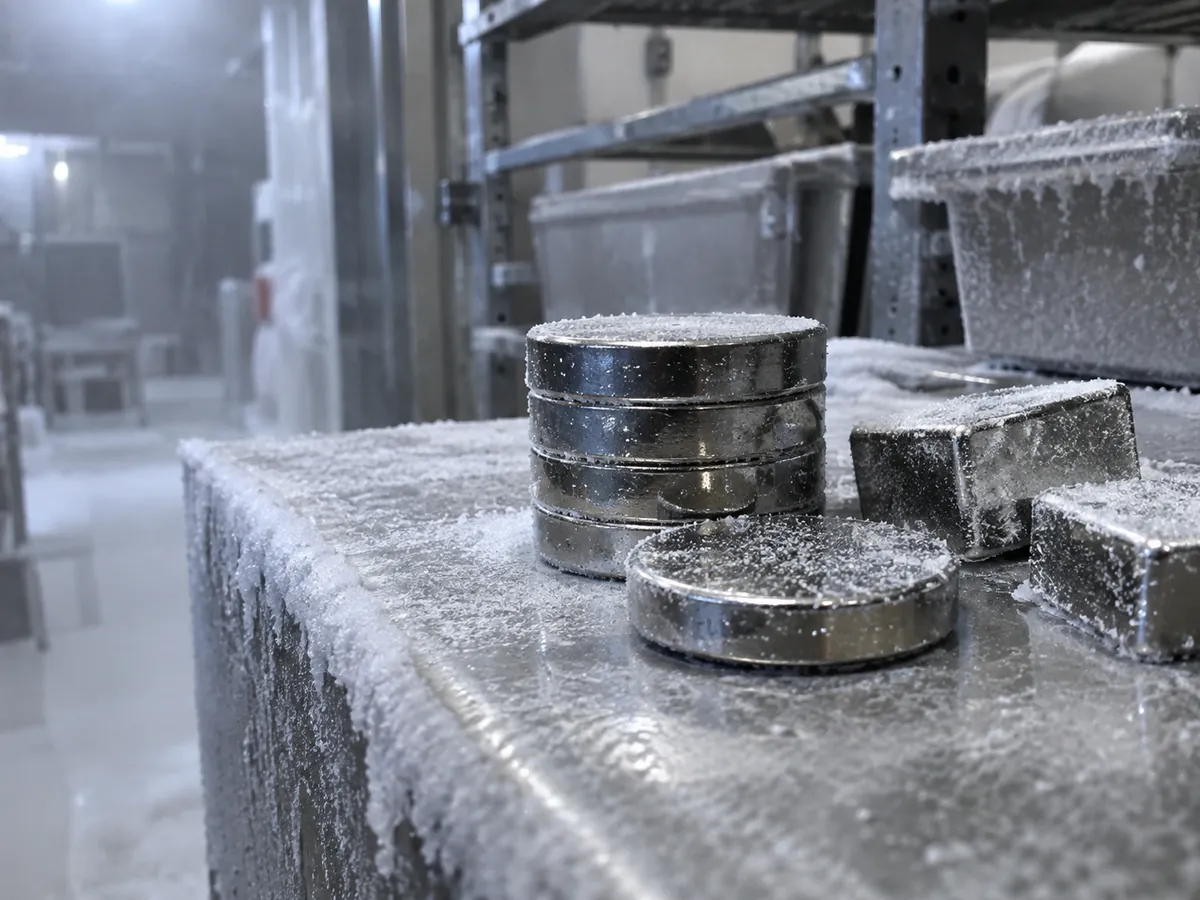
Si la aplicación funciona por debajo de las temperaturas industriales habituales, especifique la temperatura mínima real del imán y verifique el material seleccionado, en lugar de extrapolar indefinidamente un coeficiente medido a temperatura ambiente.
Por qué la geometría y el circuito magnético modifican la capacidad térmica
Dos imanes fabricados con el mismo grado de material pueden comportarse de forma diferente a la misma temperatura porque el coeficiente de permeancia (Pc) y la línea de carga dependen de la geometría y del circuito magnético circundante. Por tanto, un mismo valor de Hcj puede proporcionar márgenes térmicos muy diferentes en dos conjuntos.
Un imán delgado en la dirección de magnetización, un mayor entrehierro efectivo, una trayectoria de retorno de acero deficiente o un campo opuesto pueden desplazar el punto de funcionamiento hacia la rodilla de la curva de desmagnetización a alta temperatura. Este es el mecanismo que explica por qué la “temperatura máxima de servicio” no es un valor único e invariable para todos los imanes fabricados con el mismo material.
- Dimensiones del imán: el espesor en la dirección de magnetización puede modificar sustancialmente el punto de funcionamiento.
- Entrehierro: un mayor entrehierro efectivo suele hacer que el circuito magnético sea menos favorable.
- Trayectoria de retorno de acero: el circuito ferromagnético circundante puede modificar la distribución del flujo y el margen de funcionamiento.
- Campo opuesto: una bobina u otro imán pueden añadir una solicitación desmagnetizante justo cuando el calor reduce el valor de Hcj.
- Dirección de magnetización: la forma por sí sola no permite determinar la dirección de los polos, y el cálculo geométrico correcto requiere conocer la orientación real de la magnetización.
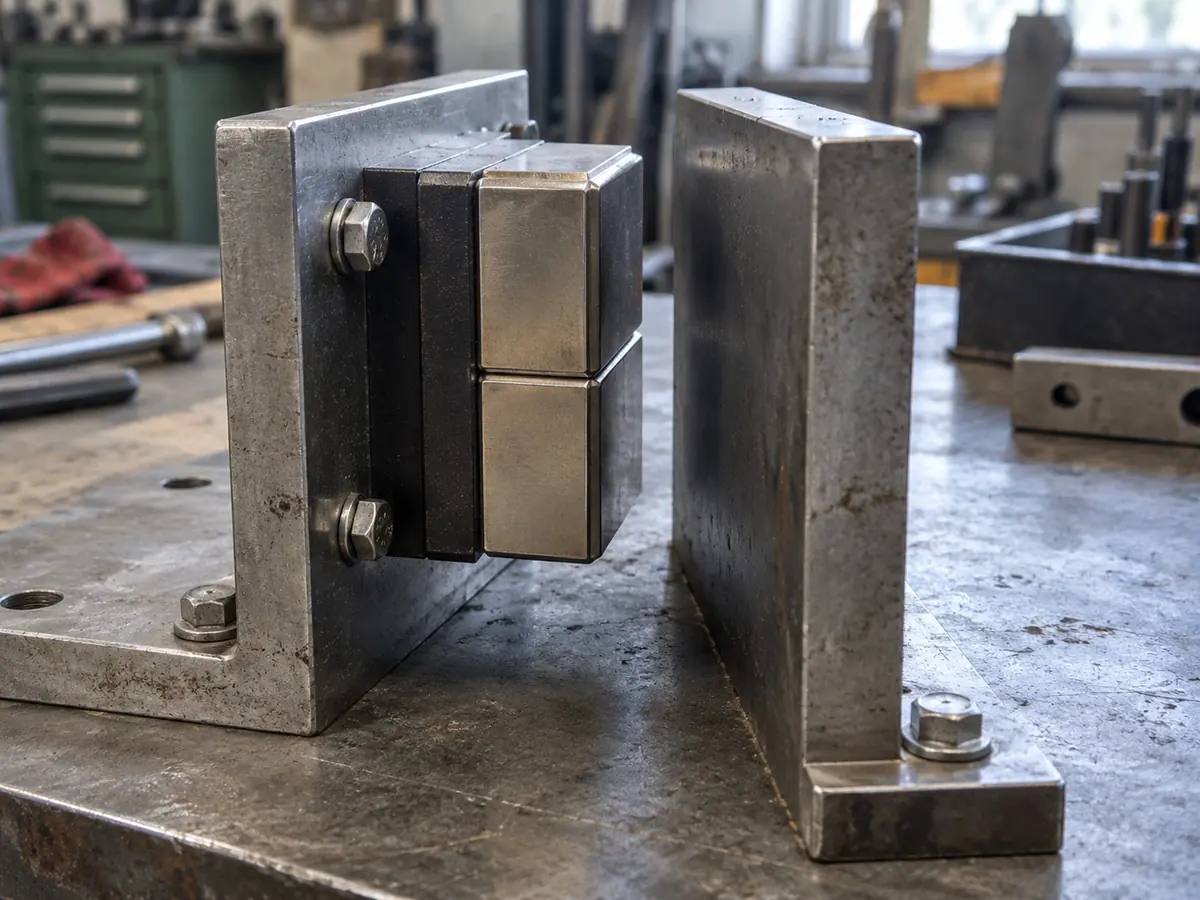
En proyectos donde los márgenes térmico y magnético sean ajustados, una la simulación del campo magnético puede resultar útil para evaluar el circuito magnético antes de cerrar el diseño.
Por qué el campo superficial en Gauss o la fuerza de tracción por sí solos pueden inducir a error a distintas temperaturas
Una medición del campo superficial en Gauss no equivale al campo a la distancia de trabajo real, y ninguno de ellos equivale automáticamente a la fuerza de tracción. Esta distinción adquiere mayor importancia cuando cambia la temperatura.
Si Br disminuye mientras el imán está caliente, cambia la distribución del campo. La fuerza resultante depende de la geometría, el entrehierro, el acero de la pieza atraída, las condiciones de contacto y la saturación magnética. En general, no es válido hacer un cálculo sencillo del tipo “Br disminuyó 6%; por tanto, la fuerza de tracción disminuyó 6%”.
Para una aplicación de sujeción, defina las condiciones del ensayo de fuerza de tracción. Para una aplicación con sensores o motores, defina el campo o el flujo en la posición de trabajo real. En el caso de un conjunto, el mejor criterio de aceptación puede ser su respuesta funcional, en lugar de una medición superficial del imán sin montar.
Para obtener más información sobre esta distinción, consulte Gauss de un imán y el ¿Qué fuerza tiene un imán de neodimio?.
¿Cómo se comportan NdFeB, SmCo, Ferrite y Alnico a distintas temperaturas?
| Material | Comportamiento frente a la temperatura | Principal ventaja de diseño | Principal precaución |
|---|---|---|---|
| NdFeB | Alto rendimiento magnético cerca de la temperatura ambiente, con coeficientes de temperatura negativos para Br y Hcj. | Alta densidad de energía en diseños compactos. | El margen frente a la desmagnetización térmica puede convertirse en el factor limitante. |
| SmCo | Coeficiente reversible de temperatura inferior al habitual en NdFeB y gran estabilidad a altas temperaturas. | Resulta útil cuando la estabilidad térmica es más importante que la densidad de energía máxima a temperatura ambiente. | La elección del material debe seguir basándose en la aplicación completa, no solo en la temperatura. |
| Ferrita | Br disminuye al aumentar la temperatura, mientras que la coercitividad suele evolucionar en sentido contrario. | Estable, ampliamente utilizado y rentable en muchas aplicaciones. | En algunos circuitos, la desmagnetización a baja temperatura puede adquirir mayor importancia. |
| Alnico | Variación reversible del flujo con la temperatura muy pequeña en comparación con los materiales magnéticos comerciales habituales. | Excelente estabilidad del flujo frente a la temperatura. | La coercitividad relativamente baja hace que el diseño del circuito magnético sea crítico. |
Cómo verificar el rendimiento del imán antes y después de la exposición al calor
Un plan eficaz de verificación térmica distingue la variación reversible en caliente de la pérdida irreversible a temperatura ambiente. La magnitud medida debe corresponderse con la función real: campo o flujo en una ubicación definida, fuerza de atracción con una configuración controlada o rendimiento del conjunto.
- Defina la condición de referencia. Registre las características del imán o conjunto a una temperatura de referencia controlada, utilizando un útil fijo y un método de medición definido.
- Caliente hasta alcanzar la temperatura especificada del imán. Utilice la condición continua o de pico real que sea relevante para el diseño.
- Mida el rendimiento en caliente cuando sea necesario. Puede tratarse del flujo, del campo en una ubicación indicada, de la fuerza de atracción en las condiciones especificadas o del rendimiento del conjunto.
- Enfríe de nuevo hasta la condición de referencia. Repita la misma medición con el mismo entrehierro, orientación, útil y configuración del instrumento.
- Distinga la variación reversible de la irreversible. La disminución en caliente que se recupera tras el enfriamiento es distinta de la pérdida permanente que se mantiene después de enfriar.

Para la aceptación por parte del comprador, mantenga controlados el dispositivo de ensayo, el entrehierro, la orientación y la temperatura de referencia, de modo que la comparación antes / en caliente / después sea significativa. La guía publicada por OSENC Gauss de un imán explica el contexto de la medición del campo, mientras que Gestión de la calidad proporciona el contexto de calidad e inspección en planta. El método de ensayo debe seleccionarse en función de la aplicación final, no del instrumento que resulte más fácil de utilizar.
¿Cuándo debe recurrir a una simulación magnética o a una validación térmica?
La simulación o la validación de temperatura adquiere mayor valor cuando el diseño tiene poco margen térmico o magnético. No es necesaria para todas las compras de imanes sencillos, pero es la opción más segura cuando una especificación a temperatura ambiente no permite predecir con suficiente fiabilidad el punto de trabajo en caliente.
- la temperatura de servicio está próxima al límite de aplicación indicado por el proveedor;
- el imán es fino en la dirección de magnetización o el margen de Pc es reducido;
- el entrehierro de trabajo es grande o el circuito de retorno no está bien definido;
- una bobina o un imán adyacente genera un campo contrario significativo;
- el campo, la fuerza de atracción o el rendimiento del conjunto en caliente son críticos para el funcionamiento.
¿Qué información debe enviar para un imán destinado a una aplicación con temperaturas críticas?
Para que la primera revisión de ingeniería resulte útil, envíe únicamente los datos que puedan modificar la selección del material, el punto de trabajo, el método de validación o las condiciones de aceptación final:
- plano, dimensiones y tolerancias del imán;
- dirección de magnetización o configuración de polos;
- temperatura continua normal del imán;
- temperatura máxima de corta duración y tiempo de permanencia aproximado;
- temperatura mínima de servicio si el funcionamiento a baja temperatura es relevante;
- distancia de trabajo o entrehierro;
- circuito de retorno de acero, carcasa y componentes ferromagnéticos próximos;
- campo inverso procedente de bobinas, imanes adyacentes o condiciones de fallo;
- campo, flujo, fuerza de atracción o rendimiento del conjunto requeridos en caliente;
- requisitos ambientales y de recubrimiento;
- el método de ensayo y la variación aceptable antes y después de la exposición térmica.
Estos datos son más útiles que indicar únicamente el nombre de una aplicación, solicitar un grado N o establecer un objetivo de Gauss en superficie a temperatura ambiente. Para proyectos personalizados viables, utilice Imanes de neodimio a medida o envíe el proyecto a través de la página de contacto de OSENC.
Preguntas frecuentes sobre el calor, el frío y la fuerza de los imanes
¿Afecta el calor a los imanes?
Sí. Calentar un imán permanente normalmente reduce su rendimiento magnético mientras está caliente. En los imanes de neodimio, parte de esa pérdida puede ser reversible, pero una temperatura excesiva también puede provocar una desmagnetización irreversible.
¿El calor debilita un imán de forma permanente?
No siempre. Si el imán se mantiene dentro de una región de funcionamiento adecuada, gran parte de la pérdida relacionada con la temperatura puede recuperarse tras el enfriamiento. Si el calor desplaza el punto de trabajo más allá de la rodilla de la curva de desmagnetización, puede persistir cierta pérdida después de que el imán vuelva a temperatura ambiente.
¿A qué temperatura pierden su magnetismo los imanes de neodimio?
No existe una única temperatura de desmagnetización aplicable a todos los imanes de neodimio. Los grados estándar de NdFeB sinterizado suelen asociarse a temperaturas máximas de servicio relativamente moderadas, mientras que los grados con mayor coercitividad pueden funcionar a temperaturas más elevadas. La temperatura de Curie de un material de NdFeB sinterizado representativo ronda los 310°C, pero la temperatura de Curie no constituye un límite seguro de temperatura de servicio.
¿El frío hace que los imanes sean más fuertes?
Dentro de los intervalos habituales de temperatura industrial, los imanes de neodimio suelen presentar una mayor remanencia al descender la temperatura. Esta tendencia no debe extrapolarse indefinidamente, ya que NdFeB presenta un comportamiento adicional a bajas temperaturas en condiciones criogénicas.
¿Es la temperatura de Curie la misma que la temperatura máxima de funcionamiento?
No. La temperatura máxima de servicio es un límite de aplicación destinado a evitar una pérdida irreversible inaceptable. La temperatura de Curie es una transición del material mucho más elevada, en la que desaparece el orden normal del imán permanente.
¿Qué temperatura es demasiado alta para un imán N52?
N52 identifica un grado de producto energético, no una clasificación universal de temperatura. La temperatura de servicio segura depende de la especificación exacta del material, la coercitividad intrínseca, la geometría del imán, el circuito magnético, los campos inversos y la pérdida de rendimiento admisible. Utilice las curvas de desmagnetización del proveedor correspondientes al grado exacto en lugar de un valor genérico de N52.
¿Puede recuperarse un imán de neodimio sobrecalentado?
La pérdida reversible puede recuperarse tras el enfriamiento. La desmagnetización irreversible no se recupera por completo únicamente mediante enfriamiento y puede requerir una nueva magnetización si el material no ha sufrido daños estructurales permanentes. Si el circuito magnético y la exposición a la temperatura no cambian, la pérdida puede volver a producirse.
Referencias técnicas
Este artículo utiliza datos representativos de imanes permanentes con fines explicativos. La temperatura máxima admisible definitiva debe determinarse a partir de la especificación exacta del material y del circuito magnético real.
Envíenos el plano del imán y las condiciones de temperatura
Envíenos el plano del imán, la dirección de magnetización, la temperatura continua y máxima del imán, el tiempo de permanencia a la temperatura máxima, el entrehierro de trabajo, la presencia de acero cercano o de un campo inverso, y el campo, flujo, fuerza de atracción o rendimiento del conjunto que deben mantenerse en caliente. Estos datos son suficientes para iniciar una evaluación técnica fundamentada, sin asumir que un único límite genérico de temperatura permite seleccionar el imán.