Order 3–15 mm small neodymium magnets with ±0.02 mm tolerances, consistent polarity trays, and ±3% flux sorting. No strict MOQ—samples start from 1 piece before volume runs.
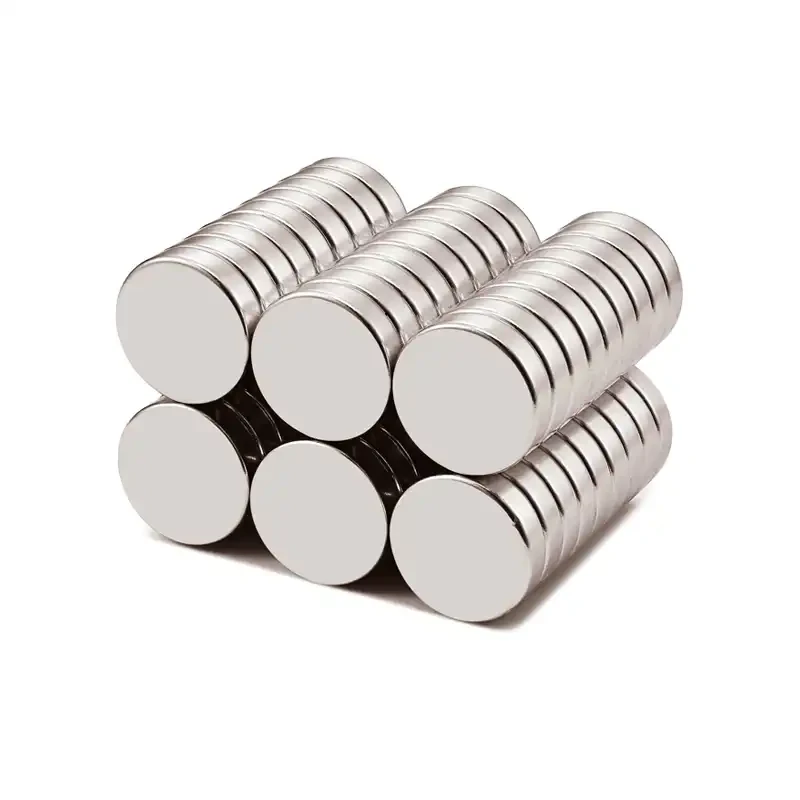
Yes, if your finished part measures 3–15 mm with features at least 1 mm thick. These compact and tiny neodymium magnets fit consumer electronics, TWS earbuds, Hall sensors, miniature motors, and rigid packaging closures.
| Your Goal | Key Choice | Standard Fit | When to Upgrade / Switch | Pre-Order Check |
|---|---|---|---|---|
| Fit tight pockets without thin-wall chipping. | Standard 3–15 mm line or micro-magnet process? | Use standard 3–15 mm production for parts with ≥1 mm walls and ±0.05 mm slots. | Switch to Micro Magnets if any critical feature drops below 1 mm. | Confirm finished post-plating size and wall thickness on your drawing. |
| Hold through plastic or paper without heat loss. | Standard N42/N52 or high-temp H grade? | Use N35–N45 below 60°C when wall gaps stay under 1 mm. | Upgrade to N42H/N45H (120°C) for 85°C curing, or add 1 mm thickness instead of N52. | Test sample pull force across your real wall gap after heating. |
| Feed small magnets cleanly on automated lines. | Bulk spacer tubes, trays, or tape-and-reel? | Use spacer tubes or foam trays for manual assembly and trial builds. | Switch to EIA-481 tape-and-reel or blister trays with polarity marks for pick-and-place. | Verify pocket width, peel force, and north-pole orientation on first reels. |
| Keep Hall-sensor trigger distances repeatable across lots. | Standard lot sampling or 100% flux sorting? | Use standard ±5% batch checks for packaging closures and mechanical catches. | Add 100% Helmholtz coil sorting to ±2%–±3% for sensors, earbuds, and actuators. | Set pass/fail dipole-moment limits using a golden sample magnet. |
Need bulk single-shape catalogs? Browse our Neodymium Disc Magnets, Block Magnets, or Ring Magnets.
Standard 3–15 mm small neo magnets hold ±0.05 mm post-plating tolerances, with ±0.02 mm precision grinding available. All figures below reflect OSENC custom capabilities and verified physical benchmarks; final limits lock on your drawing.
| Parameter / Benchmark | Standard / Custom Engineering Range |
|---|---|
| Dimensions & Tolerances | |
| Standard OEM Window | 3–15 mm largest side (1–3 mm reviewed; <1 mm routed to micro line) |
| Available Shapes | Disc, block, ring, cylinder, rod, and drawing-defined shapes |
| Post-Plating Tolerance | ±0.05 mm standard; ±0.02 mm precision ground (specify finished size) |
| Glued Pocket Clearance | 0.05–0.10 mm per side recommended to prevent edge chipping |
| Grades & Air-Gap Pull* | |
| Material Grades & Max Temp | N35–N56; M (100°C), H (120°C), SH (150°C), UH (180°C), EH (200°C), AH (220–230°C) |
| Reversible Thermal Drift | -0.09% to -0.12% per °C (thin high-D/T N52 discs cap near 65°C) |
| 6 × 2 mm Disc (N42 ref.) | 0 mm: ~0.60–0.76 kg; 1 mm gap: ~0.12 kg; 2 mm gap: ~0.04 kg; slide: ~0.15 kg |
| 8 × 3 mm Disc (N42 ref.) | 0 mm: ~1.45 kg; 1 mm gap: ~0.35 kg; 2 mm gap: ~0.12 kg (N52 ~+20–25%) |
| 10 × 3 mm Disc (N42 ref.) | 0 mm: ~1.80–2.00 kg; 1 mm gap: ~0.52 kg; 2 mm gap: ~0.19 kg (N52 ~+20–25%) |
| Coatings & Stack-Up | |
| Ni-Cu-Ni (Standard) | 15–21 µm (~0.03–0.04 mm total buildup); NSS ref. ~24 h; indoor housings |
| Black Epoxy | 20–38 µm (~0.04–0.08 mm total buildup); NSS ref. ~48 h+; sweat and humidity |
| Parylene / Everlube / Zinc | Parylene 10–15 µm (pinhole-free); Everlube 8–25 µm; Zinc 7–15 µm |
| Automated Interfaces | |
| EIA-481 Tape & Reel | Pocket A0/B0 = nominal +0.10–0.15 mm; cover peel 0.1–1.3 N at 300 mm/min |
| Trays & Spacer Tubes | Anti-stick blister trays for heavier 8–15 mm parts; spacer tubes for trials |
| Polarity Marking | Uniform N/S orientation per reel/tray; optional north-pole dot, dimple, or laser mark |
*Pull-force figures show axial single-magnet reference values against a thick, flat low-carbon steel plate. Side slide resistance averages 15%–20% of vertical pull. Actual force varies with steel thickness and gap.
Specify six core inputs on your 2D print so first samples fit your housing without rework. Missing a coating buildup or polarity callout causes most sampling delays.

Adding 1 mm of magnet thickness often beats upgrading to N52 on both pull force and cost. Smart OEM sizing protects your thermal margin and keeps automated feeders running cleanly.
Share your magnet size, working gap, and peak temperature to compare grade and feeding options.

Switch to non-magnetic nozzles and verify reel polarity before starting any high-speed run. Small sintered NdFeB parts are metallic, dense, and brittle under impact.
Verify polarity, nozzle material, and lighting on every new reel before high-speed placement.
Clear nozzle sticking, tape jump, and vision glare in under two minutes with these first steps.
MOQ has no fixed minimum, custom lead time averages ~25 days, and 100% Helmholtz sorting is optional. Every custom small NdFeB order follows OSENC’s ISO 9001 quality workflow with IQC, IPQC, and OQC checks.

| Commercial / Compliance Term | OSENC OEM Standard & Verification Basis |
|---|---|
| Sampling & MOQ | No strict MOQ (trial samples from 1 piece); custom tooling or carrier-tape setup confirmed per drawing. |
| Production Lead Time & Storage | ~25 days custom reference (confirmed by drawing); store sealed in dry areas (<60% RH) under FIFO. |
| Quality & Warranty | IQC/IPQC/OQC reports and batch CoC available; warranty and AQL terms lock on signed quotation. |
| Regulatory Compliance | RoHS/REACH statements supplied per order; B2B OEM embedded parts are exempt under CPSC 16 CFR § 1262.2(b). |
| Air & Sea Shipping | IATA PI 953 shielded air (<0.002 G at 2.1 m non-DG; ≤0.00525 G at 4.6 m Class 9) or sea / unmagnetized. |
Always enclose small magnets permanently inside consumer housings so loose parts cannot trigger CPSC 50 kG²mm² ingestion rules.
Direct answers on size boundaries, plating buildup, curing heat, CPSC compliance, and CAD submission.
Small OEM magnets cover 3–15 mm parts with walls ≥1 mm; sub-1 mm features go to micro production.
Ni-Cu-Ni adds about 0.03–0.04 mm total; black epoxy adds 0.04–0.08 mm across both sides.
Thin N52 discs have low thermal margin and can irreversibly demagnetize above ~65°C.
No—B2B industrial and OEM component magnets are explicitly exempt under 16 CFR § 1262.2(b).
Submit your specs via our contact page, then email or WhatsApp your STEP or PDF drawings.
Share size, grade, peak temperature, working gap, coating, and quantity to start sampling. Submit your specs online, then send STEP or PDF drawings by reply email or WhatsApp.