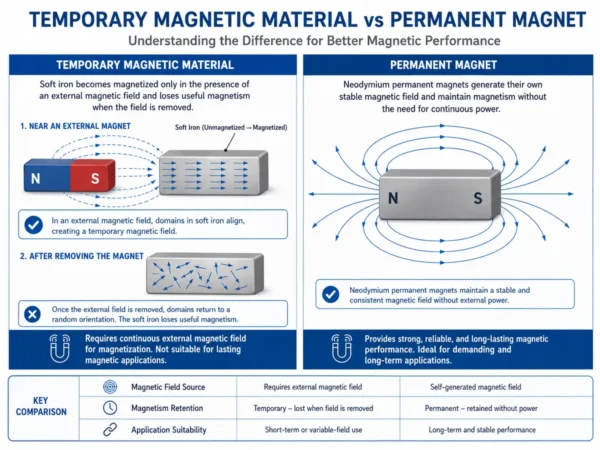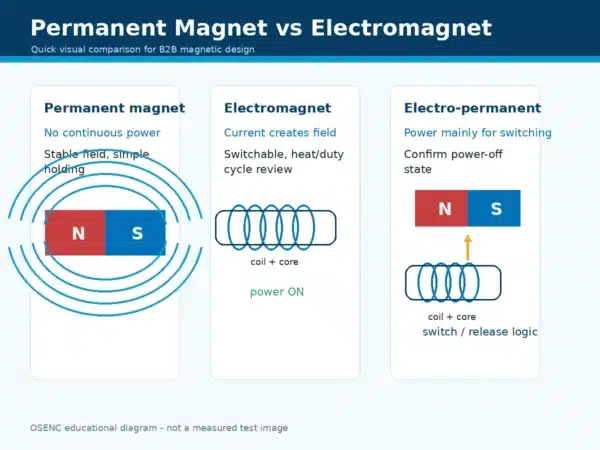







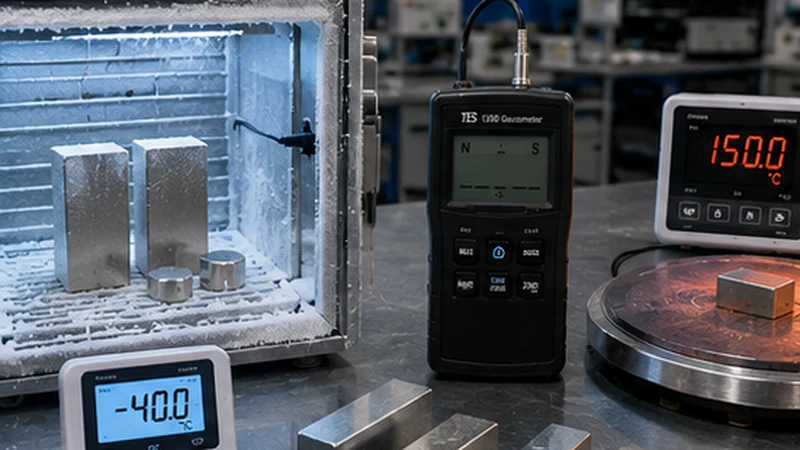
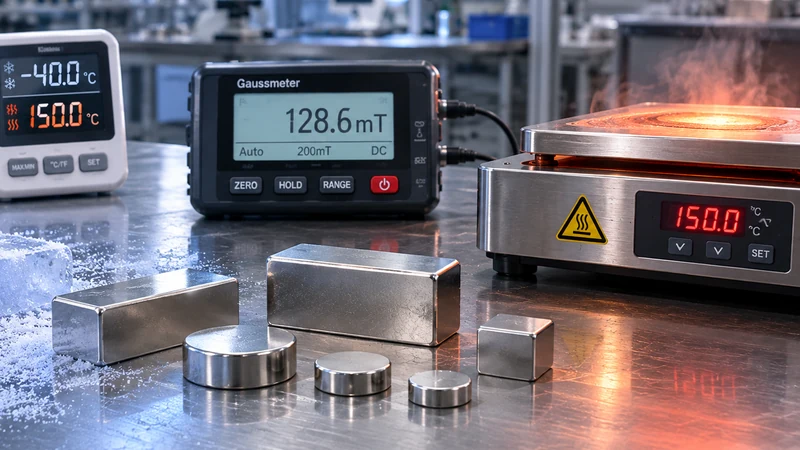
Temperature changes the magnetic performance of permanent magnets. For neodymium magnets, moderate heating usually reduces magnetic flux temporarily, while excessive heat can cause irreversible demagnetization. Cooling generally increases remanence, but extremely low temperatures can introduce additional material effects.
Na tej stronie
- Czym jest temperatura Curie?
- Jak niska temperatura wpływa na magnesy?
- How does heat affect magnets?
- How different magnet materials react
- Reversible vs irreversible magnetic loss
- Jaka temperatura jest zbyt wysoka dla magnesów neodymowych?
- Why magnet shape changes temperature performance
- How to select a magnet grade for temperature
- Najczęściej zadawane pytania
What Is the Curie Temperature?
The Curie temperature is the temperature above which a ferromagnetic or ferrimagnetic material no longer maintains its normal spontaneous magnetic order. Above this point, a permanent magnet material becomes only weakly magnetic.
For conventional sintered NdFeB, a representative Curie temperature is around 310°C. This does a nie mean a standard neodymium magnet can operate continuously at 310°C. Its useful operating limit is far lower and depends on grade, geometry, magnetic circuit and opposing fields.
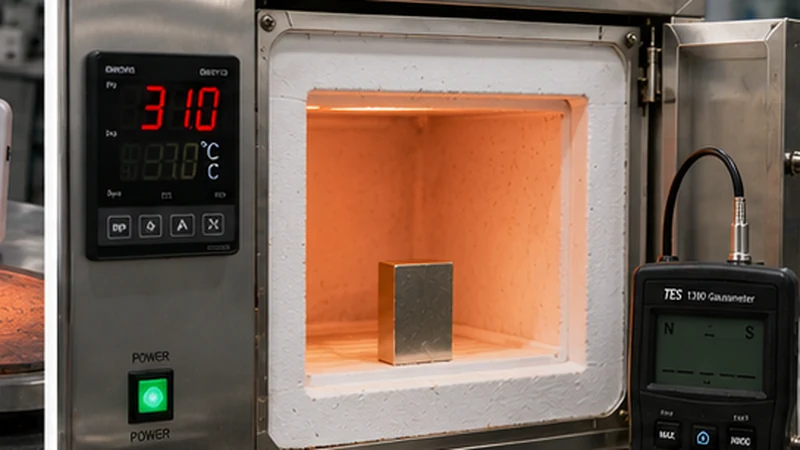
How Does Cold Affect Magnets?
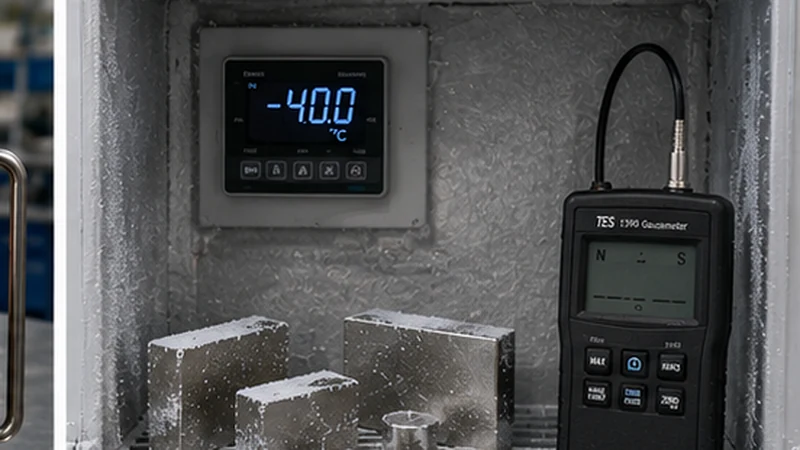
For many permanent magnets, lowering temperature increases remanence because thermal agitation is reduced. For NdFeB, that usually means a somewhat stronger magnetic field as temperature falls through normal industrial operating ranges.
That trend should not be extrapolated indefinitely. Some NdFeB compositions undergo spin reorientation at very low cryogenic temperatures, around 140 K (about -133°C), which changes the simple “colder is always stronger” picture. Ferrite also behaves differently because its coercivity decreases as temperature falls, which can make low-temperature demagnetization more important in some magnetic circuits.
Jak temperatura wpływa na magnesy?
Heating a permanent magnet generally reduces magnetic performance. In representative sintered NdFeB data, the reversible temperature coefficient of remanence is about -0.11% to -0.12% per °C. Below the safe operating range, much of this change is reversible: when the magnet cools, the flux level returns close to its previous value.
If the magnet is heated too far for its grade, shape and working point, part of the loss can become irreversible. At that stage, simply cooling the magnet does not restore the original magnetic performance.
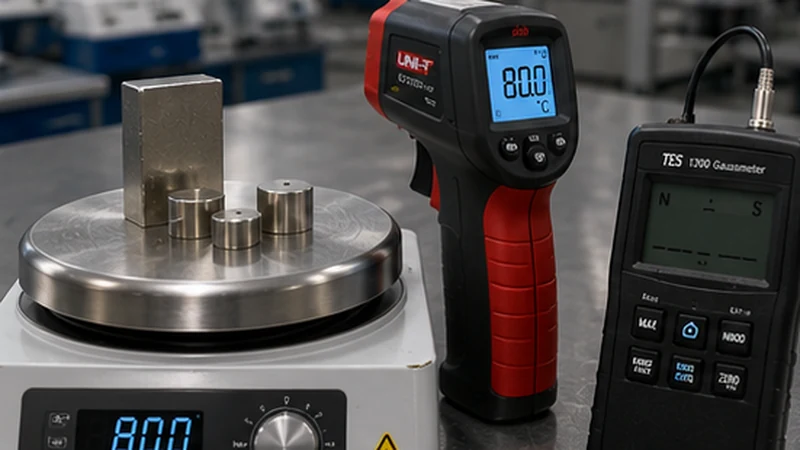
Heat resistance is therefore not determined by magnet grade name alone. Intrinsic coercivity, magnet geometry, working gap, opposing magnetic fields and the complete magnetic circuit all matter.
Different Magnet Materials React Differently to Temperature
Reversible Loss vs Irreversible Demagnetization
Reversible temperature loss
When a magnet remains within a suitable operating region, its magnetic output changes with temperature but largely recovers after the magnet returns to the original temperature. This is the behavior described by reversible temperature coefficients.
Irreversible loss
If temperature pushes the magnet’s operating point past the knee of its demagnetization curve, magnetic loss can become irreversible. The magnet may still be magnetic, but its room-temperature flux after cooling can be lower than before heating.
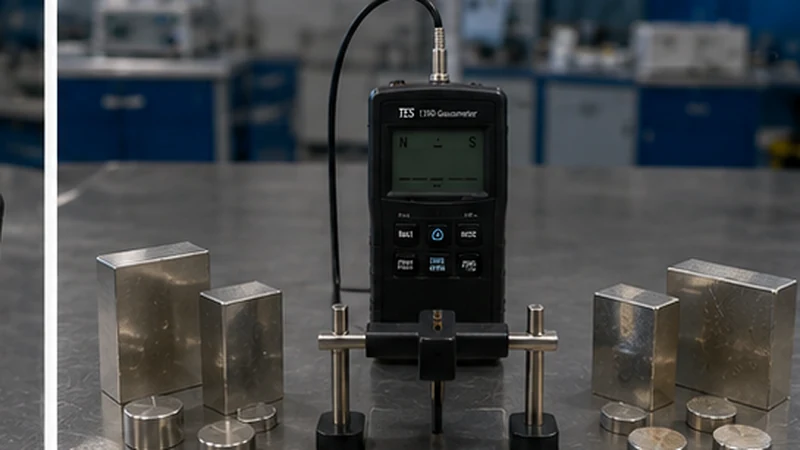
Irreversible loss can sometimes be corrected by remagnetizing the part, but that is not a sensible substitute for selecting the correct grade and magnetic circuit before production.
How Hot Is Too Hot for Neodymium Magnets?
There is no single temperature that is “too hot” for every neodymium magnet. A standard N-grade magnet may be limited to around 80°C, while higher-coercivity grades are designed for substantially hotter environments.
Why Magnet Shape Changes Temperature Performance
Two magnets made from the same material grade can behave differently at the same temperature because geometry changes the magnet’s permeance coefficient and operating point.
A thicker magnet working in a favorable magnetic circuit may have more resistance to irreversible demagnetization than a thin magnet with a low permeance coefficient. Air gaps, steel return paths and external opposing fields also shift the working point.
- Do not choose temperature grade from temperature alone.
- Provide magnet dimensions and magnetization direction.
- Define the working gap and nearby steel components.
- Identify any reverse field from coils or other magnets.
- Specify both normal operating temperature and short-duration peak temperature.
How to Select a Magnet Grade for Temperature
For an OEM design, start with the real thermal condition and then verify magnetic margin. OSENC reviews temperature together with geometry, grade, coating, magnetization direction and the final assembly instead of treating the maximum operating temperature as an isolated number.
- Continuous temperature: the normal temperature the magnet sees during operation.
- Peak temperature: short-duration excursions during startup, curing, sterilization or overload.
- Magnet geometry: diameter/thickness, length/height and magnetization direction.
- Magnetic circuit: air gap, steel path and any demagnetizing field.
- Warunki środowiskowe: humidity, chemicals, salt spray and coating requirements.
- Acceptance method: surface field, flux, pull force or assembly-level performance before and after thermal exposure.
For custom projects, see our neodymium magnet capabilities or send your drawing and operating temperature range for review.
FAQ About Magnets and Temperature
Does heat permanently weaken a magnet?
Not always. Moderate temperature changes can cause reversible magnetic loss. If the magnet exceeds a safe operating region for its grade and magnetic circuit, some loss can become irreversible. Above the Curie temperature, normal permanent magnet order is lost.
Do neodymium magnets get stronger when cold?
Within normal industrial temperature ranges, NdFeB remanence generally increases as temperature decreases. At very low cryogenic temperatures, additional material behavior such as spin reorientation can change that simple trend.
What temperature is too hot for an N52 magnet?
A standard N52 grade is commonly referenced around 80°C maximum operating temperature. If the application runs hotter, a higher-coercivity suffix such as M, H, SH, UH, EH or AH should be evaluated rather than assuming a standard N52 will remain stable.
Is Curie temperature the same as maximum operating temperature?
No. Curie temperature is the material transition where normal ferromagnetic or ferrimagnetic order disappears. Maximum operating temperature is a much lower application limit used to control irreversible magnetic loss.
Jak temperatura wpływa na magnesy samarowo-kobaltowe?
SmCo has much better thermal stability than NdFeB and is often selected for high-temperature applications. Depending on the specific SmCo grade, maximum operating temperatures around 250–350°C are available.
Can a magnet recover after overheating?
Reversible temperature loss recovers when the magnet cools. Irreversible loss does not fully recover by cooling alone. A severely demagnetized magnet may require remagnetization or replacement.
Technical References
This guide uses representative permanent-magnet temperature data. Actual limits vary by material grade, supplier specification, geometry and magnetic circuit.
Need a Neodymium Magnet for a High-Temperature Application?
Send us the magnet dimensions, magnetization direction, continuous temperature, peak temperature, working gap and target performance. OSENC can review the grade and magnetic circuit before sampling so you do not pay for a stronger grade that the design does not need—or select a standard grade that loses performance in service.
Poproś o konsultację techniczną