






Guide de comparaison technique
Aimant permanent ou électroaimant : quelle source de champ magnétique choisir pour votre conception ?
Si vous comparez un aimant permanent à un électroaimant, la différence fondamentale est la suivante : un aimant permanent produit un champ magnétique sans alimentation électrique continue, tandis qu’un électroaimant conventionnel produit son champ magnétique lorsqu’un courant circule dans une bobine. Pour la conception d’un produit réel, la question pertinente est de savoir si vous avez besoin d’un champ constant, d’un champ commandable électriquement, d’une force réglable ou d’un état de maintien défini hors tension.
Aimant permanent ou électroaimant : comparaison rapide
Pour un projet d’ingénierie, la comparaison doit inclure trois options : l’aimant permanent, l’électroaimant conventionnel et l’aimant électropermanent. Chaque option peut être adaptée lorsqu’elle correspond à la distance de travail, au besoin de commande, à la condition d’alimentation, au matériau cible et à l’état de sécurité.
| Facteur | Aimant permanent | Électroaimant conventionnel | Aimant électropermanent |
|---|---|---|---|
| Alimentation nécessaire au maintien de la force magnétique | Aucune alimentation continue | Nécessite généralement une alimentation continue | Selon la conception, l’alimentation sert généralement surtout à la commutation ou au déverrouillage |
| Commande du champ magnétique | Non réglable électriquement en fonctionnement normal | Peut être activé ou désactivé et souvent réglé par le courant | Commutable, mais le mode de commande dépend de la structure |
| Comportement hors tension | Conserve le champ magnétique | Perd généralement sa force de maintien lorsque l’alimentation est coupée | Peut conserver sa force de maintien après la commutation, selon la conception |
| Risque d’échauffement | Aucun échauffement de bobine | L’échauffement de la bobine et le cycle de service doivent être vérifiés | Échauffement moindre lors du maintien dans de nombreuses conceptions, mais le système de commutation doit néanmoins être étudié |
| Applications privilégiées | Maintien constant, détection, assemblages compacts, applications sans alimentation électrique | Préhension avec activation/désactivation, libération, tri, commande d’automatisation | Maintien avec une demande de puissance continue réduite ou libération contrôlée |
| Risque principal | Nuance, forme, revêtement, entrefer ou direction d’aimantation inadaptés | Surchauffe, puissance insuffisante, comportement dangereux en cas de perte d’alimentation | Mauvaise compréhension de la logique de commutation ou de l’état de libération |
Qu’est-ce qu’un aimant permanent ?
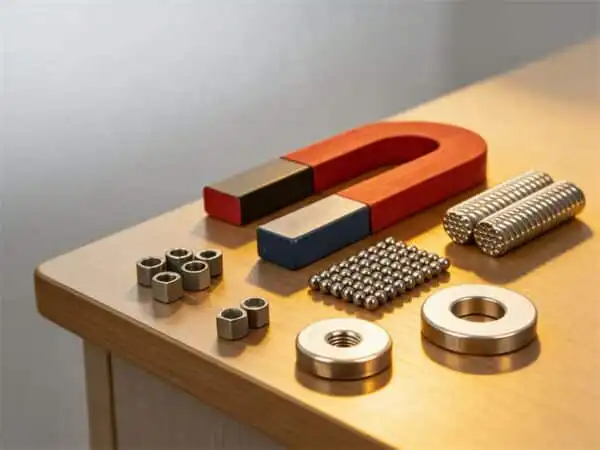
Un aimant permanent est un matériau magnétique capable de maintenir un champ magnétique sans alimentation électrique continue. Les matériaux couramment utilisés pour les aimants permanents comprennent le néodyme, la ferrite, le SmCo et l’Alnico.
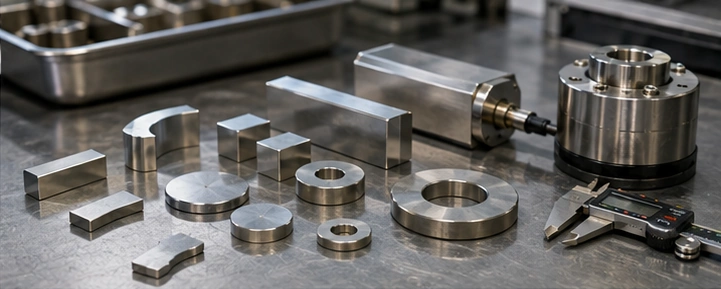
Dans les projets B2B habituels d’Osenc, l’accent porte le plus souvent sur les aimants néodyme sur mesure et les assemblages magnétiques. Il peut s’agir de micro-aimants, d’aimants de grandes dimensions, d’aimants de grade élevé, de formes irrégulières, de rotors de moteurs, d’accouplements magnétiques, de réseaux de Halbach et d’autres assemblages techniques.
Un aimant permanent constitue généralement un meilleur point de départ lorsque la conception exige une force magnétique stable dans un espace restreint, sans nécessiter de commutation électrique.
Qu’est-ce qu’un électroaimant ?
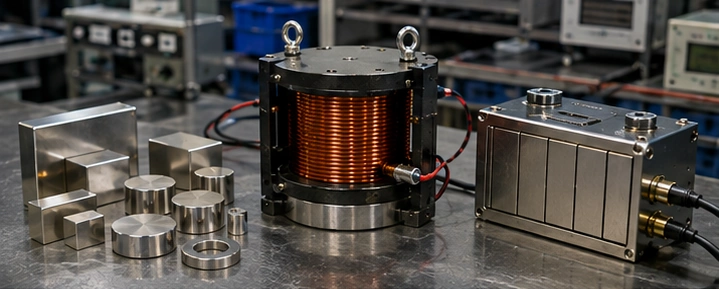
Un électroaimant conventionnel utilise le courant électrique circulant dans une bobine pour créer un champ magnétique. Dans de nombreuses conceptions, la force magnétique peut être activée ou désactivée en commandant le courant.
Un électroaimant est donc utile lorsque l’application nécessite le relâchement d’une pièce, une commande temporisée, le tri, le levage, la préhension ou une logique d’automatisation.
En contrepartie, il faut prendre en compte la bobine, l’alimentation électrique et l’échauffement. Le cycle de service est important, car une alimentation continue peut générer de la chaleur et réduire les performances si le système n’est pas correctement dimensionné.

Qu’est-ce qu’un aimant électropermanent ?
Un aimant électropermanent est différent d’un électroaimant conventionnel. Dans de nombreuses conceptions, il associe des éléments à aimants permanents à un système de commutation électrique.
L’énergie électrique peut donc servir principalement à commuter l’état magnétique ou à libérer la pièce, au lieu d’alimenter en continu la force de maintien. Le fonctionnement exact dépend de la conception du produit.

En quoi le champ magnétique est-il différent ?
Un aimant permanent génère un champ magnétique grâce à son matériau et à son aimantation. Son champ utile dépend de la nuance, des dimensions, de la forme, de la direction d’aimantation, de la disposition des pôles, de l’épaisseur du revêtement, de l’entrefer de fonctionnement et du circuit magnétique environnant.
Un électroaimant crée son champ magnétique à partir du courant. Ce champ dépend de la conception de la bobine, du courant, du nombre de spires, du matériau du noyau, de la surface polaire, de l’échauffement et de l’alimentation électrique disponible.
C’est pourquoi la comparaison des champs magnétiques ne doit pas reposer uniquement sur le “ type d’aimant ”. Un petit aimant permanent en contact direct peut être plus performant qu’un électroaimant mal adapté. Un électroaimant bien conçu peut être mieux adapté lorsque le champ doit être activé, réglé ou supprimé.

Dans quels cas choisir un aimant permanent ?
Choisissez un aimant permanent lorsque le champ magnétique doit rester disponible en permanence sans alimentation électrique.
Cette solution est couramment utilisée dans les capteurs, les codeurs, les moteurs, les accouplements magnétiques, les dispositifs de maintien, les appareils compacts, les assemblages de rotors et de nombreux assemblages magnétiques sur mesure.
| Exigence | Pourquoi un aimant permanent peut convenir |
|---|---|
| Absence d’alimentation électrique continue | L’aimant fonctionne sans alimentation électrique. |
| Conception compacte | Le NdFeB peut offrir des performances magnétiques élevées dans un espace restreint. |
| Champ magnétique stable requis | Utile pour la détection, le positionnement et le maintien. |
| Risque d’échauffement réduit | Aucun échauffement de bobine lors du maintien en fonctionnement normal. |
| Assemblage simple | Un nombre réduit de composants électriques peut diminuer la complexité du système. |
Si la conception exige des libérations fréquentes, une force réglable, une commutation à distance ou un état désaimanté contrôlé, une autre solution peut être préférable.
Dans quels cas un électroaimant est-il préférable ?
Un électroaimant est souvent préférable lorsque le champ magnétique doit être commandé par une machine, un circuit ou un opérateur.
Il peut être utile pour les systèmes de prise et dépose, les séparateurs, les verrous, le maintien automatisé, les mécanismes de libération, les montages d’essai et les applications dans lesquelles le champ doit varier en cours de fonctionnement.
| Exigence | Pourquoi un électroaimant peut convenir |
|---|---|
| Une commande marche/arrêt est nécessaire | Le courant permet de commander l’activation magnétique. |
| Une force réglable est utile | Le courant peut être réglé dans les limites de conception. |
| Le désengagement fait partie du processus | Dans de nombreuses configurations, le système peut être mis hors tension pour permettre le désengagement. |
| La synchronisation de l’automatisation est importante | L’action magnétique peut être reliée aux capteurs et aux commandes. |
| La commande de la polarité est nécessaire | Le sens d’enroulement de la bobine peut influer sur la direction du champ dans les conceptions adaptées. |
La tension, le courant, la stabilité de l’alimentation électrique, la température de la bobine, le cycle de service, l’espace d’installation et l’état en cas de défaillance sont tous à prendre en compte.
Quand le recours à un aimant électropermanent est-il pertinent ?
Un aimant électropermanent peut être pertinent lorsque le projet nécessite un maintien magnétique sans alimentation électrique continue pendant le maintien.
Cette solution peut être utile dans certaines applications de maintien de pièces, de serrage, d’automatisation ou de manutention. Elle peut également être utile lorsque le comportement en cas de coupure de courant est important.
| Question | Pourquoi est-ce important ? |
|---|---|
| Est-il commandé par impulsions, alimenté pour maintenir ou alimenté pour libérer ? | Détermine la logique de commande. |
| Que se passe-t-il en cas de coupure de courant ? | Point critique pour la sécurité et la conception du procédé. |
| Comment la libération est-elle commandée ? | Influe sur le séquencement de l’automatisation et la planification des solutions de secours. |
| Quel matériau est requis pour la cible ? | La force magnétique dépend du circuit magnétique. |
| Quel entrefer est admissible ? | Même un faible entrefer peut réduire la force de maintien utile. |
Sans ces informations, l’acheteur risque de choisir un système magnétique inadapté, même si la force nominale semble intéressante.
Quels critères techniques déterminent le choix ?
En pratique, le choix dépend de l’ensemble du système magnétique, et pas seulement de la désignation de l’aimant.
| Critère technique | Pourquoi est-ce important ? | Points à confirmer |
|---|---|---|
| Fonction requise | Le maintien, la détection, le couple, la libération et la préhension nécessitent des conceptions différentes. | Que doit réellement faire l’aimant ? |
| Entrefer de fonctionnement | La force magnétique varie fortement avec la distance et les entrefers non magnétiques. | Épaisseur de l’entrefer, du revêtement, de l’adhésif, du capot, de la peinture ou de l’entretoise. |
| Matériau cible | La nuance d’acier, son épaisseur et l’état de surface influent sur la force. | Matériau, épaisseur, planéité, revêtement, rouille ou peinture. |
| Conditions d’alimentation | Les électroaimants nécessitent une alimentation et une commande adaptées. | Tension, courant, facteur de marche et limite thermique. |
| État hors tension | Cela peut déterminer la sécurité et la logique de la machine. | Maintien, libération ou maintien de l’activation après une coupure de courant. |
| Méthode d’essai | La force d’arrachement et les mesures de champ dépendent des conditions d’essai. | Plaque d’essai, entrefer, direction, montage et critère d’acceptation. |

Pourquoi la seule notion de “ puissance magnétique ” peut induire en erreur
De nombreux acheteurs demandent lequel est le plus puissant : un électroaimant ou un aimant permanent. Cette question est incomplète.
Une conception magnétique pertinente doit définir la force requise à la distance réelle de fonctionnement. Elle doit également préciser la direction de la force, le matériau cible, la surface de contact, le cycle de fonctionnement et le facteur de sécurité.
Par exemple, un aimant qui semble puissant en contact direct avec un acier propre et épais peut offrir des performances très différentes à travers un capot en plastique, une surface peinte, une couche d’adhésif ou une pièce incurvée.
C’est pourquoi Osenc demande généralement des plans techniques, des échantillons ou les conditions d’application avant de recommander un aimant ou un assemblage magnétique.
Un assemblage magnétique serait-il préférable à un aimant seul ?
Oui. Dans de nombreux projets B2B, la véritable solution ne se limite pas à un seul aimant.
Un assemblage magnétique peut comprendre des aimants, des culasses en acier, des pièces polaires, des boîtiers, des arbres, des adhésifs, des revêtements, des fixations ou une structure de commande. Ces éléments peuvent guider le champ magnétique et faciliter l’installation du produit.
Osenc peut contribuer à examiner aimant en néodyme les exigences, micro-aimant les contraintes et les architectures magnétiques à l’échelle de l’assemblage lorsqu’une seule pièce standard ne suffit pas.

Liste de contrôle pour une demande de devis : quelles informations transmettre avant de choisir ?
Une demande de devis bien préparée doit décrire les conditions de fonctionnement, et pas seulement les dimensions de l’aimant.
| Informations pour la demande de devis | Pourquoi ces informations sont utiles |
|---|---|
| Fonction de l’application | Maintien, détection, transmission de couple, préhension, serrage, libération ou séparation. |
| Matériau cible | Type d’acier, épaisseur, état de surface et revêtement. |
| Entrefer de fonctionnement | Entrefer, épaisseur du couvercle, couche d’adhésif ou peinture. |
| Force ou champ requis | Force d’arrachement, force de maintien, couple ou champ magnétique cible. |
| Conditions d’alimentation | Tension et courant disponibles, mode de commande et facteur de marche. |
| État hors tension | Nécessité pour le système de maintenir, de libérer ou de rester verrouillé. |
| Environnement | Exposition à l’humidité, à la corrosion, à l’huile, à la poussière ou aux conditions extérieures. |
| Exigence d’essai | Essai d’arrachement, contrôle en gauss, essai de l’assemblage ou revue de simulation. |
Si la force exacte n’est pas connue, envoyez le plan technique de l’application et décrivez le fonctionnement attendu. Osenc peut aider à déterminer si le projet est mieux adapté à un aimant permanent, un électroaimant, un aimant électropermanent ou un assemblage magnétique sur mesure.

Erreurs courantes lors de la comparaison des aimants permanents et des électroaimants
La force dépend du matériau cible, de la surface de contact, de l’entrefer et de la direction d’arrachement.
Un électroaimant classique et un système électropermanent peuvent se comporter très différemment en cas de perte d’alimentation.
Des performances magnétiques supérieures peuvent accroître le coût, la fragilité, la sensibilité à la température ou les risques liés à l’assemblage.
Comment Osenc accompagne le choix d’un aimant sur mesure
Osenc se concentre sur les aimants en néodyme et les assemblages magnétiques sur mesure, notamment les micro-aimants, les aimants de grandes dimensions, les aimants de grade élevé, les formes irrégulières, les rotors de moteurs, les accouplements magnétiques, les réseaux de Halbach et d’autres produits magnétiques conçus sur mesure.
Pour les projets faisant appel à des électroaimants ou à des aimants électropermanents, Osenc peut aider à évaluer la structure magnétique, les exigences de l’application et la pertinence d’une solution à aimant permanent, électromagnétique ou hybride.
Selon le projet, Osenc peut contribuer à l’analyse du circuit magnétique, à la simulation par éléments finis, à l’étude de l’assemblage ainsi qu’à des contrôles tels que l’inspection dimensionnelle, la mesure en gauss, l’essai de force d’arrachement, l’inspection du revêtement ou d’autres vérifications convenues. Les valeurs propres au produit, les paramètres électriques, la force de maintien et les résultats d’essai doivent être confirmés à partir du plan technique, des conditions d’essai et de l’analyse technique réels.
Pour les questions liées à l’environnement ou aux dimensions, les acheteurs peuvent également consulter revêtement d’aimant en néodyme les options et les informations d’Osenc management de la qualité avant d’envoyer une demande de devis.
Sources techniques et limites
Cet article s’appuie sur des sources externes pour présenter les principes fondamentaux de l’électromagnétisme, les limites de conception des aimants permanents, les précautions liées à l’entrefer et à l’état de surface, ainsi que le fonctionnement des aimants électropermanents. Il ne publie aucune donnée propre à Osenc concernant la tension, le courant, le cycle de service, la force de maintien, le temps de libération ou les cas clients, car ces informations n’ont pas été fournies pour une utilisation publique.
- OpenStax / LibreTexts : sources des champs magnétiques
- U.S. Department of Energy : la force électromagnétique
- Recommandations relatives aux aimants / guide MMPA de conception des aimants permanents
- Manuel d’utilisation des aimants de levage d’Industrial Magnetics
- Magbat Europe : comparaison des aimants électropermanents
La corrosion peut-elle réduire la force d’attraction d’un aimant en néodyme ?
Un électroaimant est-il plus puissant qu’un aimant permanent ?
Pas nécessairement. Un électroaimant conventionnel peut être conçu pour exercer une force élevée et contrôlée, mais la force réellement exploitable dépend de la conception de la bobine, de l’alimentation électrique, de l’échauffement, de la surface des pôles, de l’entrefer et du matériau de la pièce cible. Un aimant permanent peut exercer une force plus élevée dans une conception compacte sans alimentation électrique, à condition que la géométrie et le circuit magnétique soient adaptés.
Un aimant permanent a-t-il besoin d’électricité ?
Non. Un aimant permanent n’a pas besoin d’une alimentation électrique continue pour conserver son champ magnétique.
Un électroaimant fonctionne-t-il sans alimentation électrique ?
Un électroaimant classique a généralement besoin d’un courant pour créer son champ magnétique. Lorsque l’alimentation est coupée, la force de maintien diminue généralement. Les aimants électropermanents sont différents et doivent être évalués en fonction de leur conception spécifique de commutation.
Quel est le principal avantage d’un aimant permanent ?
Le principal avantage réside dans une force magnétique stable sans alimentation électrique continue. Cela peut réduire le câblage, la chaleur et la complexité du système d’alimentation.
Quel est le principal avantage d’un électroaimant ?
Le principal avantage réside dans la maîtrise du champ magnétique. Celui-ci peut souvent être activé ou désactivé, temporisé ou ajusté par commande électrique.
Quel est le principal avantage d’un aimant électropermanent ?
Le principal avantage est que de nombreuses conceptions peuvent maintenir la force magnétique sans alimentation électrique permanente après la commutation. Toutefois, le mode de commutation, l’état de relâchement et le comportement en cas de perte d’alimentation doivent être confirmés.
Quelle option convient le mieux à l’automatisation ?
Le choix dépend des besoins de l’automatisation : maintien permanent, libération commandée, force réglable, faible dégagement de chaleur ou état défini hors tension. Les aimants permanents, les électroaimants et les aimants électropermanents peuvent tous convenir selon le système.
Que dois-je envoyer à OSENC pour examen ?
Envoyez les plans techniques, le matériau cible, l’entrefer de fonctionnement, la force requise, la température, l’espace disponible, les conditions d’alimentation, le comportement en cas de coupure de courant, la quantité à produire et les éventuelles exigences d’essai. Si vous ne savez pas quel type d’aimant convient, Osenc peut vous aider à comparer les options avant la réalisation d’échantillons.
Besoin d’aide pour choisir une source de champ magnétique ?
Envoyez à Osenc votre plan technique, le matériau cible, l’entrefer de fonctionnement, la force visée, les conditions d’alimentation électrique et le comportement requis en cas de coupure d’alimentation. Nous pouvons vous aider à déterminer si un aimant permanent, un électroaimant, un aimant électropermanent ou un assemblage magnétique sur mesure constitue le meilleur point de départ.
Demander une étude technique