Seal sintered NdFeB magnets in ABS, PP, or PEEK shells for 100% waterproof, shatter-resistant OEM assemblies. Prototype from 1 piece via CNC shells before investing in injection molds.
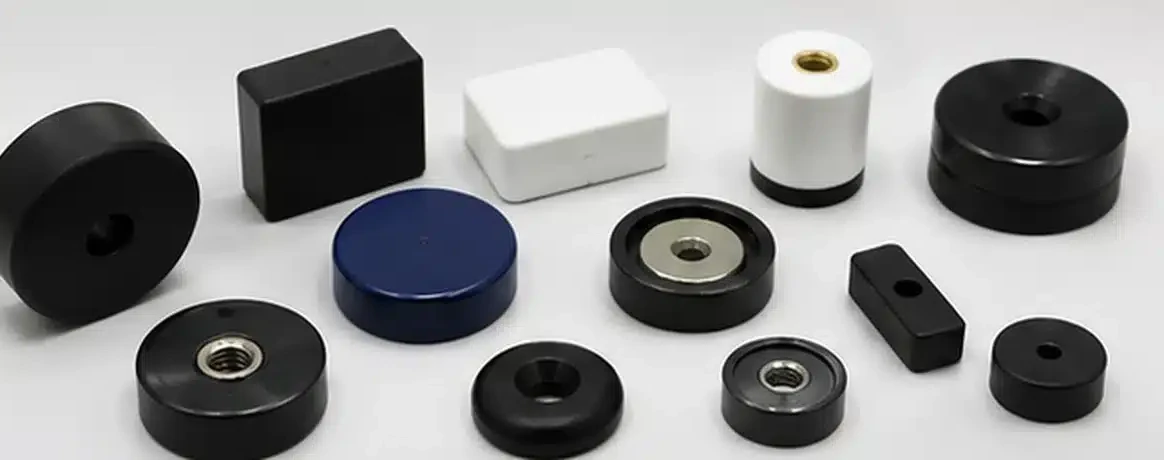
Choose ABS, PP, or PEEK encapsulation when water, washdowns, or drops break bare or plated magnets.
| Ihr Ziel | Wichtige Auswahlentscheidung | Standardausführung | Wann aufrüsten oder wechseln | Prüfung vor der Bestellung |
|---|---|---|---|---|
| Stop rust and chipping in wet or impact assemblies. | ABS or PP shell? | ABS (≤80–95°C) with N35–N52 core fits aquariums, closures, and splashes. | Switch to PP for acids, alkalis, or washdowns up to 105°C. | Confirm fluid temp, chemicals, and ≥1.0 mm wall thickness. |
| Survive hot washdowns or 121–134°C steam autoclaves. | PP or PEEK shell? | Food-grade PP (FDA 21 CFR 177.1520) + H/SH core handles 100°C wash. | Upgrade to PEEK (FDA 21 CFR 177.2415 / USP Class VI) + SH/UH core. | Specify post-mold magnetization or ultrasonic welding to stop demagnetization. |
| Hold loads on vertical painted steel or tight gaps. | Hard plastic vs. rubber or epoxy? | Hard plastic fits submerged housings needing molded tabs or holes. | Switch to Rubber Coated for vertical grip, or Epoxy/Parylene for <0.1 mm gaps. | Compare smooth plastic (~13–20% shear) against rubber (~30% shear). |
| Maximize holding force inside a waterproof plastic shell. | Plastic-coated vs. plastic-bonded? | Sintered core (33–55 MGOe) delivers 3–6× higher force from MOQ 1. | Switch to plastic-bonded NdFeB (4–14 MGOe) only for multi-pole rotors. | Note PA12 bonded magnets hydrolyze in hot water; check exposure first. |
OSENC holds ±0.10–±0.20 mm molded tolerances and locks resin grades before cutting tooling.
| Parameter | Standard Specification | Custom / Upgrade Options |
|---|---|---|
| Core & Polymer Resins | ||
| Magnetkern | Sintered NdFeB N35–N52 (≤80°C) | M (100°C), H (120°C), SH (150°C), UH (180°C) |
| ABS Shell | Continuous ≤80–95°C; melt 220–250°C | Rigid housing, custom colors, indoor/splash |
| PP Shell | Continuous ≤100–105°C; melt 160–170°C | Acids/alkalis; FDA 21 CFR 177.1520 / EU 10/2011 |
| PEEK Shell | Continuous ≤250–260°C; melt 340–343°C | 121–134°C autoclave; FDA 21 CFR 177.2415 / USP Class VI |
| Assembly Temp Limit | Lower limit of core grade or plastic shell | Pair hot washdowns with H, SH, or UH cores |
| Reference Size & Pull-Force Derating Anchors | ||
| Ø10 × 3 mm (N42) | Bare ~1.6–1.8 kg on thick mild steel | 0.8–1.0 mm wall cuts pull ~35%–55% |
| Ø12 × 3 mm (N42) | Bare ~2.3–2.5 kg on thick mild steel | Upgrade to N52 or thicker core to offset gap |
| Ø20 × 5 mm (N42) | Bare ~6.4 kg (62.8 N) direct pull | 0.7 mm axial wall drops pull to ~3.9 kg (-39.1%) |
| Vertical Shear Load | Smooth plastic shear ~13%–20% of pull | Add stops or switch to rubber coating |
| Sealing & Drawing Interface Standards | ||
| Minimum Sealing Wall | ≥1.0 mm full encapsulation for IP68 | 0.5–0.8 mm active face for splash only |
| Fertigmaße | Dimensions apply AFTER encapsulation | ±0.10–±0.20 mm molded; ±0.05–±0.10 mm CNC |
| Core Anti-Rotation | Pocket with ≥0.5 mm step or chamfer | 2×2 mm locking grooves for overmolding |
| Montagemerkmale | Through holes, countersinks, molded tabs | 316 stainless inserts for saltwater |
| Magnetization & Validation | ||
| Magnetisierungsablauf | Post-mold impulse or ultrasonic assembly | Axial, diametrical, thickness, multipole |
| Working-Gap Test | Surface Gauss & pull at 0.0–2.0 mm | 0.0 / 0.5 / 1.0 / 1.5 / 2.0 mm matrix |
Lock these three details on your 2D or 3D drawing before releasing tooling.

A 0.8–1.0 mm plastic wall cuts pull force by 35%–55%, so compensate before cutting steel molds.

Non-magnetic plastic adds air-gap distance between the NdFeB core and target steel.
PEEK melts at 340–343°C, exceeding NdFeB’s ~310°C Curie point and wiping pre-magnetized cores.
Verify gap force and sealing before committing $8,000–$25,000+ to hardened steel molds.
Share your gap or sterilization target so Ben and the OSENC team can size your assembly.
Test plastic shells with hydrostatic soak or vacuum decay—never rely on metal-style helium leak tests.
Run these three checks on first articles and production lots against your approved golden sample.
Inspect these root causes first whenever an encapsulated magnet underperforms in testing or service.

OSENC manufactures in Dongguan with MOQ 1 prototyping, ~25-day custom lead times, and IATA-compliant packing.
Every batch passes incoming core inspection, in-process molding checks, and outgoing Gauss verification. See our full process on the OSENC-Qualitätsmanagement Seite.

| Handelsartikel | Standard Policy / Reference Range | Order Verification & Scope |
|---|---|---|
| Prototype Sampling | MOQ 1 via CNC ABS, PP, or PEEK housing (zero mold fee) | Sample cost and timing confirmed per drawing |
| Tooling & Batch MOQ | Aluminum mold ~$2,500–$5,000 (2–4 wks); steel ~$8,000–$25,000+ (4–7 wks) | Molded MOQ typically 500–2,000+ pcs; quoted per part |
| Lieferzeit und Garantie | ~25 days reference for custom NdFeB (tooling separate) | AQL inspection and warranty locked per signed PI |
| Qualität und Konformität | ISO 9001 IQC/IPQC/OQC; RoHS & REACH declarations | Resin FDA 21 CFR / EU 10/2011 / USP Class VI CoC per order |
| Packaging & Air Freight | Foam trays, OEM labels, steel-shielded export cartons | IATA PI 953 (UN 2807): <0.159 A/m @ 2.1 m or ≤0.418 A/m @ 4.6 m |
Direct answers on bonded vs. coated magnets, molding heat, compliance, prototyping, and quote inputs.
Plastic coated magnets encase solid sintered NdFeB (33–55 MGOe), delivering 3–6× higher force than bonded magnets.
We mold unmagnetized cores first and magnetize after cooling, or use two-piece ultrasonic welding.
Yes—when you specify compliant resin grades and verify sealing rather than industrial ABS.
Yes. OSENC prototypes from MOQ 1 using CNC-machined ABS, PP, or PEEK shells with zero mold fees.
Send five core details so OSENC can confirm resin grade, wall thickness, and tooling once.
Share your dimensions, working temperature, media, and quantity to get a resin and tooling quote.
Vergleichen Gummibeschichtete Magnete, Epoxidbeschichtete Magnete, PTFE-beschichtete Magnete, und Parylene-beschichtete Magnete.